
Comment:
This study provides compelling, high-quality data (although observational) that directly addresses the question of soy safety in a western population.
For decades, the bulk of the robust epidemiological evidence linking high isoflavone intake to improved survival was rooted in Asian populations—populations with a lifetime of high whole-soy food consumption. Since women in Western populations generally consume far lower amounts of isoflavone, it was an open question whether their modest intake would yield any benefit at all, and most importantly, at least not cause harm.
This cohort, which is large and notably ethnically diverse (including substantial non-Hispanic White, Hispanic, Black, and Asian American women), gives us the clearest signal yet that the survival benefit of moderate post-diagnosis isoflavone intake is highly applicable to the Western patient.
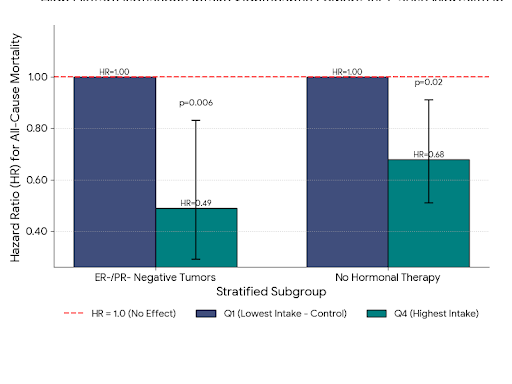
However, a fascinating and clinically critical finding here is the strong inverse association found only in the Hormone Receptor-Negative (ER-/PR-) subgroup (HR = 0.49; 95% CI, 0.29–0.83), which is opposite of what we would have expected.
Given that isoflavones are weak phytoestrogens, the initial biological concern centered on them stimulating ER-positive tumors. Conversely, the expected benefit was often theorized to be protective via anti-estrogenic effects (competing for the ER receptor) in ER-positive disease. The fact that the benefit was not observed in the ER-positive group, but was highly significant in the ER-negative group, strongly suggests that one mechanism of action here is independent of the estrogen receptor.
This points to isoflavone’s other well-documented mechanisms—such as its anti-angiogenic, anti-proliferative, or tyrosine kinase inhibition properties—as the likely drivers of improved survival in this critical, often more aggressive, tumor subtype.
For the ER-positive survivor, the finding that intake was not detrimental—even for those on hormone therapy—is in line with many other studies, and reassuring.
Summary:
Clinical Bottom Line 🎯
This large, multiethnic observational cohort study suggests a strong inverse association between higher dietary isoflavone intake (the primary phytoestrogen in soy foods) and reduced all-cause mortality in breast cancer survivors . However, this association was largely confined to women with hormone receptor-negative tumors (ER-negative/PR-negative) and those who did not receive hormone therapy as part of their cancer treatment . Observational data can show association but cannot prove causation . Given the potential for unmeasured confounders, these findings are best interpreted as supportive evidence for a benefit, particularly in hormone receptor-negative disease, but should not immediately change clinical practice for patients on hormone therapy, where isoflavone’s estrogen-like properties are a concern .
Main Results: Overall All-Cause Mortality
Overall, women in the highest quartile of dietary isoflavone intake ( ≥1.5 mg daily) had a 21% decrease in all-cause mortality compared with women in the lowest quartile (< 0.3 mg daily) .
-
Hazard Ratio (HR): 0.79
-
95% Confidence Interval (CI): 0.64–0.97
-
Definition: An HR of 0.79 means that the hazard of death from any cause was 21% lower in the highest isoflavone intake group compared to the lowest intake group over the median follow-up of 113 months (approximately 9.4 years) . The Ptrend across quartiles was statistically significant (Ptrend = 0.01) .
Stratified Results by Tumor Type and Treatment
The lower mortality associated with higher isoflavone intake was statistically significant only in specific subgroups :
-
Tumor Hormone Receptor Status: The reduced risk was significant only for women with estrogen receptor-negative/progesterone receptor-negative (ER-/PR-) tumors .
-
HR (Q4 vs Q1): 0.49
-
95% CI: 0.29–0.83
-
The association was not observed for women with hormone receptor-positive tumors .
-
-
Hormone Therapy: The reduced risk was significant only for women who did not receive hormone therapy .
-
HR (Q4 vs Q1): 0.68
-
95% CI: 0.51–0.91
-
The association was not observed for those who received hormone therapy .
-
-
Prediagnosis vs. Postdiagnosis Intake: The inverse association was statistically significant for women who reported postdiagnosis isoflavone intake (HR = 0.65; 95% CI, 0.41 – 1.00; Ptrend = 0.02) but was weaker and not significant for prediagnosis intake (HR = 0.84; 95% CI, 0.66 – 1.06; Ptrend = 0.13) .
Isoflavone Types
The three common types of isoflavone—genistein, daidzein, and glycitein—were associated with similar reductions in all-cause mortality .
Assertive Critical Appraisal
Limitations & Bias (STROBE Framework) 🧐
-
Potential for Confounding: As an observational study, the findings are susceptible to confounding, meaning the results could be due to factors associated with both high isoflavone intake and survival that were not measured or perfectly controlled . The authors did adjust for numerous factors (e.g., race/ethnicity, BMI, physical activity, alcohol use, smoking status, and a Healthy Eating Index), which strengthens the internal validity . However, high isoflavone consumers were more likely to be Asian American, younger, more educated, physically active, and nonsmokers, highlighting the presence of lifestyle differences that could lead to residual confounding .
-
Measurement Error in Diet: Dietary intake was assessed using a Food Frequency Questionnaire (FFQ), which is subject to measurement error . The authors note that the misclassification of intake is likely nondifferential (equal across groups), which would tend to bias the results toward the null (underestimating the true association) .
-
Reliance on Self-Reported Data: Information on both dietary intake and cancer treatment (e.g., hormone therapy) was based on self-report . While treatment self-reports in this registry have shown high agreement with medical records , lacking detailed information on the type and duration of hormone therapy limited a more in-depth analysis of potential drug-nutrient interactions .
-
Limited Outcome: The primary outcome was restricted to all-cause mortality . The study could not evaluate breast cancer-specific mortality or recurrence, which are clinically critical endpoints .
Reporting Quality Assessment (STROBE) ✅
The reporting quality is generally high . The authors clearly describe their efforts to address potential sources of confounding, which is critical for an observational study . They specified the use of multivariable Cox proportional-hazard models and adjusted for a comprehensive list of known confounders (including race/ethnicity, education, BMI, physical activity, and overall diet quality (HEI-2010)) .
Applicability 🌍
The study’s findings are highly relevant to clinical practice, particularly in managing breast cancer survivors in Western populations .
-
The cohort is large and ethnically diverse, which increases the generalizability of the findings compared to previous studies that focused primarily on Asian or non-Hispanic white women .
-
The finding that the benefit is strongest for ER-/PR- tumors and those not on hormone therapy provides crucial context for clinicians counseling patients about soy intake . It suggests that the theoretical antiestrogenic benefits of isoflavone are most apparent when its weak estrogenic activity doesn’t pose a concern or interfere with treatment .
-
The stronger association with postdiagnosis intake highlights the potential for a dietary change after diagnosis to impact survival .
Study Details
Research Objective 🔬
The objective of the study was to examine the association between dietary intake of isoflavone (the major phytoestrogen in soy) and all-cause mortality in a multiethnic cohort of women with breast cancer, and to assess whether this association differed by race/ethnicity, tumor hormone receptor status, and receipt of hormone therapy .
Study Design 📝
-
Study Design: Prospective cohort study (an observational study) .
-
Model: Multivariable Cox proportional-hazard models were used to estimate hazard ratios (HRs) and 95% confidence intervals (CIs) .
-
Time Scale: Days since diagnosis, with follow-up time left-truncated at the date of interview .
-
Data Collection: Dietary intake was assessed at enrollment using a self-administered Food Frequency Questionnaire (FFQ) developed for the Hawaii-Los Angeles Multiethnic Cohort .
Setting and Participants 🧑🤝🧑
-
Registry: The Breast Cancer Family Registry (BCFR), an international research infrastructure established in 1995 .
-
Setting/Location: The analysis was limited to women from 5 North American BCFR sites (United States and Canada) .
-
Participants: 6,235 women diagnosed with a first primary, invasive breast cancer who reported reliable dietary intake .
-
Follow-up: Median follow-up time was 113 months (approximately 9.4 years), during which 1,224 deaths were documented .
-
Dietary Intake Timing: 4,769 women reported on their prediagnosis diet (within 5 years before diagnosis) and 1,466 women reported on their postdiagnosis diet (within 5 years after diagnosis) .
-
Cohort Diversity: The cohort was ethnically diverse, including non-Hispanic whites (58.5%), Hispanics (16.6%), blacks (12%), and Asians (11.1%) .
Bibliographic Data
-
Title: Dietary Isoflavone Intake and All-Cause Mortality in Breast Cancer Survivors: The Breast Cancer Family Registry
-
Authors: Fang Fang Zhang, MD, PhD; Danielle E. Haslam, MS; Mary Beth Terry, PhD; Julia A. Knight, PhD; Irene L. Andrulis, PhD; Mary B. Daly, MD, PhD; Saundra S. Buys, MD; and Esther M. John, PhD
-
Journal: Cancer
-
Year: 2017
-
DOI: 10.1002/cncr.30615
Would you like me to suggest some popular soy-based foods that contain isoflavones?
Original Article:
Full text: PubMed Central