
Postoperative Tamoxifen in DCIS: Treating Precancer Like Malignancy
It is always tempting when a pharmaceutical intervention demonstrates a reduction in local events. However, we have to be incredibly careful when tempted to translate these findings to actual patient survival, particularly when treating ductal carcinoma in situ (DCIS). Despite being categorized biologically as a non-obligate precancer, DCIS is routinely subjected to the full oncologic treatment. This Cochrane meta-analysis by Staley and colleagues illustrates the clinical friction between suppressing local tissue events and altering genuine patient longevity.
The surrogate win versus the survival flatline:
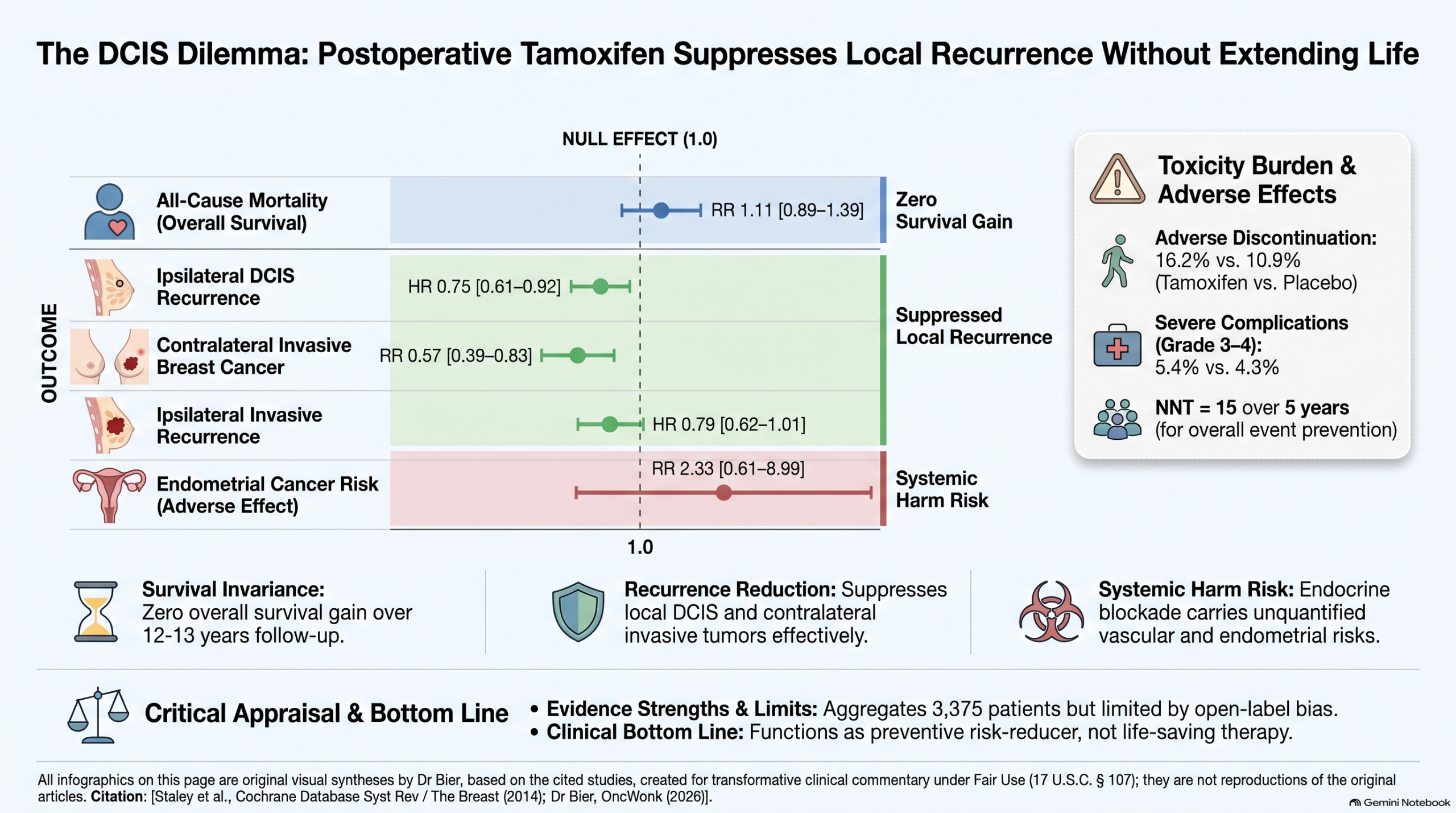
Looking at the combined trial data across 3,375 women, the authors report an overall number needed to treat (NNT) of 15 over five years to prevent any single breast event [Disc, p2]. Tamoxifen reliably reduced ipsilateral DCIS recurrence (HR 0.75; 95% CI 0.61–0.92) and contralateral invasive breast cancer (RR 0.57; 95% CI 0.39–0.83) [Abs, p1]. But when you examine hard clinical outcomes over 12 to 13 years of follow-up, the absolute effect size on survival completely evaporates. There was no difference in distant metastatic disease (RR 0.78; 95% CI 0.29–2.08) and absolutely no benefit in all-cause mortality (RR 1.11; 95% CI 0.89–1.39) [Abs, p1] [Disc, p1]. Blocking systemic estrogen receptor activity alters tissue histology, but it does not prolong life.
The clinical relevance of uncounted harms:
The therapeutic trade-off becomes even more problematic when you account for systemic toxicity and trial design confounding. In the NSABP B-24 cohort, 16.2% of women discontinued tamoxifen specifically due to adverse effects, alongside a trend toward increased endometrial cancer (RR 2.33; 95% CI 0.61–8.99) [Disc, p1] [Disc, p7]. Compounding this, the UK/ANZ trial used an open-label design where clinicians could electively withhold or assign therapies, introducing substantial performance bias while failing to track adverse events altogether [Meth, p24] [Disc, FigLegend p6_191]. When we cannot calculate a reliable number needed to harm, yet know all-cause mortality is unaffected, reflexively prescribing five years of endocrine suppression for a localized precancer ignores whole-person physiology in pursuit of an oncologic surrogate.
Clinical Bottom Line
Adjuvant tamoxifen for 5 years following surgical excision of ductal carcinoma in situ (DCIS)—evaluated in 3,375 women across two randomized controlled trials—significantly reduces recurrent ipsilateral DCIS, contralateral DCIS, and contralateral invasive breast cancer, yielding an overall number needed to treat (NNT) of 15 to prevent any breast event [Abs, p1] [Disc, p2]. However, tamoxifen confers no reduction in all-cause mortality (relative risk [RR] 1.11; 95% CI 0.89 to 1.39) or distant metastases (RR 0.78; 95% CI 0.29 to 2.08) [Abs, p1] [Disc, p1]. The therapeutic benefit must be weighed against severe limitations in safety reporting: only one trial documented adverse outcomes, observing a non-significant elevation in endometrial cancer (RR 2.33; 95% CI 0.61 to 8.99; 10 events total) and a 16.2% discontinuation rate due to side effects (versus 10.9% on placebo), precluding calculation of a reliable number needed to harm (NNH) [Abs, p1] [Disc, p1] [Disc, p2] [Disc, p7]. Methodological certainty is tempered by high risk of performance/detection bias in the UK/ANZ trial (open-label design and elective treatment choice) and unclear allocation concealment and blinding in NSABP B-24 [Meth, p17] [Meth, p18] [Meth, p24] [Meth, p25] [Disc, FigLegend p6_191].
Results in Context
The meta-analysis synthesized data from two multicenter randomized controlled trials (NSABP B-24 and UK/ANZ DCIS) comprising 3,375 participants [Abs, p1] [Res, p1] [Res, p4]:
- Ipsilateral Recurrent DCIS: Hazard ratio (HR) 0.75 (95% CI 0.61 to 0.92); NNT = 47 [Abs, p1] [Disc, p2].
- Contralateral DCIS: RR 0.50 (95% CI 0.28 to 0.87); NNT = 93 [Abs, p1] [Disc, p2].
- Contralateral Invasive Breast Cancer: RR 0.57 (95% CI 0.39 to 0.83); NNT = 54 [Abs, p1] [Disc, p2].
- Ipsilateral Invasive Breast Cancer: HR 0.79 (95% CI 0.62 to 1.01); NNT = 63 (borderline statistical significance) [Abs, p1] [Meth, p20] [Disc, p2].
- All Breast Events Combined: NNT = 15 overall (321/1693 tamoxifen vs 436/1682 control) [Disc, p2]. With adjuvant radiotherapy, NNT = 17; without adjuvant radiotherapy (UK/ANZ data only), NNT = 13 [Disc, p2].
- Regional/Distant Metastases: RR 0.78 (95% CI 0.29 to 2.08) reported from one trial [Disc, p1].
- All-Cause Mortality: RR 1.11 (95% CI 0.89 to 1.39), with median/long-term follow-up of 12 to 13 years [Abs, p1] [Meth, p28] [Disc, p1].
- Adverse Events: Endometrial cancer occurred in 10/1798 participants (0.5%) in NSABP B-24 (RR 2.33; 95% CI 0.61 to 8.99) [Disc, p1] [Concl, p1]. Discontinuation of tamoxifen due to side effects was 16.2% in NSABP B-24 (versus 10.9% on placebo) [Disc, p7].
Statistical Metric Definitions:
- Relative Risk (RR): The ratio of the probability of an outcome occurring in the treated group versus the control group. An RR < 1.0 denotes a risk reduction.
- Hazard Ratio (HR): The ratio of event hazard rates over time between two groups, incorporating time-to-event censoring. An HR < 1.0 indicates a decreased rate of event occurrence in the intervention arm.
- Confidence Interval (95% CI): The interval estimate within which the true population parameter is expected to fall 95% of the time upon repeated sampling.
- Number Needed to Treat (NNT): The average number of patients who need to receive treatment for a defined period (here, 5 years) to prevent one additional adverse outcome.
- Higgins I² Statistic: A measure of the percentage of total variation across studies attributable to statistical heterogeneity rather than chance (0%–40%: might not be important; 30%–60%: moderate; 50%–90%: substantial; 75%–100%: considerable) [Meth, p6].
Assertive Critical Appraisal
GRADE Evidence Certainty Audit
The authors did not construct a formal Summary of Findings (SoF) table explicitly detailing GRADE ratings per outcome, representing a reporting limitation. Methodologically, certainty must be appraised across critical outcomes:
- Recurrent Breast Events (Ipsilateral DCIS, Contralateral DCIS/Invasive): Moderate certainty. Evidence is downgraded by one level due to risk of bias: UK/ANZ was open-label without placebo, and allowed surgeon/patient preference schedules pre-randomization, whereas NSABP B-24 provided inadequate descriptions of allocation concealment and blinding [Meth, p17] [Meth, p18] [Meth, p23] [Meth, p25] [Disc, FigLegend p6_191].
- All-Cause Mortality and Distant Disease: Low certainty. Downgraded for risk of bias (as above) and imprecision, characterized by wide 95% confidence intervals crossing 1.0 and failing to exclude clinically meaningful harm or benefit (mortality RR 1.11; 95% CI 0.89 to 1.39; metastases RR 0.78; 95% CI 0.29 to 2.08) [Disc, p1].
- Adverse Events / Toxicity: Very Low certainty. Severely downgraded for high risk of selective reporting and publication attrition (UK/ANZ omitted adverse events entirely) and extreme imprecision (only 10 endometrial cancer events in 1,798 women, resulting in wide CI: 0.61 to 8.99) [Disc, p1] [Disc, p7].
Heterogeneity and Pooling Model
The meta-analysis applied a fixed-effect model in RevMan 5.1 using the Chi-squared test and Higgins I² statistic [Meth, p5]. While statistical heterogeneity thresholds were prespecified (0% to 40% not important, 30% to 60% moderate, 50% to 90% substantial) [Meth, p6], quantitative values of Higgins I² and Cochran’s Q (Chi-squared) were not documented in the text for several forest plot comparisons [Meth, Fig 1] [Meth, Fig 2] [Meth, Fig 3] [Meth, Fig 4]. Furthermore, clinical heterogeneity was substantial: NSABP B-24 required adjuvant radiotherapy and permitted positive/uncertain margins (approx 25%) as well as LCIS, whereas UK/ANZ was a 2 × 2 factorial trial allowing omission of radiotherapy and excluding margin-positive disease and LCIS [Res, p2] [Meth, p10] [Meth, p22] [Meth, p23] [Disc, p4] [Disc, p8]. The use of a fixed-effect model under disparate baseline interventions and surgical margin criteria poses a risk of artificially narrow confidence intervals.
Small-Study Effects and Publication Bias
The systematic review identified only two eligible trials (k = 2) [Res, p1]. Formal statistical asymmetry evaluations (such as Egger linear regression or Begg rank correlation) and funnel plots were appropriately not performed or reported, adhering to the principle that asymmetry testing requires at least k ≥ 10 trials to prevent spurious findings. Because both included studies were large, multicenter, cooperative group trials (recruiting 1,804 and 1,701 patients), small-study publication bias is unlikely to skew the primary effect estimates [Res, p2] [Res, p3].
Study Power, Aggregation, and Fragility
The statistically significant reductions in ipsilateral DCIS (HR 0.75; 95% CI 0.61 to 0.92) and contralateral DCIS (RR 0.50; 95% CI 0.28 to 0.87) did not arise from aggregating fragile, underpowered trials; rather, both included trials were large-scale multicenter studies with extended follow-up [Abs, p1] [Res, p2] [Res, p3] [Disc, p3]. However, the pooled effect is reliant on just two investigations, and formal leave-one-out sensitivity analyses were not conducted. Furthermore, in patients receiving adjuvant radiotherapy within the UK/ANZ trial, tamoxifen did not demonstrate an independent statistically significant reduction in local recurrence, highlighting that pooled significance across trials must be contextualized against baseline radiotherapy status [Disc, p5].
Subgroup Multiplicity & Interaction Testing
Stratified analyses were performed by radiotherapy status (NNT = 17 with radiotherapy vs NNT = 13 without radiotherapy) and margin status (post-hoc observation in NSABP B-24 showing tamoxifen offset recurrence risk in margin-positive disease) [Disc, p2] [Disc, p8]. However, formal statistical tests for interaction (p-interaction) across radiotherapy strata or margin status were omitted in the text, violating multiplicity safeguards and risking false-positive subgroup claims. Furthermore, neither trial stratified by estrogen receptor (ER) status, obscuring whether the treatment effect is confined to ER-positive DCIS [Disc, p9].
Safety and Harm Reporting
Reporting of harms was severely deficient. The UK/ANZ trial completely failed to report adverse outcomes [Disc, p7]. In NSABP B-24, absolute event rates were documented only for endometrial cancer (10 events in 1,798 participants, RR 2.33; 95% CI 0.61 to 8.99) and overall discontinuation due to side effects (16.2%), whereas explicit event counts, relative risk estimates, and 95% CIs were omitted for stroke and venous thromboembolism despite being prespecified secondary endpoints [Meth, p3] [Disc, p1] [Disc, p7]. No scientific rationale or repository data-access link was provided for these missing endpoints, violating safety transparency standards.
PRISMA Reporting and Study Flow
The authors reported screening 43 records and retrieving 24 full-text articles, ultimately including 2 trials [Res, p1]. However, a formal PRISMA study flow diagram with explicit, itemized exclusion rationales for each excluded full-text article was omitted from the text, and complete, line-by-line reproducible database search strings with Boolean operators were not provided [Meth, p1] [Res, p1].
Research Objective
To evaluate the effects and safety of postoperative adjuvant tamoxifen compared with placebo or no tamoxifen following surgical resection of ductal carcinoma in situ (DCIS), with or without adjuvant radiotherapy, in women regardless of estrogen receptor (ER) status [Abs, p1] [Meth, p2].
- P (Population): Women aged 18 years or older who underwent surgical resection (mastectomy or wide local excision) for DCIS, irrespective of ER status [Meth, p2].
- I (Intervention): Tamoxifen (10 mg twice daily or 20 mg once daily) for 5 years [Meth, p14] [Meth, p23].
- C (Comparator): Placebo or no adjuvant tamoxifen (with or without adjuvant radiotherapy) [Meth, p2] [Meth, p13] [Meth, p23].
- O (Outcomes): Primary outcomes: local recurrence of DCIS (ipsilateral or contralateral), new primary invasive carcinoma (ipsilateral or contralateral), distant/regional disease, and all-cause mortality [Meth, p3]. Secondary outcomes: adverse effects including endometrial carcinoma, thromboembolic events, and stroke [Meth, p3].
Study Design
- Design: Systematic review and meta-analysis of randomized controlled trials (based on a Cochrane Review) [Intro, p12] [Meth, p2] [Concl, p2].
- Protocol/Registration: Conducted under the aegis of the Cochrane Breast Cancer Group (Cochrane Database of Systematic Reviews 2012, Issue 10, Art. no.: CD007847) [Concl, p2] [Concl, p3].
- Databases Searched: Cochrane Register of Controlled Trials (2011), Cochrane Breast Cancer Group Specialised Register (2011), and the WHO International Trials Registry Platform (2011) [Meth, p1]. Bibliographies were checked and primary trial authors contacted [Meth, p1].
- Search Date Limits: Searches conducted up to 2011 [Meth, p1].
- Synthesis Model: Fixed-effect model using RevMan 5.1, calculating relative risks (RRs) and hazard ratios (HRs) with 95% confidence intervals [Meth, p5] [Meth, p6].
Setting and Participants
- Settings: Multicenter trials conducted in academic and community oncology centers across the USA, Canada, the United Kingdom, Australia, and New Zealand [Res, p2] [Res, p3] [Disc, p3].
- Total Pooled Participants: 3,375 women across 2 RCTs (NSABP B-24: n = 1,804; UK/ANZ DCIS: n = 1,701) [Abs, p1] [Res, p2] [Res, p3].
- Inclusion Criteria: Women aged ≥ 18 years who underwent surgical resection for DCIS, with or without adjuvant radiotherapy [Meth, p2]. NSABP B-24 included women with clear or involved/uncertain lumpectomy margins, life expectancy ≥ 10 years, and also permitted LCIS [Res, p2] [Meth, p10]. UK/ANZ included completely excised DCIS [Res, p3] [Meth, p23].
- Exclusion Criteria: Prior long-term hormonal treatment [Meth, p2]. NSABP B-24 excluded prior invasive cancer (except in situ cervix, basal/squamous cell skin carcinoma) [Meth, p11]. UK/ANZ excluded LCIS, atypical ductal hyperplasia without DCIS, uncertain pathological margins, Paget’s disease of the nipple, reduced life expectancy, or previous cancer [Meth, p23].
Bibliographic Data
- Title: Postoperative Tamoxifen for ductal carcinoma in situ: Cochrane systematic review and meta-analysis [Doc Header]
- Authors: H. Staley, I. McCallum, J. Bruce [Doc Header]
- Journal: The Breast [Doc Header] [Meth, p6]
- Year: 2014 [Doc Header]
- DOI / PubMed ID: https://doi.org/10.1016/j.breast.2014.06.015 / https://pubmed.ncbi.nlm.nih.gov/25023044/ [Doc Header]
Fair Use & Copyright: This post provides a transformative, thesis‑driven critical appraisal intended for educational and scholarly purposes. It is not a reproduction of, nor a market substitute for, the original research article.
Support the Version of Record: To support the copyright holders and verify the underlying data—including primary survival curves, risk estimates, and other core outcomes—readers are strongly encouraged to access the original Version of Record via the link or DOI provided above.
Medical Disclaimer: This content is for informational and educational purposes only and is not a substitute for professional medical advice, diagnosis, or treatment.