
IV Vitamin C and Ferritin: Uncoupling the Biomarker Reflex in Chronic Inflammation
Too many clinicians still operate under the outdated reflex that intravenous vitamin C drives up ferritin and must be withheld in hyperferritinemic states. In reality, the exact opposite is true. We see this misapprehension paralyze care not just in end-stage renal disease, but across the entire spectrum of anemia of chronic disease and functional iron deficiency—including oncology. Ferritin in these settings is fundamentally an acute-phase reactant, a biological distress flare signaling sequestered iron and systemic inflammatory tone rather than simple, benevolent tissue storage. Mobilizing trapped reticuloendothelial iron requires reducing its storage form to facilitate ferroportin export and transferrin loading; ascorbic acid acts as an essential electron donor in precisely that biochemical cascade.
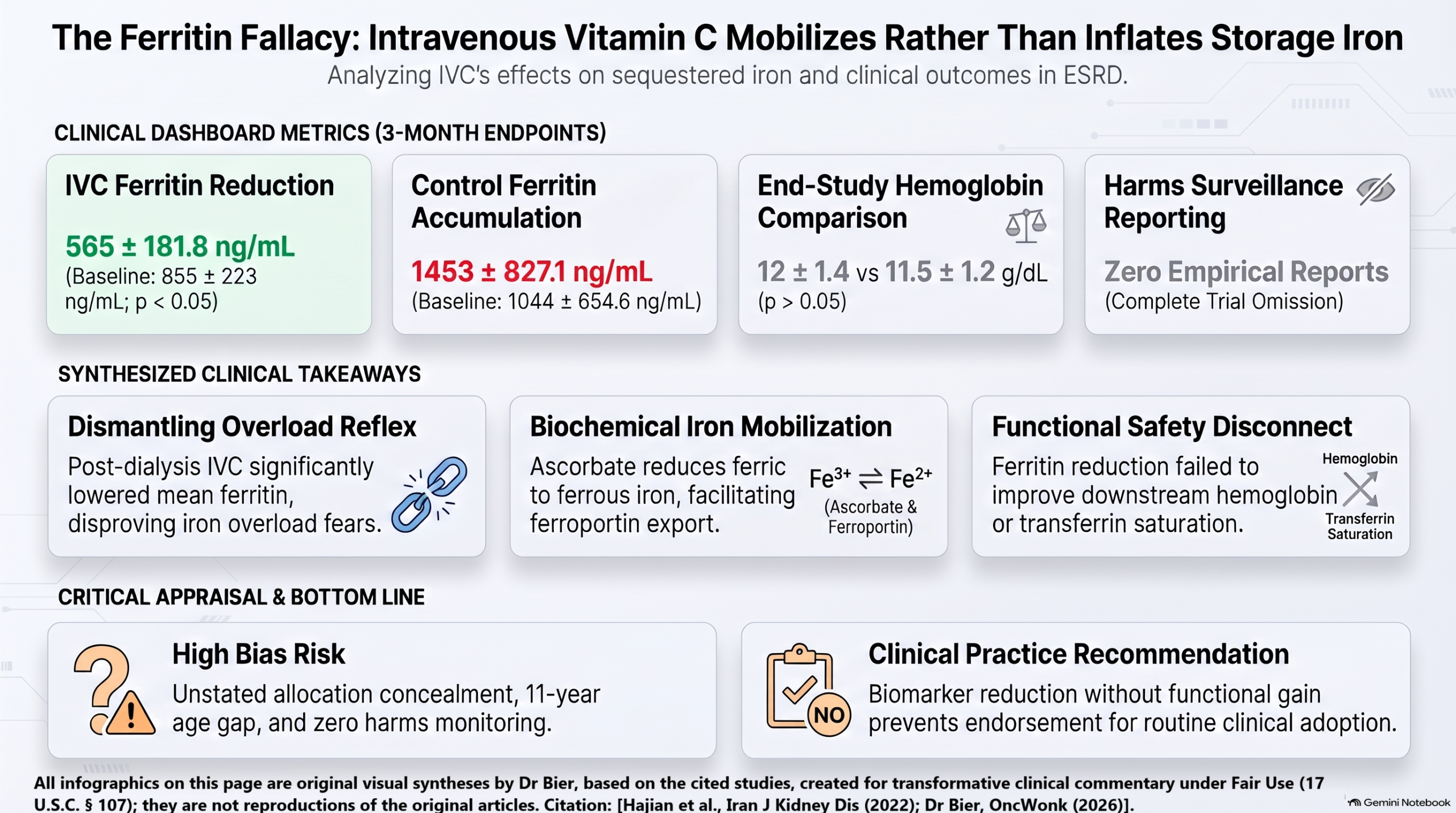
The trial by Hajian et al. provides a direct human illustration of this dynamic, evaluating 500 mg of post-dialysis intravenous ascorbic acid three times weekly over three months [Methods, Para 2]. Rather than compounding iron overload, IVC drove a statistically significant drop in mean serum ferritin from 855 ± 223 ng/mL down to 565 ± 181.8 ng/mL (p < 0.05) [Results, Table p4_537]. Meanwhile, the control arm drifted higher, climbing from 1044 ± 654.6 ng/mL to 1453 ± 827.1 ng/mL [Discussion, Table p4_553]. The biochemical directionality is unmistakable: high-dose ascorbate does not inflate ferritin. It down-regulates or mobilizes it.
Yet we must maintain ruthless clinical objectivity regarding the actual effect size on downstream endpoints. Moving a surrogate lab value is meaningless if whole-person hematologic capacity remains untouched. Despite the sharp ferritin drop, the clinical relevance on functional iron delivery was largely neutral: transferrin saturation (TSAT) rose modestly across both the intervention (18% to 22%) and control (19% to 23%) cohorts, and final hemoglobin showed no statistically significant difference between arms (12 ± 1.4 g/dL vs. 11.5 ± 1.2 g/dL, p > 0.05) [Results, Table p3_319] [Discussion, Table p4_553]. Nor was there any measurable absolute risk reduction in dialysis inadequacy, which remained strictly predicted by baseline adequacy (OR 5.71) rather than the antioxidant infusion [Results, Para 11].
Compounding these flat functional metrics is severe baseline confounding: an 11-year age disparity between cohorts (mean age 60.9 years in the intervention group versus 49.7 years in controls) and completely unstated allocation concealment [Methods, Table p3_331] [Results, Table p3_319]. Furthermore, despite acknowledging theoretical risks like secondary oxalosis or pro-oxidant shifts [Introduction, Para 8], the investigators reported zero empirical safety surveillance data [Results, Para 1]. The physiological takeaway remains paramount: stop withholding IVC out of a misguided fear of elevating ferritin in chronic inflammatory anemia. But do not mistake the normalization of a single acute-phase surrogate for the complete resolution of complex, organ-level metabolic pathology.
The Effect of Intravenous vitamin C on Ferritin Levels in Patients Hemodialysis Patients, A Clinical Trial
Clinical Bottom Line
In maintenance hemodialysis patients presenting with functional iron deficiency and hyperferritinemia, adjuvant intravenous vitamin C (500 mg post-dialysis three times weekly for 3 months) significantly reduced mean serum ferritin concentrations compared to placebo [Abs, p1] [Abs, Results]. However, this biochemical reduction did not translate into statistically significant improvements in key clinical or hematologic parameters—including hemoglobin, total iron-binding capacity (TIBC), transferrin saturation (TSAT), platelet counts, or dialysis adequacy [Abs, Results] [Res, p6] [Res, p11]. Methodologically, the trial carries a high risk of bias stemming from unstated allocation concealment, marked baseline prognostic imbalances (notably an 11-year age disparity between arms), complete omission of adverse event monitoring or safety outcome disclosure, and lack of protocol cross-referencing [Meth, p1] [Meth, Table p3_331] [Res, Table p3_319]. Consequently, routine clinical adoption cannot be recommended until adequately powered, rigorously concealed trials verify clinical efficacy and safety.
Results in Context
- Mean Ferritin Concentration (Primary Outcome): Decreased in the intervention group from 855 ± 223 ng/mL at baseline to 565 ± 181.8 ng/mL at 3 months (p < 0.05) [Abs, Results] [Res, Table p4_537]. In contrast, the control group exhibited an increase from 1044 ± 654.6 ng/mL at baseline to 1453 ± 827.1 ng/mL at 3 months [Disc, Table p4_553].
- Hemoglobin (Hb): Intervention baseline was 9.8 ± 1.1 g/dL and ended at 12 ± 1.4 g/dL; control baseline was 10.2 ± 1 g/dL and ended at 11.5 ± 1.2 g/dL (between-group comparison at study end: p > 0.05) [Meth, Table p3_331] [Res, Table p3_319].
- Serum Iron (Fe): Intervention baseline was 53 ± 29.6 mcg/dL and ended at 75 ± 89.9 mcg/dL; control baseline was 62 ± 13.6 mcg/dL and ended at 71 ± 17.8 mcg/dL [Res, Table p4_537] [Disc, Table p4_553].
- Total Iron-Binding Capacity (TIBC): Intervention baseline was 280 ± 145.8 g/dL and ended at 306 ± 257.6 g/dL; control baseline was 323 ± 67.8 g/dL and ended at 308 ± 56.8 g/dL [Res, Table p4_537] [Disc, Table p4_553].
- Transferrin Saturation (TSAT): Intervention baseline was 18 ± 1% and ended at 22 ± 7.8%; control baseline was 19 ± 0.7% and ended at 23 ± 3.8% [Disc, Table p4_553].
- Dialysis Adequacy: Prior adequate dialysis was associated with a 5.71-fold increased chance of adequate dialysis at study termination, but the intervention itself showed no significant effect [Res, p11].
- Biomarkers & Electrolytes: No significant differences between groups were observed at study termination for blood urea nitrogen (BUN: intervention 63.1 ± 17 mg/dL vs control 74.3 ± 24.1 mg/dL, p > 0.05), creatinine (Cr: intervention 8.2 ± 2.4 mg/dL vs control 10.5 ± 4.3 mg/dL, p > 0.05), sodium (Na: intervention 140 ± 2.7 mmol/L vs control 140.5 ± 3 mmol/L, p > 0.05), potassium (K: intervention 5.5 ± 0.6 mmol/L vs control 5.8 ± 1 mmol/L, p > 0.05), or platelet count (Plt: intervention 192.1 ± 71.8 × 10³/µL vs control 177.2 ± 53 × 10³/µL, p > 0.05) [Meth, Table p3_331] [Res, Table p3_319].
- Safety & Harms: The manuscript provided zero empirical counts, percentages, or relative effect sizes for prespecified or emergent adverse toxicities (e.g., secondary oxalosis, hemolysis, pro-oxidant events) [Intro, p8] [Res, p1].
Key Metric Definitions
- Odds Ratio (OR): A relative measure of the odds of an outcome occurring in an exposed group compared to the odds in an unexposed group (an OR of 1 indicates no difference in odds).
- Hazard Ratio (HR): The ratio of the hazard rates corresponding to the conditions described by two levels of an explanatory variable over time in survival analysis.
- I²: A statistic describing the percentage of total variation across studies due to true heterogeneity rather than sampling error (chance).
Assertive Critical Appraisal
- Domain 1: Risk of Bias Arising from the Randomization Process: High Risk. The authors state patients were randomly allocated (n = 16 per group), but fail to describe the sequence generation method, random component, or allocation concealment mechanism [Abs, p1] [Meth, p1]. Furthermore, significant prognostic baseline imbalances are apparent: the mean age in the intervention arm was 60.94 ± 14.29 years versus 49.69 ± 21.82 years in the control arm [Meth, Table p3_331] [Res, Table p3_319]. Weight also differed markedly at baseline (69.81 ± 12.37 kg vs 61.81 ± 15.38 kg), indicating possible allocation failure or unstratified randomization artifacts [Meth, Table p3_331] [Res, Table p3_319].
- Domain 2: Risk of Bias Due to Deviations from the Intended Interventions: Some Concerns. The trial is labeled “triple-blind” in the discussion, with vitamin C and distilled water administered via identical syringes [Meth, p2] [Meth, p5] [Disc, p5]. However, the manuscript does not detail whether participants, clinical nephrology staff, or trial statisticians were verified as effectively blinded, nor is there explicit declaration of an Intention-to-Treat (ITT) population framework [Meth, p1] [Meth, p5].
- Domain 3: Risk of Bias Due to Missing Outcome Data: Low Risk. All 32 enrolled participants (16 intervention, 16 control) are accounted for in the baseline and 3-month tabular outcome displays without post-randomization attrition [Res, p1] [Meth, Table p3_331] [Res, Table p3_319].
- Domain 4: Risk of Bias in Measurement of the Outcome: Low Risk. Ferritin and biochemical laboratory parameters were measured objectively via standard automated central laboratory assays, making detection bias unlikely despite lack of explicit description of assessor blinding [Abs, p1] [Meth, p5].
- Domain 5: Risk of Bias in Selection of the Reported Result: Some Concerns. While the trial registered an Iranian clinical trial ID (IRCT20191112045426N1), no published statistical analysis plan or protocol comparison was provided to verify whether all prespecified exploratory analyses and secondary thresholds were analyzed without post-hoc modification [Meth, p1].
- Overall RoB 2 Judgment: High Risk, driven by undefined allocation concealment, major prognostic imbalances at baseline, and selective absence of planned harms reporting.
- CONSORT Harms & Safety Reporting Audit: Severe deficiency. Although the introduction explicitly highlights critical clinical toxicities of parenteral ascorbic acid in hemodialysis (including oxalosis, renal oxalate deposition, pro-oxidant stress, potential hemolysis, and acid-base disturbances), the results section completely omits any safety reporting, zero-event tracking, or harms tabular data [Intro, p8] [Res, p1].
Research Objective
To evaluate the clinical efficacy of intravenous vitamin C (ascorbic acid) supplementation on reducing elevated serum ferritin levels in patients with end-stage renal disease undergoing maintenance hemodialysis [Doc Header] [Abs, p1] [Intro, p9].
Study Design
- Design: Single-center, parallel-group, 2-arm randomized controlled clinical trial [Abs, p1] [Meth, p1].
- Intervention: Group A received intravenous ascorbic acid (500 mg) administered three times weekly post-hemodialysis for 3 months in conjunction with standard erythropoietin therapy [Abs, p1] [Meth, p2].
- Control: Group B received an identical volume of distilled water placebo administered post-hemodialysis three times weekly for 3 months alongside erythropoietin [Abs, p1] [Meth, p2].
- Blinding: Stated as triple-blind; placebos and active drug administered via identical-gauge/sized syringes [Meth, p2] [Meth, p5] [Disc, p5].
Setting and Participants
- Setting: Hemodialysis unit at Qazvin Velayat Hospital, Iran, conducted during the year 2019 [Meth, p1].
- Participant Count: Total of 32 participants enrolled (16 in the intervention arm, 16 in the control arm) [Abs, p1] [Meth, p1] [Res, p1].
- Inclusion Criteria: Adult patients with chronic renal failure undergoing maintenance hemodialysis presenting with functional iron deficiency anemia and high baseline serum ferritin levels [Abs, p1].
- Exclusion Criteria: Not formally detailed in the published text, though patients with normal ferritin or G6PD deficiency were noted contextually in the background [Intro, p8] [Intro, p9].
Bibliographic Data
- Title: The Effect of Intravenous vitamin C on Ferritin Levels in Patients Hemodialysis Patients, A Clinical Trial [Doc Header]
- Authors: Sepideh Hajian, Mohammad Taheri, Navid Mohammadi [Doc Header]
- Journal: Iranian Journal of Kidney Diseases [Doc Header]
- Year: 2022 [Doc Header]
- PubMed ID:https://pubmed.ncbi.nlm.nih.gov/35271495/ [Doc Header]
Fair Use & Copyright: This post provides a transformative, thesis‑driven critical appraisal intended for educational and scholarly purposes. It is not a reproduction of, nor a market substitute for, the original research article.
Support the Version of Record: To support the copyright holders and verify the underlying data—including primary survival curves, risk estimates, and other core outcomes—readers are strongly encouraged to access the original Version of Record via the link or DOI provided above.
Medical Disclaimer: This content is for informational and educational purposes only and is not a substitute for professional medical advice, diagnosis, or treatment.