
Ductal Carcinoma In Situ & Tamoxifen: Managing Risk vs. Overtreating Non-Invasive Disease
Ductal carcinoma in situ is not invasive cancer, and it is past time we stop treating it as such. We routinely subject women with localized, non-obligate precursors to systemic endocrine blockades under the banner of oncologic vigilance, yet we consistently fail to move the needle on what matters most: hard clinical survival. The pooled analysis of NRG Oncology/RTOG 9804 and ECOG-ACRIN E5194 offers another textbook lesson in the divergence between local event manipulation and true mortality benefit.
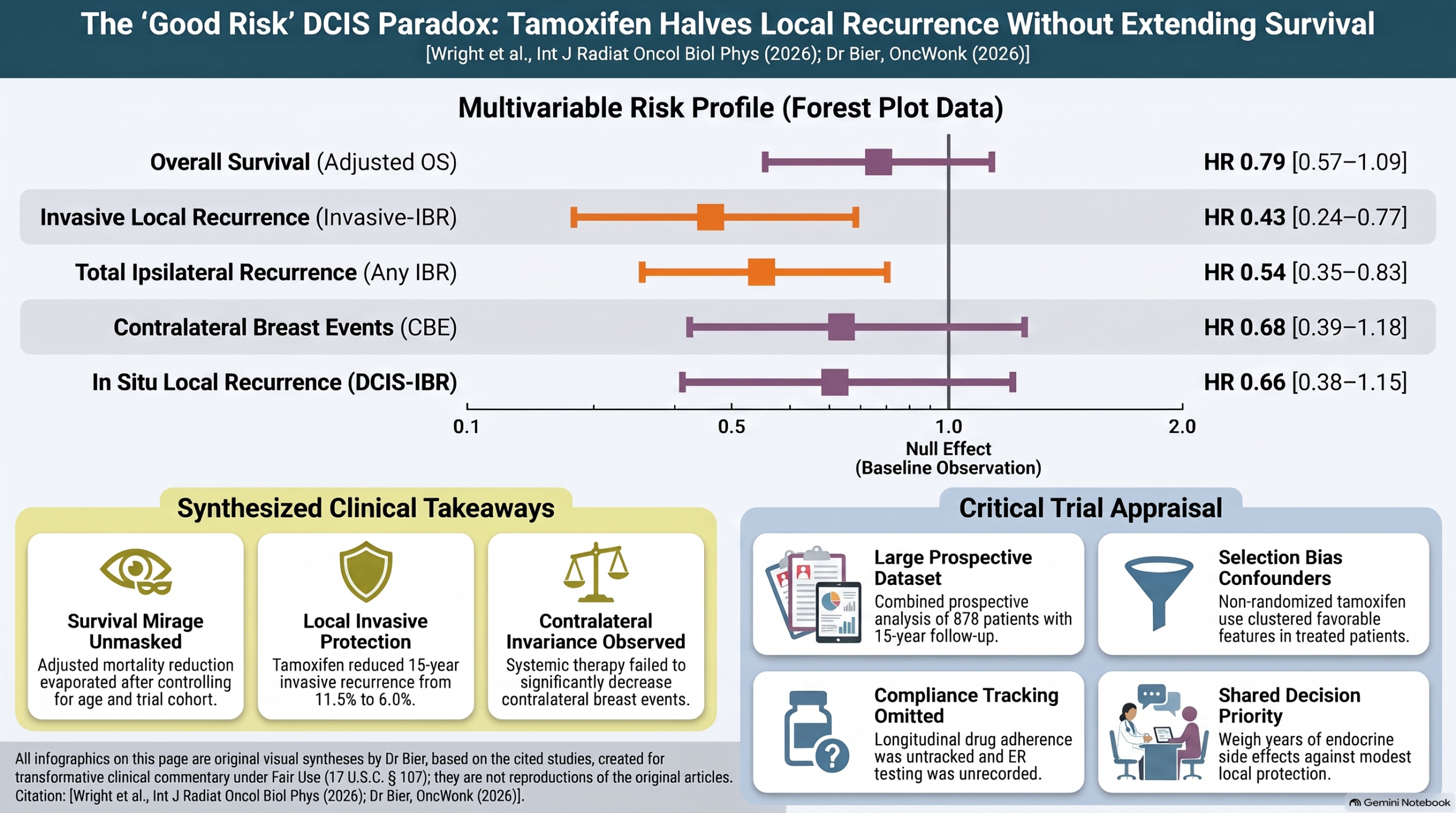
The raw survival data initially look alluring: a crude 50% relative risk reduction in mortality favoring tamoxifen (unadjusted HR = 0.50, 95% CI: 0.37 to 0.68) [Res, Table 2]. But this is classic confounding by indication and selection bias. Once the investigators adjusted for baseline age and trial cohort, the survival signal evaporated entirely (multivariable HR = 0.79, 95% CI: 0.57 to 1.09; p = 0.15) [Res, p2]. The only variable that independently drove survival was chronological age itself (HR = 1.12, 95% CI: 1.10 to 1.14; p < 0.001) [Res, p2]. Decades into studying selective estrogen receptor modulators for “good risk” in situ lesions, the clinical reality remains unchanged: tamoxifen does not save lives in this setting.
What the drug does accomplish is a reduction in local recurrences, but we must contextualize the absolute effect size. Over a 15-year horizon, tamoxifen reduced ipsilateral breast recurrence from 19.0% to 11.4% (multivariable HR = 0.54, 95% CI: 0.35 to 0.83) and invasive local recurrences from 11.5% to 6.0% (multivariable HR = 0.43, 95% CI: 0.24 to 0.77) [Res, Table 2] [Res, p2]. That translates to a 15-year absolute risk reduction of just 5.5% for invasive local events, with zero statistically significant impact on contralateral breast disease (multivariable p not significant; 5.6% vs 8.8%) or overall survival [Res, Table 2] [Res, p2]. Furthermore, these modest risk shifts stem from an observational, non-randomized allocation where compliance went unmonitored and favorable pathology naturally clustered in the treated cohort [Meth, FigLegend p2_258] [Res, Table 1].
When we counsel a woman with low- or intermediate-grade DCIS who has undergone complete surgical excision, we must be brutally honest about these trade-offs. We are asking patients to navigate years of systemic estrogen deprivation, vasomotor instability, thromboembolic vulnerability, and musculoskeletal side effects to achieve a minor absolute risk reduction in localized events, without extending life by a single day. Rather than reflexively defaulting to long-term pharmacological blockades for non-invasive biology, clinical relevance demands that we prioritize whole-person resilience, active surveillance, metabolic optimization, and shared decision-making.
Clinical Bottom Line
For patients with clinicopathologically defined “good risk” ductal carcinoma in situ (DCIS) treated with lumpectomy without adjuvant radiation therapy (RT), tamoxifen use was not associated with any statistically significant improvement in Tier 1 overall survival (OS) after adjusting for age and trial cohort (multivariable HR = 0.79, 95% CI: 0.57 to 1.09; p = 0.15) [Res, p2] [Disc, p1]. A statistically significant crude survival benefit observed on univariate analysis (unadjusted HR = 0.50, 95% CI: 0.37 to 0.68; p < 0.001) completely attenuated once adjusting for baseline age and trial source, serving as a direct signal of confounding and selection bias [Res, Table 2] [Res, p2]. Similarly, tamoxifen demonstrated no statistically significant benefit in reducing Tier 2 contralateral breast events (multivariable p not significant; unadjusted HR = 0.68, 95% CI: 0.39 to 1.18; p = 0.17) [Res, Table 2] [Res, p2].
For Tier 3 local recurrence endpoints, tamoxifen was associated with a statistically significant reduction in 15-year ipsilateral breast recurrence (IBR) (multivariable HR = 0.54, 95% CI: 0.35 to 0.83; p = 0.0045; 15-year risk: 11.4% vs 19.0%) and invasive IBR (multivariable HR = 0.43, 95% CI: 0.24 to 0.77; p = 0.0042; 15-year risk: 6.0% vs 11.5%) [Abs, Results] [Res, Table 2] [Res, p2]. It did not significantly reduce in situ recurrences (DCIS-IBR multivariable HR = 0.66, 95% CI: 0.38 to 1.15; p = 0.14) [Res, p2]. However, because tamoxifen receipt was entirely non-randomized (physician and patient discretion), actual longitudinal drug compliance was unmonitored, baseline risk factors favored the tamoxifen cohort (smaller tumors and higher rates of clear margins by re-excision), and ER status was neither tested nor mandated in RTOG 9804, these observational associations cannot prove causal efficacy [Meth, FigLegend p2_258] [Res, Table 1] [Disc, p2] [Disc, p3].
Results in Context
- Overall Survival (OS) (Tier 1):
- Events: 214 deaths (59 in tamoxifen vs 155 in no-tamoxifen) [Res, p1].
- 15-year OS: 84.8% (95% CI: 80.7% to 88.8%) with tamoxifen vs 72.7% (95% CI: 68.4% to 77.0%) without tamoxifen [Res, Table 2].
- Unadjusted: HR = 0.50 (95% CI: 0.37 to 0.68; p < 0.001) [Res, Table 2].
- Multivariable-adjusted (adjusted for age and trial number): HR = 0.79 (95% CI: 0.57 to 1.09; p = 0.15) [Res, p2]. Increasing age was the only variable independently associated with OS (HR = 1.12, 95% CI: 1.10 to 1.14; p < 0.001) [Res, p2].
- Contralateral Breast Events (CBE) (Tier 2):
- Events: 55 CBEs (19 in tamoxifen vs 36 in no-tamoxifen) [Res, p1].
- 15-year CBE: 5.6% (95% CI: 3.4% to 8.6%) with tamoxifen vs 8.8% (95% CI: 6.2% to 12.0%) without tamoxifen (p = 0.17) [Res, Table 2].
- Unadjusted: HR = 0.68 (95% CI: 0.39 to 1.18) [Res, Table 2]. No variables were statistically significant on multivariable modeling [Res, p2].
- Ipsilateral Breast Recurrence (IBR) (Tier 3):
- Events: 117 IBRs (35 in tamoxifen vs 82 in no-tamoxifen) [Res, p1].
- 15-year IBR: 11.4% (95% CI: 7.9% to 15.5%) with tamoxifen vs 19.0% (95% CI: 15.3% to 22.9%) without tamoxifen (p = 0.001) [Res, Table 2].
- Unadjusted: HR = 0.52 (95% CI: 0.35 to 0.77) [Res, Table 2].
- Multivariable-adjusted (adjusted for pathologic size and trial number): HR = 0.54 (95% CI: 0.35 to 0.83; p = 0.0045) [Res, p2].
- Invasive Ipsilateral Breast Recurrence (Invasive-IBR) (Tier 3):
- Events: 65 invasive-IBRs (18 in tamoxifen vs 47 in no-tamoxifen) [Res, p1].
- 15-year invasive-IBR: 6.0% (95% CI: 3.5% to 9.4%) with tamoxifen vs 11.5% (95% CI: 8.5% to 14.9%) without tamoxifen (p = 0.005) [Res, Table 2].
- Unadjusted: HR = 0.47 (95% CI: 0.27 to 0.80) [Res, Table 2].
- Multivariable-adjusted (adjusted for DCIS nuclear grade and trial number): HR = 0.43 (95% CI: 0.24 to 0.77; p = 0.0042) [Res, p2]. Grade 2 vs Grade 1 was also associated with invasive recurrence (HR = 1.77, 95% CI: 1.07 to 2.95; p = 0.027) [Res, p2].
- DCIS Ipsilateral Breast Recurrence (DCIS-IBR) (Tier 4):
- Events: 52 DCIS-IBRs (17 in tamoxifen vs 35 in no-tamoxifen) [Res, p1].
- 15-year DCIS-IBR: 5.5% (95% CI: 3.2% to 8.7%) with tamoxifen vs 8.1% (95% CI: 5.7% to 11.0%) without tamoxifen (p = 0.09) [Res, Table 2].
- Unadjusted: HR = 0.61 (95% CI: 0.34 to 1.08) [Res, Table 2].
- Multivariable-adjusted: HR = 0.66 (95% CI: 0.38 to 1.15; p = 0.14) [Res, p2].
Plain-Language Statistical Definitions
- Hazard Ratio (HR): The relative rate at which an event occurs in the treated group compared to the control group at any given point in time across the study period. A hazard ratio below 1.0 indicates a lower event rate in the exposed group. The validity of a single constant summary HR relies strictly on the proportional hazards assumption (that the relative risk remains constant over time).
Assertive Critical Appraisal
- Survival Statistics and Proportional Hazards (): The authors used multivariable Cox proportional hazards modeling for OS and Fine-Gray subdistribution hazard modeling for recurrence endpoints with death as a competing risk [Meth, FigLegend p2_258] [Meth, p1]. However, the manuscript reports no formal testing or diagnostics for the proportional hazards assumption (such as Schoenfeld residual tests, log-minus-log plots, or time-varying coefficients) [Meth, p1]. This remains an unverified statistical assumption across 15 to 24 years of follow-up [Res, p1].
- Confounder Selection and Multivariable Adjustment (): Exposure to tamoxifen was entirely non-randomized, determined by patient or treating physician discretion [Meth, FigLegend p2_258]. Baseline prognostic covariates showed significant structural imbalances: patients receiving tamoxifen were significantly more likely to have tumors 5 mm or smaller (57.0% vs 41.3%, p < 0.0001) and negative margins achieved by re-excision (27.2% vs 10.6%, p < 0.0001) [Res, Table 1]. Covariate adjustment relied on automated data-driven backward elimination (alpha = 0.05) rather than prespecified causal diagrams (DAGs) [Meth, p1]. Furthermore, no sensitivity analyses for unmeasured confounding (such as E-values) were reported to evaluate how strong unmeasured factors would need to be to nullify findings.
- Univariate to Multivariable Attenuation (): A pronounced confounding signal occurred for Tier 1 overall survival: the crude, unadjusted model demonstrated a statistically significant 50% relative reduction in mortality associated with tamoxifen (unadjusted HR = 0.50, 95% CI: 0.37 to 0.68; p < 0.001) [Res, Table 2]. However, once adjusted for patient age and clinical trial cohort, this association attenuated and was non-significant (multivariable HR = 0.79, 95% CI: 0.57 to 1.09; p = 0.15), with age fully accounting for survival differences (HR = 1.12 per year of age, p < 0.001) [Res, p2].
- Outcome Prioritization and Abstract Spin (,): The authors committed selective reporting spin in the Abstract. Despite analyzing OS and highlighting crude survival in the Results section text, the Abstract Results and Conclusion completely omitted the null multivariable OS finding (HR = 0.79, p = 0.15), framing the study entirely around positive Tier 3 local recurrence reductions [Abs, Results] [Abs, Conclusions] [Res, p2]. Clinically, tamoxifen conveys toxicities without extending OS in good-risk DCIS [Disc, p1] [Disc, p3].
- Cohort Selection and Reverse Causality (): The pooled cohort combines two heterogeneous trial settings: RTOG 9804 was an amended randomized trial where tamoxifen was initially mandatory and later optional (65.6% uptake), while E5194 was a non-randomized observational cohort (30.3% uptake) [Intro, p2] [Meth, FigLegend p2_258]. Central pathology review in E5194 subsequently upgraded a subset of patients to Grade 3 DCIS under 2009 CAP criteria, but this analysis reverted to the original historical grading, introducing histologic misclassification [Meth, FigLegend p2_258] [Disc, p3]. Additionally, estrogen receptor (ER) status was never tested or recorded in RTOG 9804, leaving biologically unresponsive ER-negative cases potentially included [Meth, FigLegend p2_258] [Disc, p2].
- Immortal Time Bias and Drug Adherence (): Intent to take tamoxifen was declared at trial entry [Meth, FigLegend p2_258]. However, timing of drug initiation and longitudinal adherence were not tracked across both trials [Meth, FigLegend p2_258] [Disc, p3]. If exposure was classified based on intention at baseline rather than confirmed, time-dependent dispensing, misclassification and immortal time bias cannot be ruled out.
Research Objective
To evaluate the association between adjuvant tamoxifen use and ipsilateral breast recurrence (IBR), contralateral breast events, and overall survival in patients with clinicopathologically defined “good risk” DCIS treated with lumpectomy alone without adjuvant radiation therapy [Abs, p1] [Intro, p2].
Study Design
Retrospective pooled cohort analysis of non-randomized, optional tamoxifen exposure among patients enrolled in the observation arms of two prospective clinical trials (the non-RT arm of NRG/RTOG 9804 and Cohort 1 of ECOG-ACRIN E5194) [Abs, p1] [Meth, FigLegend p2_258]. Follow-up extended to a median of 14.85 years (maximum 24.44 years) [Res, p1]. Competing risks of death were modeled using cumulative incidence and Fine-Gray regression for breast events; overall survival was evaluated using Kaplan-Meier and Cox proportional hazards regression with backward elimination [Meth, FigLegend p2_258] [Meth, p1].
Setting and Participants
- Setting and Data Sources: Multi-institutional cooperative group trials conducted across North America: ECOG-ACRIN E5194 (enrolled 1997–2002) and NRG/RTOG 9804 (enrolled 1998–2006) [Meth, FigLegend p2_258].
- Eligibility Criteria: Female patients with low- or intermediate-grade (nuclear grade 1 or 2) mammographically detected DCIS, tumor size 2.5 cm or smaller, surgical excision margins 3 mm or wider (or negative margins on re-excision), treated with breast-conserving surgery (lumpectomy) without whole-breast irradiation [Abs, p2] [Meth, FigLegend p2_258].
- Sample Size and Cohort Breakdown: 878 total patients: 317 from the observation arm of RTOG 9804 and 561 from Cohort 1 of E5194 [Abs, Results] [Meth, FigLegend p2_258]. Overall, 378 patients (43.1%) reported tamoxifen use (208 [65.6%] in RTOG 9804 and 170 [30.3%] in E5194) and 500 patients (56.9%) did not receive tamoxifen [Res, p1] [Res, Table 1].
Bibliographic Data
- Title: Impact of Tamoxifen Only after Lumpectomy for “Good Risk” Duct Carcinoma in Situ: Combined Analysis of the NRG Oncology/RTOG 9804 and ECOG-ACRIN E5194 Trials Header
- Authors: Jean L Wright, Jennifer Moughan, Wendy A Woodward, Habib Rahbar, Amit B Shah, Christopher Comstock, Lesly A Jarvis, Judy A Tjoe, Isabelle Germain, Sunil S Badve, Eric Strom, Abram Recht, Diane C Ling, Laura A Vallow, Joseph J Stephenson, Adam Currey, Eleanor M Walker, Harold Reiter, Michael L. Steinberg, Lori J Pierce, Kathryn Winter, Joseph Sparano, Nancy E Davidson, Antonio Wolff, Eleftherios P Mamounas, Julia R White, Beryl McCormick Header
- Journal: International journal of radiation oncology, biology, physics Header
- Year: 2026 Header
- DOI / PubMed ID: https://doi.org/10.1016/j.ijrobp.2026.04.103 / https://pubmed.ncbi.nlm.nih.gov/42114785/ Header
Fair Use & Copyright: This post provides a transformative, thesis‑driven critical appraisal intended for educational and scholarly purposes. It is not a reproduction of, nor a market substitute for, the original research article.
Support the Version of Record: To support the copyright holders and verify the underlying data—including primary survival curves, risk estimates, and other core outcomes—readers are strongly encouraged to access the original Version of Record via the link or DOI provided above.
Medical Disclaimer: This content is for informational and educational purposes only and is not a substitute for professional medical advice, diagnosis, or treatment.