
Tamoxifen in Ductal Carcinoma In Situ
1. Topic Intro
Adjuvant endocrine therapy with tamoxifen is routinely considered after breast-conserving surgery for ductal carcinoma in situ (DCIS) to lower recurrence rates. However, this management paradigm introduces a profound clinical tension between reducing surrogate local recurrences versus delivering tangible improvements in overall survival and preserving quality of life.
2. Study Summaries
Postoperative Tamoxifen for ductal carcinoma in situ: Cochrane systematic review and meta-analysis.
Summary:
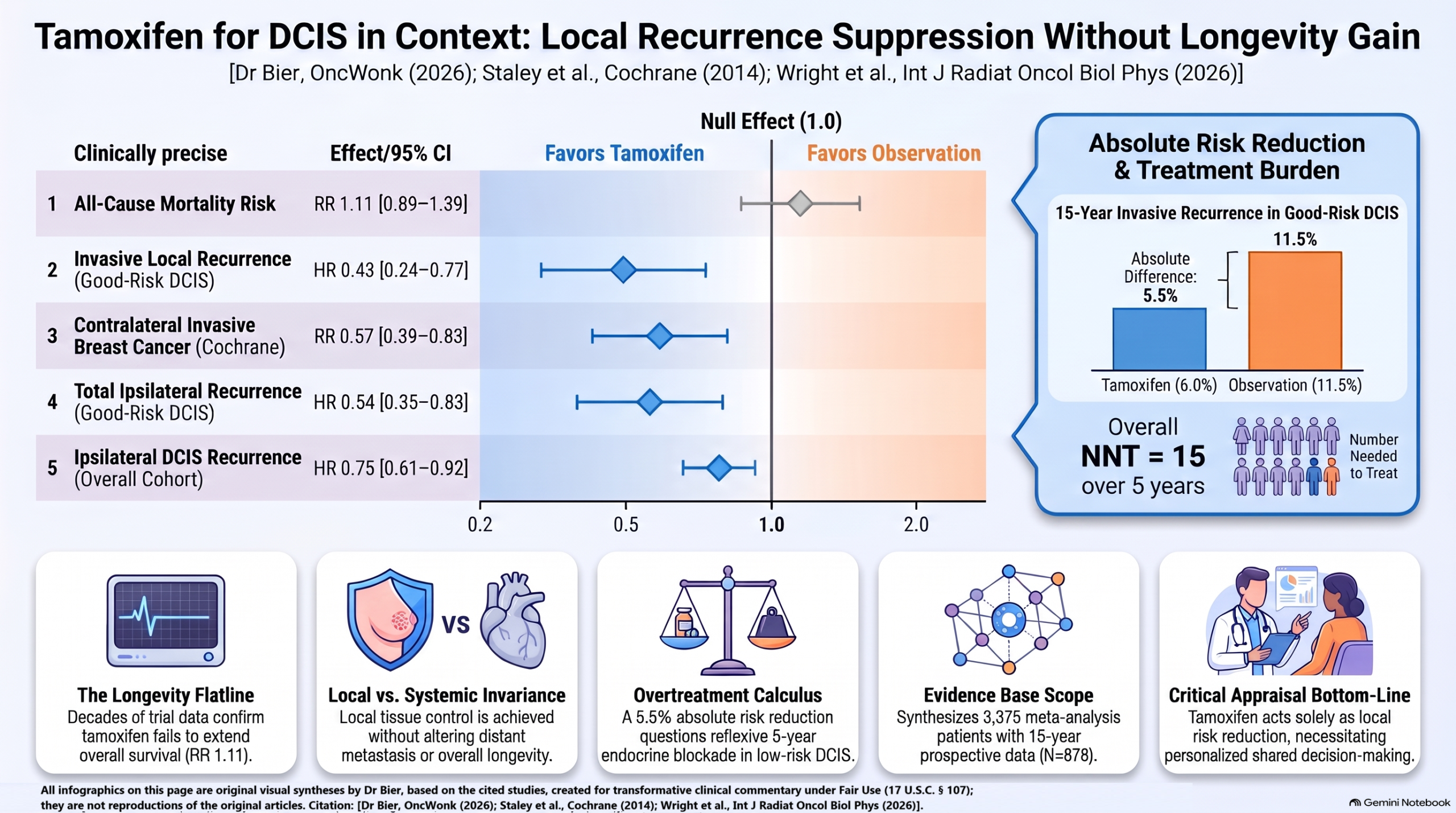
A systematic review and meta-analysis of two randomized controlled trials involving 3,375 women evaluated the effects of postoperative tamoxifen, with or without radiation therapy, following surgical removal of ductal carcinoma in situ (DCIS) regardless of estrogen receptor status. The analysis demonstrated that tamoxifen significantly reduced breast cancer events. Specifically, it lowered the rate of DCIS returning in the same breast by 25% (hazard ratio [HR] 0.75; 95% confidence interval [CI] 0.61 to 0.92) and halved the risk of new DCIS developing in the opposite breast (relative risk [RR] 0.50; 95% CI 0.28 to 0.87). It also reduced the risk of invasive cancer occurring in the opposite breast by 43% (RR 0.57; 95% CI 0.39 to 0.83). A trend toward fewer invasive cancers in the same breast was observed, though it did not reach clear statistical certainty (HR 0.79; 95% CI 0.62 to 1.01). Overall, 15 women needed to receive tamoxifen to prevent one additional breast event (number needed to treat = 15).
Despite these reductions in local disease events, tamoxifen demonstrated no benefit for hard survival outcomes. There was no statistically significant difference in all-cause mortality between the groups (RR 1.11; 95% CI 0.89 to 1.39).
Harms and adverse effects were reported by only one of the included trials, which monitored 1,799 participants over a median follow-up of 163 months. This trial found no overall statistically significant difference in adverse event rates between the tamoxifen and placebo groups, although a non-significant trend toward an increased incidence of endometrial cancer was observed among patients taking tamoxifen.
Source: https://pubmed.ncbi.nlm.nih.gov/25023044/
Impact of Tamoxifen Only After Lumpectomy for "Good-Risk" Duct Carcinoma In Situ: Combined Analysis of the NRG Oncology/RTOG 9804 and ECOG-ACRIN E5194 Trials.
Summary:
This exploratory analysis evaluated the long-term impact of tamoxifen in 878 patients with "good-risk" ductal carcinoma in situ (DCIS)—defined as low- or intermediate-grade, tumor size of 2.5 cm or smaller, and surgical margins of at least 3 mm—who underwent lumpectomy without radiation therapy. Data were combined from the non-radiation arms of the NRG/RTOG 9804 and ECOG-ACRIN E5194 trials, in which tamoxifen use was optional and taken by 43.1% of participants overall. Over a median follow-up of 14.85 years, 117 total ipsilateral breast recurrences (IBRs) occurred, comprising 65 invasive cases and 52 DCIS recurrences.
Patients who took tamoxifen experienced a statistically significant reduction in breast cancer returning in the same breast compared to those who did not. The estimated 15-year rate of any recurrence in the treated breast was 11.4% with tamoxifen compared to 19.0% without it. After adjusting for other variables in a multivariable analysis, tamoxifen use was associated with a 46% reduction in the risk of any recurrence in the same breast (hazard ratio [HR], 0.54; 95% confidence interval [CI], 0.35–0.83; p = .0045) and a 57% reduction in the risk of invasive recurrence (HR, 0.43; 95% CI, 0.24–0.77; p = .0042).
Conversely, tamoxifen did not show a statistically significant benefit in reducing non-invasive recurrences, with the reduction in DCIS-specific recurrence failing to reach significance (p = .089). While the study tracked contralateral breast events and overall survival, the abstract does not report whether tamoxifen significantly improved these hard outcomes, nor does it provide data regarding adverse events, treatment-related toxicities, or side effects experienced by the patients.
Source: https://pubmed.ncbi.nlm.nih.gov/42114785/
Physical Health Decline After Chemotherapy or Endocrine Therapy in Breast Cancer Survivors.
Summary:
In a prospective cohort study of 2,566 breast cancer survivors (median age 56.3 years) and 12,826 age-matched women without cancer, researchers evaluated post-diagnosis physical health declines using the Patient-Reported Outcomes Measurement Information System Global Health Scale. Physical health outcomes differed depending on whether patients received chemotherapy, endocrine therapy, or a combination of both.
Within two years of diagnosis, breast cancer survivors experienced measurable drops in physical health scores relative to cancer-free participants. On average, physical health scores fell by 1.12 points for patients receiving endocrine therapy alone (95% confidence interval [CI], -1.64 to -0.60), 3.13 points for those receiving chemotherapy alone (95% CI, -4.19 to -2.07), and 3.26 points for those receiving both treatments (95% CI, -3.97 to -2.55). The physical decline identified among endocrine therapy recipients was specifically restricted to those taking aromatase inhibitors.
The duration of this adverse effect varied significantly by treatment type. Beyond two years after diagnosis, the decline in physical health persisted only among women who had received chemotherapy, whereas those who received endocrine therapy without chemotherapy did not show a sustained long-term physical decline compared with women without cancer. The abstract reported no data on mortality, overall survival, or therapeutic benefits.
Source: https://pubmed.ncbi.nlm.nih.gov/40019757/
3. Conclusion
Across the available trial evidence, tamoxifen yields a reduction in surrogate and local endpoints—curbing ipsilateral and contralateral DCIS events and associating with an absolute risk difference of roughly 7.6% for overall ipsilateral recurrence over 15 years in exploratory 'good-risk' cohorts (with 15-year invasive recurrence estimated at 6.0% vs 11.5%). Yet, looking strictly at hard clinical outcomes, the Cochrane meta-analysis demonstrates zero evidence of an all-cause mortality benefit (RR 1.11, 95% CI 0.89–1.39). While long-term patient-reported physical health decline appears largely driven by chemotherapy rather than single-agent tamoxifen, trial data demonstrate no overall significant difference in adverse events between tamoxifen and placebo groups, alongside an isolated non-significant trend toward endometrial malignancy, while offering no extension in patient survival.
4. Final Analysis
When counseling patients with resected DCIS, clinicians must look past relative risk spin and evaluate the modest absolute risk reduction against the lack of survival extension. The therapeutic goal in non-obligate precursors like 'good-risk' DCIS is preventing progression to invasive disease without incurring unnecessary treatment burdens. Because tamoxifen demonstrates no clinical relevance for overall survival and primarily manages local surrogate recurrences, its reflexive prescription must be replaced with shared decision-making. For low- and intermediate-grade DCIS excised with clear margins, the small effect size on ipsilateral invasive recurrence may not justify years of endocrine modulation for an asymptomatic individual, particularly when whole-person physiology, baseline confounding, and potential medication-related side effects are considered.
Fair Use & Copyright: This post provides a transformative, thesis‑driven critical appraisal intended for educational and scholarly purposes. It is not a reproduction of, nor a market substitute for, the original research article.
Support the Version of Record: To support the copyright holders and verify the underlying data—including primary survival curves, risk estimates, and other core outcomes—readers are strongly encouraged to access the original Version of Record via the link or DOI provided above.
Medical Disclaimer: This content is for informational and educational purposes only and is not a substitute for professional medical advice, diagnosis, or treatment.