
Comment:
We always need to keep “first, do no harm”, and I always have a higher index of suspicion to anything that has wide applicability to energy metabolism, be it supplement or hormones, especially when patients are working with a history or diagnosis of cancer. While creatine is a staple in the fitness world for muscle growth, this study in Cell Metabolism provides a sobering look at why it might have a different and dangerous effect in a cancer context.
The “Oncogenic” Switch
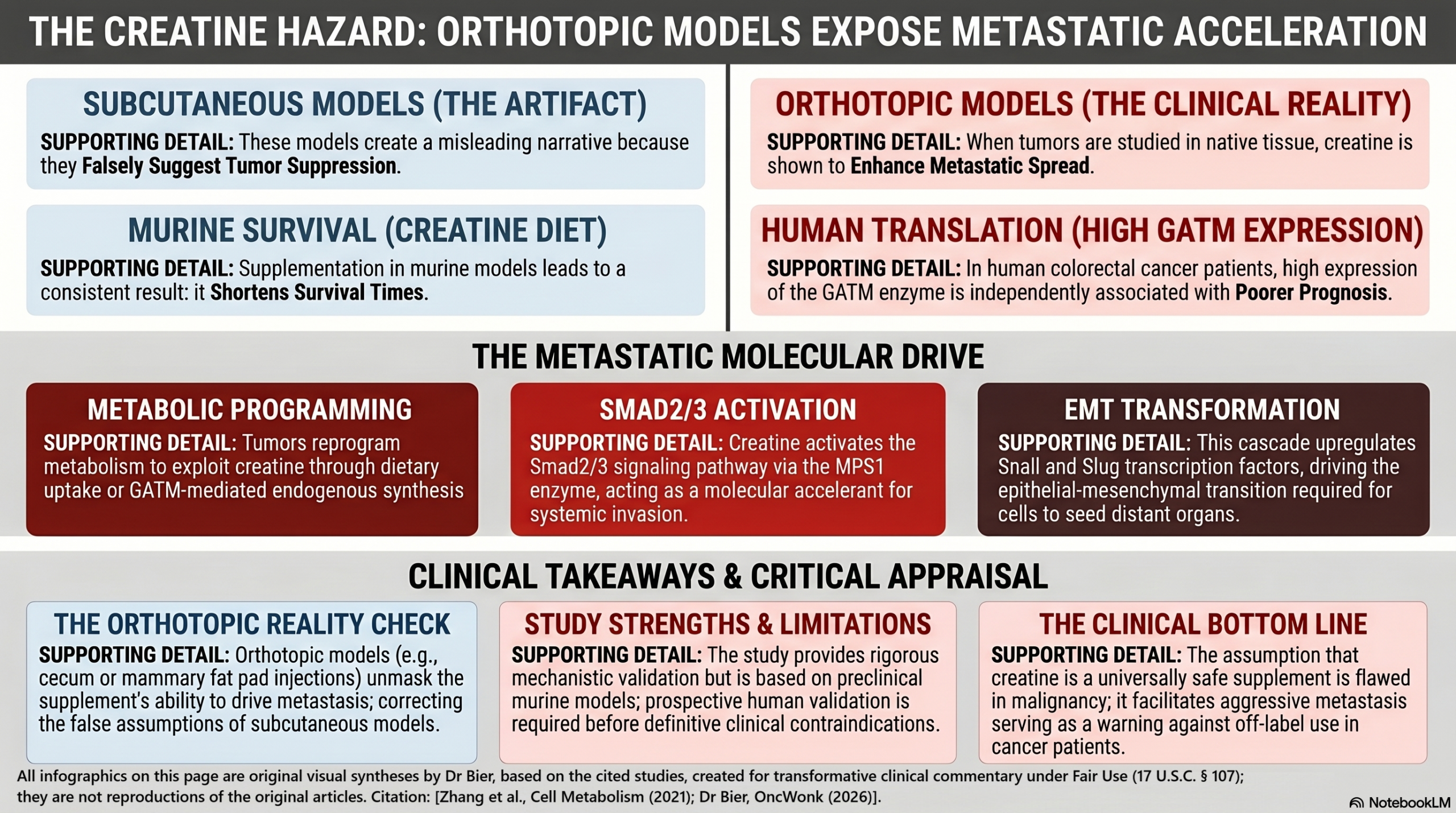
The central tension in this study is the shift in perspective from subcutaneous models—which may falsely suggest creatine is anti-tumor—to orthotopic mouse models that more closely mimic how human cancers grow and spread. The researchers found that creatine doesn’t necessarily boost the primary tumor’s size, but it potently activates the Smad2/3 signaling pathway via the enzyme MPS1. This pathway upregulates Snail and Slug, which are classic drivers of the epithelial-mesenchymal transition (EMT)—the very mechanism that allows stationary cancer cells to break loose, invade tissue, and seed distant metastases in the liver and lungs.
The Clinical Red Flag
The data is quite concerning:
-
The Metastatic Drive: Creatine uptake and endogenous synthesis (via the enzyme GATM) significantly enhanced metastatic spread in both colorectal and breast cancer models.
-
The Survival Penalty: Mice on a creatine-supplemented diet consistently faced shorter survival times compared to controls, even when their primary tumors were slightly smaller or unaffected.
-
The Prognostic Marker: High expression of GATM in human colorectal cancer patients was independently associated with a poorer prognosis, suggesting that tumor cells are not just passive consumers of creatine—they are actively reprogramming their own metabolism to exploit it for invasion.
The Wonk Debate – Audio Critique & Clinical Commentary:
Summary:
Clinical Bottom Line
This study provides evidence that creatine supplementation—a popular performance-enhancing supplement—promotes cancer metastasis in colorectal and breast cancer models. While creatine is frequently used to boost muscle mass, clinicians should exercise caution, as these findings suggest it may inadvertently facilitate cancer cell invasion and metastasis via the Snail/Slug signaling pathway.
Results in Context
- Primary Outcome: Dietary creatine supplementation significantly enhanced liver metastasis in colorectal cancer (CRC) models and lung metastasis in breast cancer models.
- Oncology Endpoints & Response Criteria: The study utilized orthotopic mouse models (injecting cells into the cecum or mammary fat pad) rather than subcutaneous models to assess tumor progression, arguing that these are more clinically relevant as they better mirror the coupling of tumor growth and metastasis.
- Mechanisms: The researchers identified that creatine activates Smad2 and Smad3 phosphorylation via MPS1 (monopolar spindle 1), independent of the canonical TGF-$\beta$ receptor pathway. This activation leads to the upregulation of Snail and Slug, which are transcription factors known to drive epithelial-mesenchymal transition (EMT) and metastasis.
- Biomarkers: The enzyme GATM (glycine amidinotransferase), responsible for the rate-limiting step in de novo creatine synthesis, was found to be significantly upregulated in liver metastases compared to primary CRC tumors. High GATM expression is associated with poorer survival in human CRC patients.
- Harms: The study demonstrates that while creatine may not significantly increase the weight of the primary tumor, it shortens survival in mice by potently driving metastatic spread.
Assertive Critical Appraisal
- Risk of Bias: The study demonstrates strong mechanistic consistency, but because the evidence is restricted to preclinical murine models, it carries a high risk of bias regarding its applicability to human cancer patients. The authors correctly note that previous subcutaneous mouse studies suggested creatine might suppress tumor growth, but they provide a compelling argument that these models are less reliable than the orthotopic ones used here.
- Applicability: These findings are highly relevant to clinical practice. Patients with cancer often seek out supplements to combat cachexia or fatigue; this study serves as a critical warning that such supplementation could be potentially oncogenic in terms of metastatic progression.
- Reporting Quality: The study adheres to high standards, providing clear schemas of the orthotopic models and detailed Western blot and immunohistochemistry data to support its mechanistic claims. However, as a preclinical study, it does not utilize clinical trial reporting guidelines like CONSORT.
Research Objective
The objective was to elucidate the role of dietary creatine uptake and endogenous creatine synthesis in tumor progression and to identify the underlying signaling mechanisms driving creatine-mediated metastasis.
Study Design
The researchers employed orthotopic mouse models (NSG and BALB/c mice) involving cecum and mammary fat pad injections of CRC and breast cancer cell lines, respectively. They utilized genetic knockdown (SLC6A8, GATM) and pharmacological inhibition (MPS1) to validate the pathway.
Bibliographic Data
- Title: Creatine promotes cancer metastasis through activation of Smad2/3
- Authors: Liwen Zhang, Zijing Zhu, Huiwen Yan, et al.
- Journal: Cell Metabolism
- Year: 2021
- DOI: 10.1016/j.cmet.2021.03.009
Fair Use & Copyright: This post provides a transformative, thesis‑driven critical appraisal intended for educational and scholarly purposes. It is not a reproduction of, nor a market substitute for, the original research article.
Support the Version of Record: To support the copyright holders and verify the underlying data—including primary survival curves, risk estimates, and other core outcomes—readers are strongly encouraged to access the original Version of Record via the link or DOI provided above.
Medical Disclaimer: This content is for informational and educational purposes only and is not a substitute for professional medical advice, diagnosis, or treatment.