
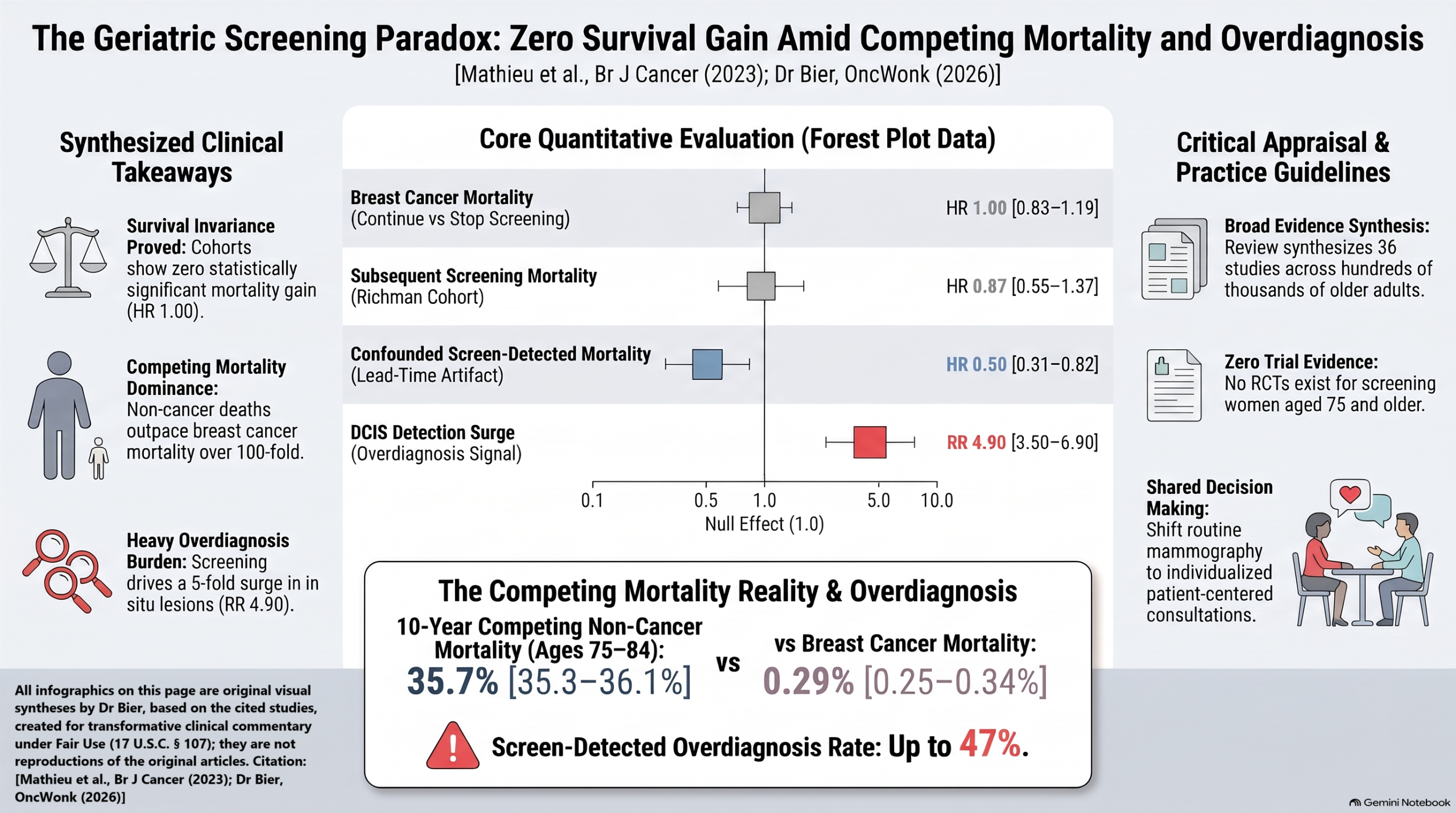
It remains an open and contentious question whether screening mammography provides a meaningful overall survival benefit in any age group. When we turn our attention to older cohorts, the clinical calculus becomes even more precarious. We intuitively lean toward screening because finding pathology early carries a reassuring appeal. However, as in many studies on early detection, surrogate markers don’t necessarily translate to increased lifespan. This systematic review by Mathieu and colleagues in the British Journal of Cancer synthesizes the evidence for screening in women aged 75 and older, and the findings illustrate a familiar pattern: tangible, documented harms paired with no reliable evidence of survival efficacy.
The Evidence Deficit and the Mortality Mirage
The most telling finding in this review is an absolute absence of randomized controlled trial data for women aged 75 and older [Res, p1]. The entire justification for continuing mammography into late life rests on observational datasets and mathematical modeling, both of which carry significant structural liabilities [Res, p1]. In the observational cohorts, whenever investigators relied on flawed comparisons—such as contrasting screen-detected against clinically detected tumors—an apparent survival advantage predictably materialized, showing dramatic hazard ratios like 0.38 and 0.50 [Res, Table 2]. But this is classic lead-time and length-time confounding [Res, p1] [Disc, p1]. When researchers examined the clinically relevant question—comparing older women who continued routine screening against those who stopped—that apparent advantage evaporated [Disc, p1]. In Garcia-Albéniz et al., continuing screening yielded an 8-year breast cancer mortality hazard ratio of exactly 1.00 (95% CI, 0.83 to 1.19), with an absolute risk difference of just 0.07 deaths per 1,000 women [Res, Table 2]. Similarly, in Richman et al., subsequent screening vs no subsequent screening showed no statistically significant reduction in breast cancer mortality (HR 0.87, 95% CI 0.55 to 1.37; 0.36 vs 0.42 deaths per 100 women) [Res, Table 2]. While certain microsimulation models projected modest reductions in breast cancer mortality or life-years gained [Res, Table 2], these simulated projections relied heavily on assumptions that frequently failed to account for non-progressive invasive or in situ disease [Disc, p2].
Competing Risks and the Harms of Overdiagnosis
Against this absent empirical mortality benefit, the harms of screening in older women are both measurable and cumulative. The structural reality of aging is that competing causes of mortality rapidly outpace breast cancer risk. As demonstrated by Demb et al., 10-year non-breast cancer mortality rises from 14.5% in women aged 66–74 to 35.7% at ages 75–84, reaching 65.4% among those aged 85–94 [Res, Table 2]. In parallel, observational estimates identified that up to 47% of breast cancers detected in screened women aged 75–84 represented overdiagnosis—tumors that would never have produced symptoms or shortened life during the patient’s natural lifespan [Res, Table 3]. It is true that in the single comparative treatment study by Garcia-Albéniz et al., continuing screening was associated with a higher proportion of breast-conserving lumpectomy (48.8% vs 32.6%) and lower radical mastectomy (14.2% vs 17.0%) [Res, Table 6]; however, this potential surgical de-escalation must be weighed against subjecting large cohorts of older women to false-positive recalls [Res, Table 3], benign biopsies [Res, Table 3], and the overtreatment of indolent disease that competing non-oncologic risks would render clinically silent [Disc, p1] [Disc, p2].
Clinical Bottom Line
This systematic review evaluated the net benefits and harms of continuing mammography screening in women aged 75 years and older [Abs, Objective]. Regarding Tier 1 (All-cause mortality / Overall Survival) and Tier 2 (Serious morbidity / Breast Cancer Mortality) endpoints, the review found no randomized controlled trials (RCTs) evaluating screening in women aged 75 and older [Res, p1]. Across observational and modelling studies, evidence regarding breast cancer mortality was mixed, with some studies reporting a beneficial association among screen-detected cancers while others—particularly those comparing continuing versus stopping screening—found no significant difference in breast cancer mortality (e.g., hazard ratio 1.00, 95% CI 0.83 to 1.19) [Res, p2]. Concurrently, competing non-breast cancer mortality increased sharply with age (reaching 65.4% in women aged 85–94 years) [Res, Table 2], and overdiagnosis increased substantially [Res, p5]. Methodologically, the review highlights that most observational studies were prone to critical or serious risks of bias and relied on uninformative comparisons (such as comparing screen-detected vs. clinically detected cancers) rather than comparing continuing versus stopping screening [Res, p1] [Disc, p1]. The study genuinely supports that high-certainty empirical evidence is lacking, and decisions should be individualized based on competing comorbidities and life expectancy [Disc, p2].
Results in Context
This systematic review identified 36 studies (27 observational studies and 9 modelling studies) comprising hundreds of thousands of older women, though exact pooled participant counts vary across individual database links [Abs, Results] [Res, p1]. Because of substantial clinical and methodological heterogeneity across the included studies, the authors performed a narrative synthesis and tabulated findings rather than pooling data via meta-analytic summary effect sizes [Disc, p1].
- Breast Cancer Mortality: Observational cohorts comparing women who continued versus stopped screening reported non-significant differences in breast cancer death risk (e.g., risk difference 0.07 per 1000 women, 95% CI -0.93 to 1.3; hazard ratio 1.00, 95% CI 0.83 to 1.19) [Res, Table 2]. Conversely, studies comparing screen-detected to clinically detected cancers reported apparent survival advantages (e.g., hazard ratios ranging from 0.38 to 0.50, p < 0.001) [Res, Table 2], which are heavily confounded by lead-time and length-time biases [Disc, p1].
- Competing Mortality: Demb et al. demonstrated that 10-year non-breast cancer mortality increased from 14.5% in ages 66–74 to 35.7% in ages 75–84 and 65.4% in ages 85–94 [Res, Table 2].
- Harms (Overdiagnosis and False Positives): Overdiagnosis estimates ranged widely from 0.5 to 7.5 per 1000 screens in modelling analyses to 47% of breast cancer cases among screened women aged 75–84 in observational data [Res, Table 3]. False-positive recalls and biopsies remained frequent [Res, Table 3].
- Statistical Terms: Hazard Ratio (HR) is the relative rate of an event occurring in the experimental group compared to the control group over time, assuming proportional hazards. Rate Ratio (RR) compares the incidence rates of events between two groups.
Assertive Critical Appraisal
1. Search Strategy & PRISMA Compliance: The review was prospectively registered in PROSPERO (CRD42020203131) [Abs, Conclusions] and searched three major bibliographic databases (Ovid Medline, Embase, Cinahl) with supplementary citation tracking [Meth, p1]. However, complete reproducible search strings and date filters were omitted from the text, representing a reporting limitation [Meth, p1].
2. Heterogeneity & Data Pooling: Substantial clinical, methodological, and statistical heterogeneity across study designs (cohorts, cross-sectional analyses, and microsimulation models) appropriately precluded statistical pooling, avoiding invalid fixed-effect or random-effects aggregation [Disc, p1].
3. Risk of Bias & GRADE Certainty: Quality appraisal using ROBINS-I and QUADAS-2 determined that the vast majority of observational studies carried serious or critical risks of bias due to uninformative comparisons, confounding, and lead-time bias [Res, p1] [Disc, p2]. Consequently, the GRADE certainty of evidence for mortality reduction from screening in women aged 75+ is Very Low, downgraded heavily for serious risk of bias, inconsistency, and indirectness.
4. Outcome Hierarchy & Surrogate Dissociation: The review correctly prioritized hard clinical endpoints (breast cancer mortality and all-cause mortality) over intermediate screening metrics (such as cancer detection rates and invasive detection yields) [Res, Table 2, Table 4]. While detection rates were maintained or higher in older women, these surrogate markers dissociated from definitive all-cause survival gains due to competing non-breast cancer mortality [Disc, p2].
Research Objective
To systematically review and synthesize evidence on the health benefits and harms of continuing mammography screening in women aged 75 years and older, in order to guide clinical screening recommendations [Abs, Objective] [Intro, p2].
- Population: Women aged 75 years and older [Abs, Objective].
- Intervention: Continuing mammography screening (annual, biennial, or self-referred) [Abs, Objective] [Intro, p1].
- Comparator: Stopping screening, no screening, uninformative age-group comparisons, or varying screening intervals [Res, p1, Table 1].
- Outcomes: Breast cancer mortality, all-cause mortality, life years gained, false-positive tests, biopsies, overdiagnosis, and treatment patterns [Meth, p2].
Study Design
A systematic review of observational and modelling studies reporting outcomes of mammography screening in women aged 75 years and older, conducted and reported in accordance with PRISMA guidelines [Abs, Methods] [Meth, FigLegend p2_193]. The protocol was prospectively registered in PROSPERO (CRD42020203131) [Abs, Conclusions]. Searches covered MEDLINE, Embase, and CINAHL from 1990 to July 2022 without language restrictions [Meth, p1].
Setting and Participants
The review synthesized data from 36 studies (27 observational studies and 9 modelling studies) conducted primarily in the USA, Europe (The Netherlands, England, Sweden), and Australia [Res, Table 1]. Included participants comprised community-dwelling older women, Medicare beneficiaries, screening programme self-referrals, and simulated cohorts aged 75 years and older [Res, Table 1]. Studies lacking age-stratified data for women aged 75 and older were excluded [Meth, p2].
Bibliographic Data
- Title: Health benefits and harms of mammography screening in older women (75+ years)-a systematic review [Doc Header]
- Authors: Erin Mathieu, Naomi Noguchi, Tong Li, Alexandra L. Barratt, Jolyn K. Hersch, Geertruida H. De Bock, Elizabeth J. Wylie, Nehmat Houssami [Doc Header]
- Journal: British Journal of Cancer [Doc Header]
- Year: 2023 [Doc Header]
- DOI: https://doi.org/10.1038/s41416-023-02504-7 [Doc Header]
Fair Use & Copyright: This post provides a transformative, thesis‑driven critical appraisal intended for educational and scholarly purposes. It is not a reproduction of, nor a market substitute for, the original research article.
Support the Version of Record: To support the copyright holders and verify the underlying data—including primary survival curves, risk estimates, and other core outcomes—readers are strongly encouraged to access the original Version of Record via the link or DOI provided above.
Medical Disclaimer: This content is for informational and educational purposes only and is not a substitute for professional medical advice, diagnosis, or treatment.