
Comment:
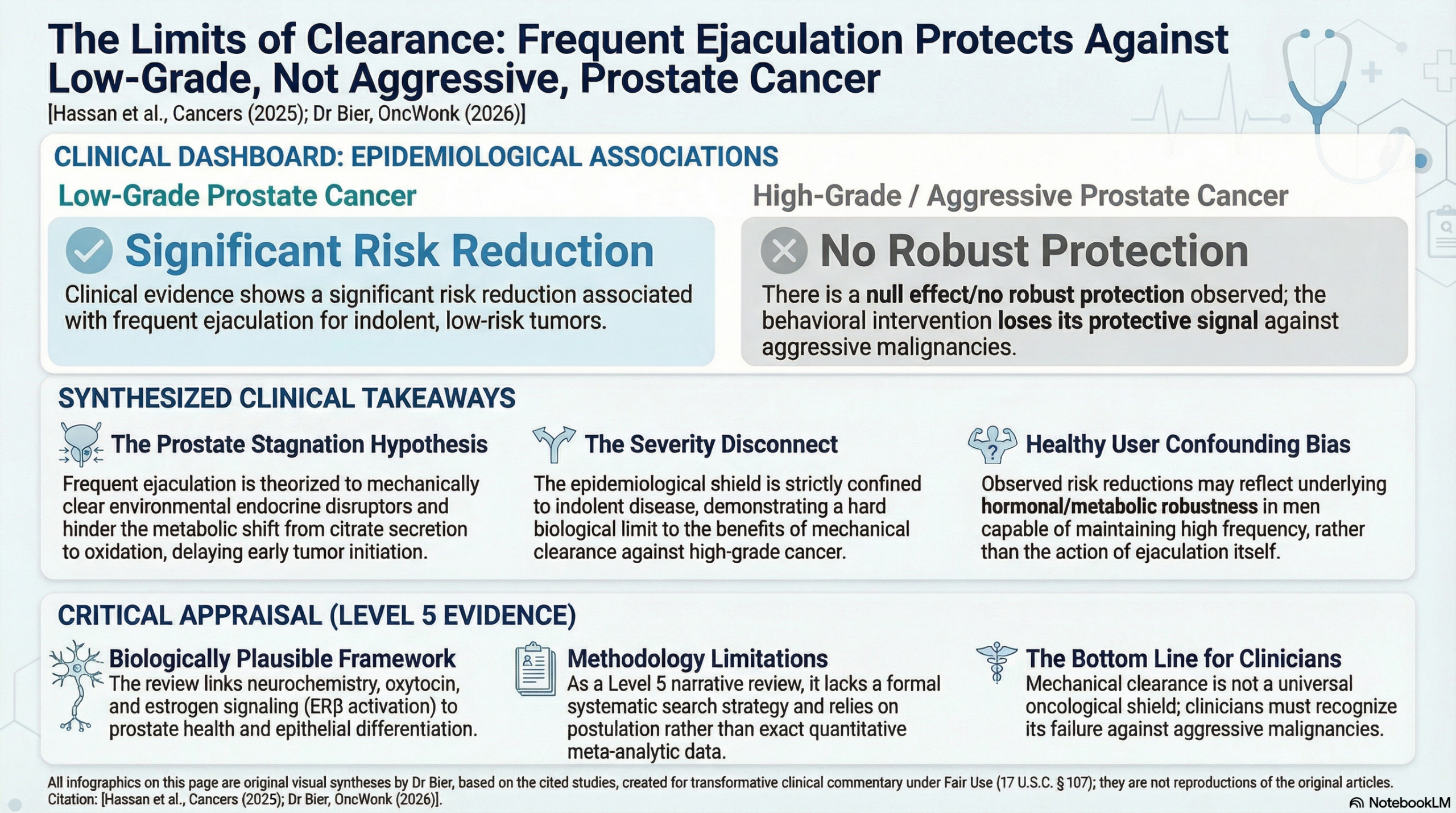
The “prostate stagnation” mechanism is biologically plausible for clearing environmental endocrine disruptors, yet it fails to move the needle on high-grade malignancy. The findings are unequivocal that higher ejaculations per month effectively lowers the risk for low-grade disease, likely by hindering the metabolic switch from citrate secretion to oxidation. However this protection does not appear to scale with disease severity. We must mirror the “Healthy User Bias” against these results: men capable of maintaining this frequency may simply have a different hormonal or baseline health profile that naturally resists low-grade tumorigenesis. And unfortunately this behavioral intervention appears to lose its protective signal when confronted with aggressive, high-grade tumors.
The Wonk Debate – Audio Critique & Clinical Commentary:
Summary:
Clinical Bottom Line
This narrative review suggests that frequent ejaculation (in the absence of risky sexual behavior) is associated with a reduced risk of prostate cancer (PCa). The authors propose several biological mechanisms for this protective effect, including the “prostate stagnation hypothesis” (flushing out carcinogens), suppression of the sympathetic nervous system (slowing cell division), and hormonal modulation involving oxytocin, estrogen, and androgen receptor signaling. While the epidemiological association is noted as significant, the review acknowledges that the specific biological pathways remain largely theoretical and require further prospective validation.
Regarding disease severity, the review notes that while frequent ejaculation is strongly linked to a reduction in PCa risk generally, this association appears less robust for aggressive (high-grade) forms of the disease compared to low-risk tumors.
Key Themes & Evidence Summary
- Scope: The review covers prostate anatomy and physiology, the neurochemical regulation of ejaculation (peripheral, spinal, and cerebral), and the hormonal changes (androgens, oxytocin, estrogens) that occur post-ejaculation.
- Proposed Protective Mechanisms:
- Prostate Stagnation/Chemical Clearance: Frequent ejaculation may reduce the biological load of harmful environmental chemicals and endocrine disruptors by “flushing” them from the gland.
- Neural Suppression: Ejaculation may suppress the sympathetic nervous system, relieving tension and slowing the division of prostate epithelial cells.
- Metabolic Switch: Frequent activity may hinder the metabolic switch from citrate secretion to citrate oxidation in peripheral zone epithelial cells, delaying tumor initiation.
- Hormonal Signaling: * Oxytocin: Post-ejaculatory oxytocin release triggers signaling pathways (via Gαi proteins and p21) that exert anti-proliferative effects on prostate cells.
- Estrogen: Activation of estrogen receptor beta by ejaculation-associated estrogens promotes epithelial differentiation and tumor suppression.
- Androgens/EGFR: Frequent ejaculation increases androgens, which in normal tissue downregulate the Epidermal Growth Factor Receptor (EGFR), a pathway often hijacked in malignant cells to drive proliferation.
Assertive Critical Appraisal
- Evidence Level: This is a Narrative Review (Level 5 Evidence/Expert Opinion). It synthesizes existing literature to propose a mechanistic framework rather than providing new clinical data.
- Quality Assessment (SANRA Scale):
- Justification & Aims: The importance of identifying modifiable risk factors for PCa is well-justified given the worldwide increase in incidence.
- Literature Search: The authors do not describe a formal search strategy (e.g., databases searched, keywords used), which is a common limitation of narrative reviews and increases the risk of selection bias.
- Referencing: Key physiological and neurochemical statements are heavily supported by 390 references .
- Scientific Reasoning: The reasoning is multi-disciplinary, linking neurobiology to oncology; however, many links between ejaculation and specific gene expression changes are described as “postulated” or “suggested” rather than proven.
- Data Presentation: The review primarily uses qualitative descriptions and schematic models rather than presenting absolute risk reduction data from primary studies.
Research Objective
The stated aim is to shed light on the possible biological and neurochemical mechanisms regulating the impact of frequent ejaculation on reducing the risk of prostate cancer.
Bibliographic Data
- Title: Reduction of Prostate Cancer Risk: Role of Frequent Ejaculation-Associated Mechanisms
- Authors: Mohamed Hassan, Thomas W. Flanagan, Abdulaziz M. Eshaq, et al.
- Journal: Cancers
- Year: 2025
- DOI: 10.3390/cancers17050843
Fair Use & Copyright: This post provides a transformative, thesis‑driven critical appraisal intended for educational and scholarly purposes. It is not a reproduction of, nor a market substitute for, the original research article.
Support the Version of Record: To support the copyright holders and verify the underlying data—including primary survival curves, risk estimates, and other core outcomes—readers are strongly encouraged to access the original Version of Record via the link or DOI provided above.
Medical Disclaimer: This content is for informational and educational purposes only and is not a substitute for professional medical advice, diagnosis, or treatment.