
Comment:
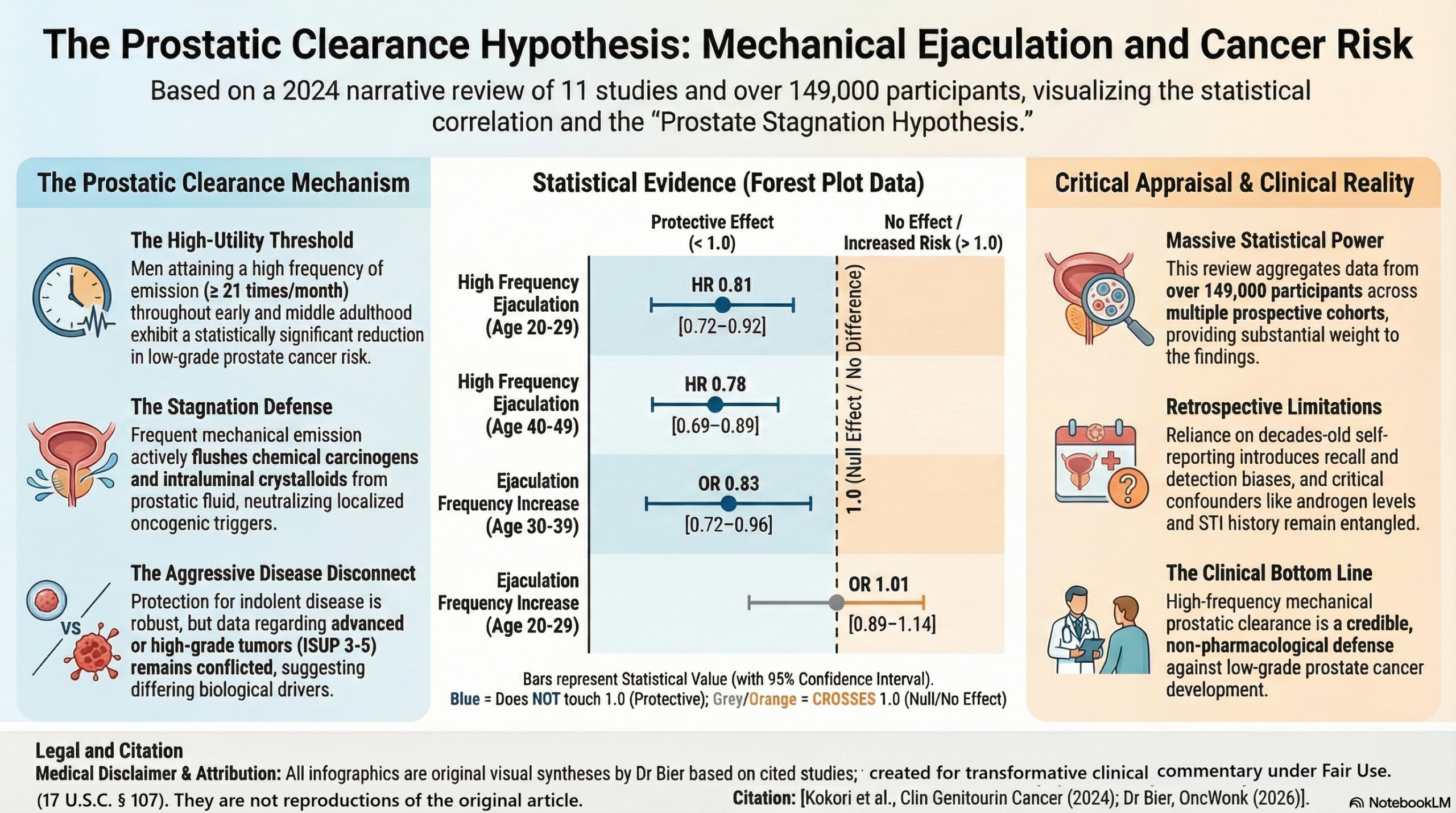
This review shows that while broad sexual behaviors offer no clear signal, ejaculation demonstrates a robust protective effect against low-grade disease. The “Prostate Stagnation Hypothesis”— says that the mechanical purging of chemical carcinogens and intraluminal crystalloids provides a credible defense. The evidence suggests a high-utility threshold: men reporting ≥ 21 ejaculations per month throughout adulthood see a significant reduction in low-risk prostate cancer. Unfortunately the signal for high risk prostate cancer isn’t as clear.
The Wonk Debate – Audio Critique & Clinical Commentary:
Summary:
Clinical Bottom Line
This narrative review suggests a potential, though not universally consistent, protective association between high ejaculation frequency and the risk of prostate cancer. The strongest evidence supports a reduction in low-grade (low-risk) disease for men reporting ≥ 21 ejaculations per month throughout adulthood. Conversely, the evidence for high-grade or advanced prostate cancer is conflicting; while some studies show weak inverse associations in specific age groups, others suggest that moderate frequencies may correlate with higher risks for aggressive tumors (ISUP 3-5) compared to very low frequencies. Clinicians should interpret these findings with caution due to the retrospective nature of most data and significant methodological heterogeneity across the included studies.
Key Themes & Evidence Summary
Scope of Review The review synthesizes findings from 11 studies (6 prospective and 5 case-control) involving approximately 149,580 participants.
Low-Grade vs. High-Grade Prostate Cancer Risk
The impact of ejaculation frequency appears to vary significantly by the aggressiveness of the disease:
- Low-Grade/Low-Risk Disease: Multiple large studies (e.g., Rider et al., Sinnott et al.) identified a clear inverse association, where frequent ejaculation throughout adult life significantly reduced the risk of low-risk prostate cancer.
- High-Grade/Advanced Disease: Findings are discordant. Nathan P. Papa et al. found only weak evidence of an inverse association between frequency in the 4th decade of life and advanced prostate cancer. In contrast, Lozano-Lorca et al. (2023) observed a higher risk for locally advanced-metastatic and high-grade (ISUP 3-5) tumors in men with more than 4 ejaculations per month compared to those with exactly 4.
Biological Mechanisms
Several hypotheses are proposed to explain the potential protective effect:
- Prostate Stagnation Hypothesis: Frequent ejaculation may clear the prostate of chemical carcinogens and xenobiotic compounds that accumulate in prostatic fluid.
- Intraluminal Crystalloids: Regular emission may reduce the development of prostatic crystalloids, which have been associated with cancer development in some pathology studies.
- Psychological Factors: Ejaculation may release psychological tension, potentially lowering sympathetic nervous activity and adrenergic stimulation of prostate epithelial cell division.
Age-Specific Variations The protective effect may be age-dependent. One study found that frequent sexual activity in younger life (20s) was associated with increased risk, while it appeared protective in older age (50s). However, other large prospective cohorts suggest that high frequency (≥ 21 times/month) is beneficial across both early (20-29) and middle (40-49) adulthood.
Assertive Critical Appraisal
Evidence Level This document is a Narrative Review, representing Level 5 Evidence (Expert Opinion). Unlike a systematic review, it is more susceptible to selection bias as the authors may have selectively included studies to support a specific narrative.
Quality Assessment (SANRA Scale)
- Justification & Aims: The review provides a clear justification based on the global burden of prostate cancer and the lack of consensus on non-modifiable risk factors.
- Literature Search: The authors describe a comprehensive search across multiple databases (PubMed, Embase, Scopus, etc.) with no time limit. However, it does not follow the strict PRISMA protocols required for systematic reviews.
- Referencing: The arguments are well-supported by 34 references to primary research and established clinical guidelines .
- Scientific Reasoning: The review acknowledges major confounding variables—such as hormone levels, lifestyle factors, and sexually transmitted infections—that complicate the ejaculation-cancer link.
- Data Presentation: The review appropriately highlights the limitations of the current literature, specifically the reliance on self-reported, retrospective data which is highly susceptible to recall bias and detection bias.
Applicability While the review advocates for incorporating sexual behavior into patient counseling, the lack of definitive causative evidence makes it difficult to issue rigid clinical prescriptions. The “≥ 21 ejaculations per month” figure is a useful benchmark but should be discussed as a potential part of a broader, healthy lifestyle rather than a guaranteed preventive measure.
Research Objective
The objective of this review was to evaluate and synthesize current evidence regarding the association between ejaculation frequency and the risk of prostate cancer, exploring potential biological mechanisms and clinical implications.
Bibliographic Data
- Title: Ejaculation Frequency and Prostate Cancer Risk: A Narrative Review of Current Evidence
- Authors: Emmanuel Kokori, Gbolahan Olatunji, David Timilehin Isarinade, John Ehi Aboje, Ikponmwosa Jude Ogieuhi, Zainab Doyinsola Lawal, Nathnael Abera Woldehana, Muhammad Wajeeh Nazar, Godfred Yawson Scott, Nicholas Aderinto
- Journal: Clinical Genitourinary Cancer
- Year: 2024
- DOI: https://doi.org/10.1016/j.clgc.2024.01.015
Fair Use & Copyright: This post provides a transformative, thesis‑driven critical appraisal intended for educational and scholarly purposes. It is not a reproduction of, nor a market substitute for, the original research article.
Support the Version of Record: To support the copyright holders and verify the underlying data—including primary survival curves, risk estimates, and other core outcomes—readers are strongly encouraged to access the original Version of Record via the link or DOI provided above.
Medical Disclaimer: This content is for informational and educational purposes only and is not a substitute for professional medical advice, diagnosis, or treatment.