
Comment:
I have been using oral beta-glucans to support systemic immune function, and this elegant Cell Reports study maps out the exact biological structural reality of why they are so effective. We often incorrectly conceptualize natural immune modulators as transient, short-term stimulants. What this data demonstrates is a much deeper, durable shift: true epigenetic reprogramming.
The Upstream Shift: Trained Immunity
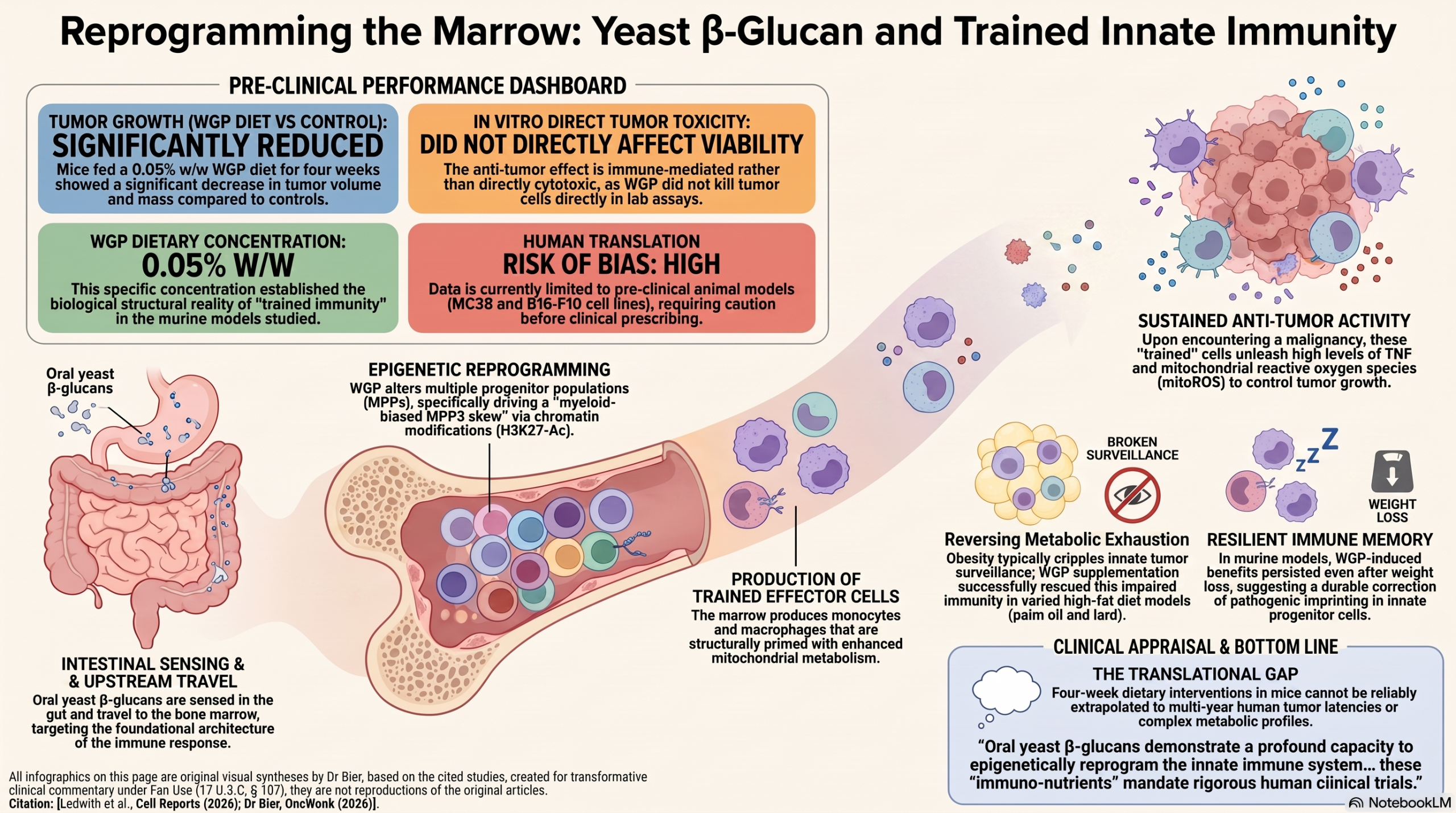
The most compelling aspect of this paper is the upstream target. The authors demonstrate that yeast-derived whole glucan particles (WGP) do not just temporarily agitate circulating immune cells; they travel to the bone marrow to alter the foundational architecture of the immune response.
By epigenetically modifying multiple progenitor populations (MPPs)—specifically driving a myeloid-biased MPP3 skew—the beta-glucan effectively “trains” the innate immune system. It builds a robust reserve of monocytes and macrophages that are structurally primed to unleash a sustained, highly aggressive anti-tumor response (via TNF and mitochondrial ROS) the moment they encounter a malignancy.
Reversing the Metabolic Penalty
From a clinical perspective, the most vital takeaway is how this mechanism held up under metabolic stress. Obesity and metabolic syndrome are well-documented drivers of systemic immune exhaustion, effectively crippling the body’s baseline anti-tumor surveillance. The fact that WGP supplementation successfully rescued this impaired immunity and restored tumor control across varied high-fat, obesogenic diet models is incredibly encouraging. It provides a highly plausible biochemical pathway for how we might actively reverse the immunometabolic dysfunction we so frequently see in our patient populations.
The Clinical Takeaway
As always, we must apply a rigorous analytical filter when translating murine data to human oncology. A four-week dietary intervention in a mouse model does not perfectly map onto human dosing schedules or multi-year tumor latency periods, so we must maintain a measured stance on exact clinical equivalencies.
However, the fundamental cellular machinery of innate immune memory is highly conserved across species. While we await large-scale prospective human trials, this data provides an unassailable, mechanistic validation for an intervention that is already highly accessible and exceptionally safe. It heavily reinforces the utility of yeast beta-glucans as a foundational tool for building long-term immunometabolic resilience in our patients.
The Wonk Debate – Audio Critique & Clinical Commentary:
Summary:
Clinical Bottom Line
This pre-clinical study provides compelling evidence that oral supplementation with yeast-derived β-glucan (whole glucan particle, or WGP) induces “trained immunity” by epigenetically and metabolically reprogramming bone marrow progenitors. This reprogramming generates enhanced monocytes and macrophages that improve anti-tumor responses and reverse obesity-induced immune dysfunction in mouse models. While these findings highlight a novel nutritional approach to modulating innate immunity, the results are derived entirely from animal and cellular models and cannot yet be applied directly to human clinical practice without formal human trials.
Results in Context
- Primary Outcome: The primary findings demonstrated that mice fed a 0.05% WGP-supplemented diet for four weeks exhibited significantly reduced tumor volume and tumor mass compared to control mice fed a standard diet when challenged with MC38 colon adenocarcinoma or B16-F10 melanoma cells.
- Key Secondary & Specialized Outcomes: WGP supplementation significantly expanded lineage-committed multiple progenitor populations (MPPs), specifically driving a skew toward myeloid-biased MPP3 cells in the bone marrow. These cells exhibited elevated markers of epigenetic reprogramming, enabling a sustained increase in tumor necrosis factor (TNF) and mitochondrial reactive oxygen species (mitoROS) production upon secondary challenge.
- Oncology Endpoints & Response Criteria: Because this is a pre-clinical animal trial, traditional clinical endpoints such as Overall Survival (OS) or human-specific tumor response criteria (e.g., RECIST 1.1) were not utilized. Instead, tumor burden was quantified directly via ex vivo tumor mass and volume measurements at sacrifice.
- Patient-Reported Outcomes (PROs): Not applicable, as this is a pre-clinical murine study.
- Harms and Adverse Events: The study did not explicitly report on toxicity or clinical adverse events, but it did note that in vitro treatment with WGP did not directly impact tumor cell viability, indicating the mechanism is immune-mediated rather than directly cytotoxic.
Assertive Critical Appraisal
- Risk of Bias (RoB 2 Framework): Overall risk of bias for human translation is ‘High’ because the data relies exclusively on pre-clinical in vivo and in vitro mouse models. While the animal experiments appear well-controlled, the lack of human subjects limits direct clinical interpretation.
- Subgroup Analyses: The authors performed subgroup analyses evaluating the intervention across different dietary conditions, notably standard diets and two types of high-fat diets (palm oil and lard). WGP effectively restored impaired anti-tumor immunity and intracellular pathogen control across these diverse obesogenic models, which demonstrates high biological plausibility and consistency of the effect.
- Composite Endpoints: Not applicable to this study design.
- Appraisal of Patient-Reported Outcomes (CONSORT-PRO): Not applicable.
- Reporting Quality Assessment (CONSORT): While human-focused CONSORT guidelines do not strictly apply to animal research, the authors adequately reported participant characteristics (mouse strains, ages, and diets), experimental settings, and allocation to varied control and experimental groups. However, human-specific flow diagrams and randomization concealment methods typical of human clinical trials are absent.
- Applicability: The findings are currently not applicable to general clinical practice. While they establish a strong biological rationale for testing oral β-glucans as an “immuno-nutrient” to boost innate immunity (especially in metabolically compromised, obese populations), prospective human clinical trials are strictly required to determine safety, appropriate dosing, and efficacy.
- Research Objective: To determine if oral delivery of yeast β-glucan can reprogram bone marrow progenitors to confer durable innate immune memory and reverse the immunometabolic defects associated with obesity.
- Study Design: Pre-clinical, controlled in vivo animal trial utilizing parallel dietary interventions alongside in vitro mechanistic assays.
- Modern Trial Designs: Not applicable.
- Setting and Participants: The study utilized 10-12 week old C57BL/6J and CD45.1 mice housed under specific-pathogen-free conditions. The models included subcutaneous implantation of MC38 and B16-F10 cancer cell lines, and the use of bone marrow-derived macrophages.
- Bibliographic Data:
- Title: Yeast β-glucan supplementation supports immunometabolic anti-tumor responses and reverses obesity-induced dysfunction via trained hematopoiesis.
- Authors: Anna E. Ledwith, Hannah Prendeville, Cian JH. Horneck Johnston, et al..
- Journal: Cell Reports.
- Year: 2026.
- DOI: 10.1016/j.celrep.2026.117648.
Fair Use & Copyright: This post provides a transformative, thesis‑driven critical appraisal intended for educational and scholarly purposes. It is not a reproduction of, nor a market substitute for, the original research article.
Support the Version of Record: To support the copyright holders and verify the underlying data—including primary survival curves, risk estimates, and other core outcomes—readers are strongly encouraged to access the original Version of Record via the link or DOI provided above.
Medical Disclaimer: This content is for informational and educational purposes only and is not a substitute for professional medical advice, diagnosis, or treatment.