
Comment:
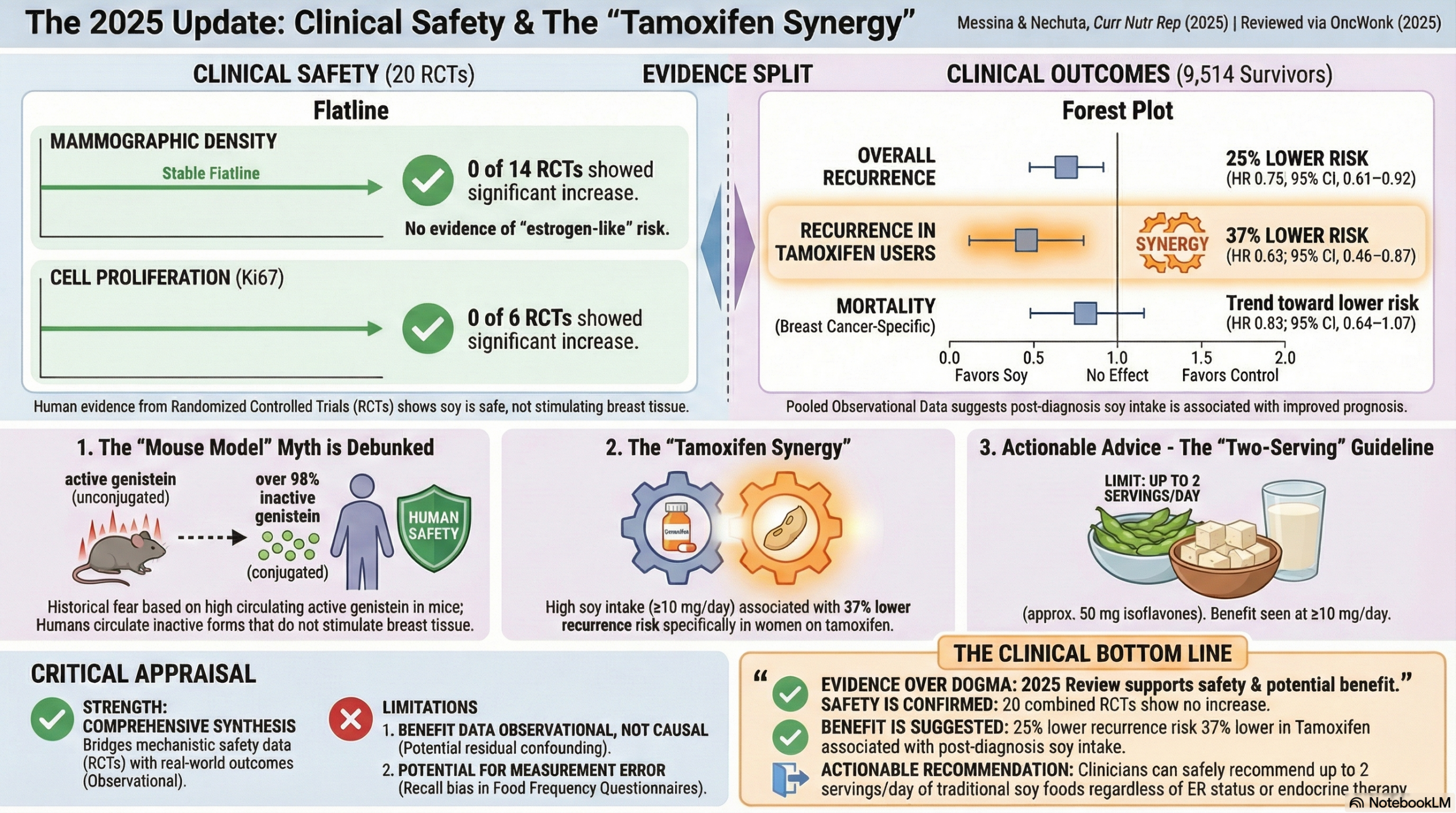
The evidence supporting the safety of soy has been building for a long time, yet the damaging myth that it is ‘dangerous’ persists—driven almost entirely by preclinical models. This 2025 review serves as a definitive corrective. It confirms that in human patients, soy intake is not only safe but consistently associated with better outcomes—specifically a 25% reduction in recurrence risk. Even more compelling is the finding that soy appears to work synergistically with standard care, showing a 37% reduction in recurrence among women taking Tamoxifen. Clinically, this validates that we should stop restricting a valuable ally based on theoretical fears; instead, we should view soy as a tool to optimize the host terrain and enhance therapeutic efficacy.
The Wonk Debate – Audio Critique & Clinical Commentary:
Summary:
Clinical Bottom Line
This narrative review concludes that women with breast cancer can safely consume soy foods, regardless of their endocrine therapy status. The evidence for safety is supported by multiple clinical trials showing no adverse effects on markers of breast cancer risk like mammographic density or breast cell proliferation. Furthermore, a consistent body of evidence from prospective observational studies suggests that postdiagnosis soy isoflavone intake is associated with a reduced risk of breast cancer recurrence and, possibly, mortality. This protective association appears to hold, and may even be stronger, in women taking tamoxifen. While the evidence is not yet strong enough to recommend soy specifically to improve prognosis, it robustly supports the safety of moderate intake, defined as up to two servings of traditional soy foods daily (providing approximately 50 mg of isoflavones).
Results
This review synthesized findings from both clinical trials assessing safety markers and observational studies assessing clinical outcomes.
-
Impact on Recurrence and Mortality (Observational Data):
-
A pooled analysis of three prospective cohort studies including 9,514 women in the US and China found that an isoflavone intake of mg/day was associated with a statistically significant 25% reduction in the risk of recurrence compared to an intake of mg/day (Hazard Ratio [HR] 0.75; 95% Confidence Interval [CI], 0.61 to 0.92).
-
In the same pooled analysis, the association with breast cancer-specific mortality was not statistically significant (HR 0.83; 95% CI, 0.64 to 1.07).
-
The largest single study, the Shanghai Breast Cancer Survival Study (SBCSS), found that women in the highest quartile of soy protein intake had a 32% lower risk of recurrence (HR 0.68; 95% CI, 0.54 to 0.87) and a 29% lower risk of death (HR 0.71; 95% CI, 0.54 to 0.92) compared to those in the lowest quartile.
-
-
Interaction with Endocrine Therapy:
-
The pooled analysis showed that the risk reduction for recurrence associated with high isoflavone intake was most pronounced among women taking tamoxifen. For tamoxifen users, an isoflavone intake of mg/day was associated with a 37% reduction in recurrence risk (HR 0.63; 95% CI, 0.46 to 0.87).
-
A smaller study focused specifically on women receiving endocrine therapy found that among postmenopausal women on an aromatase inhibitor (anastrozole), higher isoflavone intake was associated with a decreased risk of recurrence.
-
-
Safety Markers (Clinical Trial Data):
-
Fourteen randomized controlled trials (RCTs) evaluating isoflavone exposure found no significant increase in mammographic density, a key marker of breast cancer risk.
-
Six RCTs found that isoflavone intake, even at pharmacologic doses far exceeding typical dietary intake, did not significantly increase in vivo breast cell proliferation (measured by Ki67).
-
Assertive Critical Appraisal
-
Certainty of Evidence: This is a narrative review, not a formal systematic review or meta-analysis that applies a grading framework like GRADE. The primary evidence supporting a benefit on clinical outcomes (recurrence and mortality) is derived entirely from prospective observational studies. While these studies are valuable and show a consistent association, they cannot prove causation due to the potential for unmeasured or residual confounding variables. The evidence for safety is stronger, as it is supported by multiple RCTs that consistently show no adverse effects on validated surrogate markers of breast cancer risk.
Risk of Bias in Included Studies: The observational studies primarily relied on food frequency questionnaires to assess soy intake, which are subject to measurement error and recall bias. Furthermore, while the pooled analysis was large, some individual studies and many subgroup analyses (e.g., by tumor subtype) were underpowered due to small sample sizes and few outcome events, leading to imprecise estimates. The concern that isoflavones could interfere with endocrine therapy, which originated from preclinical mouse models , is not supported by the available human observational data.
Research Objective
The purpose of this review was to provide an evaluation of the clinical and epidemiologic evidence related to the impact of postdiagnosis soy intake (from both foods and supplements) on the prognosis of women with breast cancer, both overall and specifically by endocrine therapy use.
Study Design
This is a narrative review that synthesizes and evaluates evidence from two main sources: 1) randomized controlled trials that examined the effect of isoflavones on surrogate markers of breast cancer risk (e.g., mammographic density, cell proliferation) and 2) prospective observational cohort studies that examined the association between postdiagnosis soy intake and clinical outcomes (recurrence, mortality).
Setting and Participants
The review draws upon a global body of evidence. The primary observational studies were conducted in the United States, China, and Korea. The key pooled analysis included 9,514 breast cancer survivors from the Shanghai Breast Cancer Survival Study (SBCSS), the Life After Cancer Epidemiology (LACE) study, and the Women’s Healthy Eating and Living (WHEL) study. Participants in the RCTs included pre- and postmenopausal women, some healthy and others with a history of breast cancer.
Bibliographic Data
-
Title: A Review of the Clinical and Epidemiologic Evidence Relevant to the Impact of Postdiagnosis Isoflavone Intake on Breast Cancer Outcomes
-
Authors: Mark Messina, Sarah Nechuta
-
Journal: Current Nutrition Reports
-
Year: 2025
Original Article:
Full text: PubMed Central
Fair Use & Copyright: This post provides a transformative, thesis‑driven critical appraisal intended for educational and scholarly purposes. It is not a reproduction of, nor a market substitute for, the original research article.
Support the Version of Record: To support the copyright holders and verify the underlying data—including primary survival curves, risk estimates, and other core outcomes—readers are strongly encouraged to access the original Version of Record via the link or DOI provided above.
Medical Disclaimer: This content is for informational and educational purposes only and is not a substitute for professional medical advice, diagnosis, or treatment.