
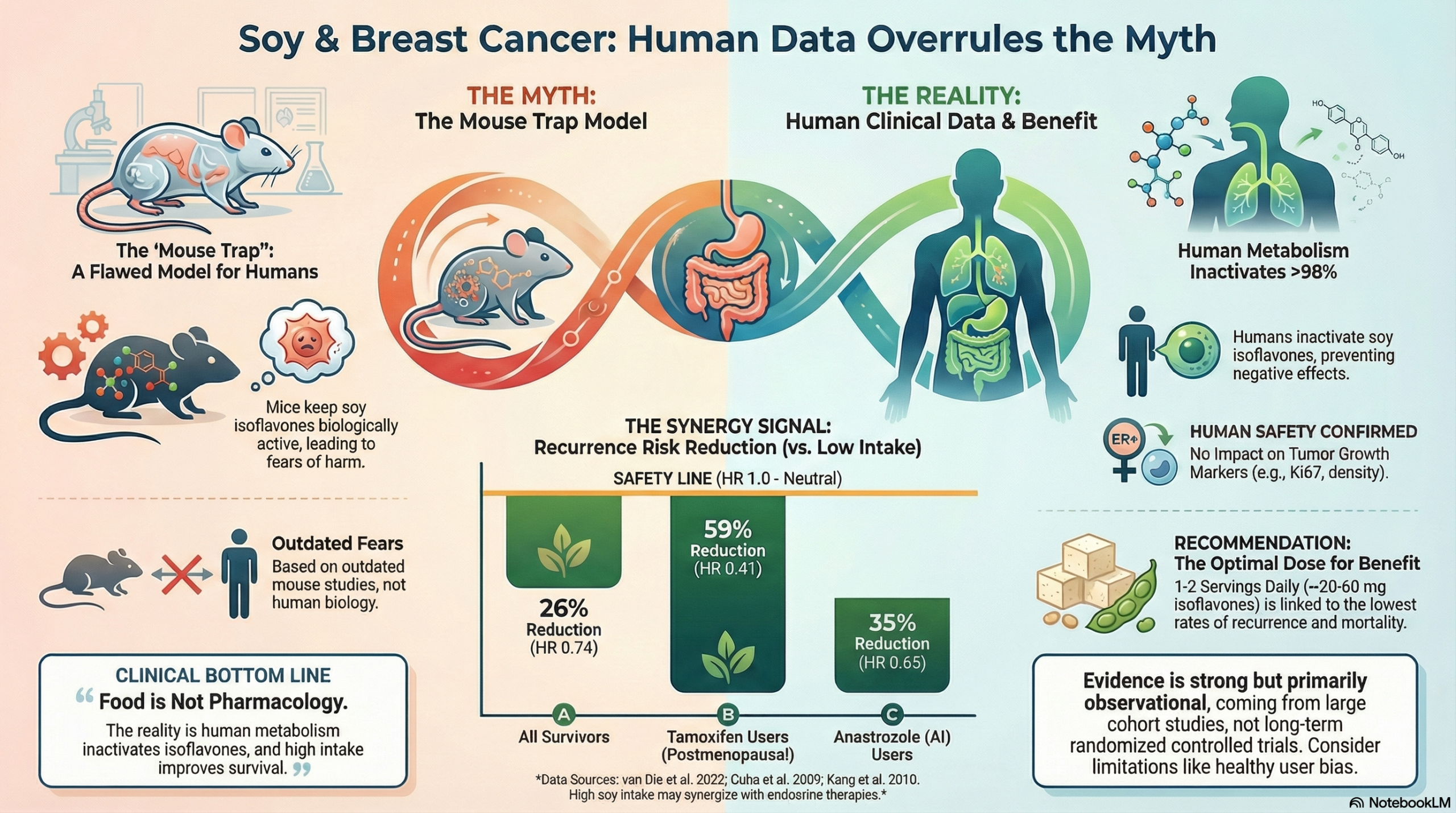
🌱Synthesized Clinical Bottom Line
updated 11-15-2025
The provided body of evidence, including two meta-analyses and several large prospective cohort studies, indicates that post-diagnosis soy food consumption is safe and likely beneficial for breast cancer survivors. Contrary to long-standing concerns fueled by inapplicable mouse models, the human data consistently show that moderate soy intake is associated with a significant reduction in breast cancer recurrence and mortality. This protective effect is most clearly demonstrated in postmenopausal women and, critically, is present in patients with estrogen receptor-positive (ER-positive) tumors. Furthermore, the evidence indicates soy consumption does not interfere with the efficacy of endocrine therapies, including tamoxifen and aromatase inhibitors, and may in fact be associated with improved outcomes in women receiving these treatments.
The Wonk Debate – Audio Critique & Clinical Commentary:
Thematic Evidence Analysis
1. Re-evaluating the “Soy Controversy”: Preclinical vs. Human Evidence
The primary concern regarding soy consumption stems from its classification as a “phytoestrogen” and from preclinical studies in athymic mice, which showed that isoflavones (like genistein) could stimulate the growth of ER-positive mammary tumors.
However, the comprehensive 2025 review by Messina & Nechuta provides a critical explanation for why this “soy and breast cancer controversy” is based on a flawed model. The authors point out a key metabolic difference:
-
In mice, a large portion of genistein remains in its biologically active (unconjugated) form, allowing it to stimulate estrogen receptors.
-
In humans, over 98% of circulating isoflavones are rapidly converted into biologically inactive (conjugated) forms.
This fundamental metabolic difference means the mouse model is not an appropriate proxy for human outcomes. Therefore, clinical decisions should be based on the extensive human clinical and epidemiological data, which show a different result.
2. Human Safety: Clinical Trials on Breast Cancer Markers
While no long-term randomized controlled trials (RCTs) have been conducted on soy intake and breast cancer survival, numerous RCTs have tested the safety of isoflavones (from foods and supplements) by measuring intermediate markers of breast cancer risk.
The Messina & Nechuta (2025) review summarizes this evidence:
-
Mammographic Density: An analysis of 14 RCTs found that isoflavone exposure, even at high doses, did not increase mammographic density.
-
Cell Proliferation: An analysis of 6 RCTs found that isoflavone exposure, at doses up to 235 mg/day (far exceeding typical dietary intake), did not increase breast cell proliferation (Ki67), a key marker of cancer progression.
This body of clinical evidence provides a strong signal of safety and does not support the hypothesis that isoflavones exert a harmful estrogen-like effect on human breast tissue.
3. Impact on Recurrence and Mortality in Survivors
The observational evidence from large patient cohorts suggests that soy consumption is not only safe but is associated with improved prognosis.
-
Meta-Analysis Data: The most recent meta-analysis, by van Die et al. (2023), synthesized data from 32 observational studies. It found that women with the highest soy isoflavone intake had a 26% reduced risk of breast cancer recurrence (Hazard Ratio [HR] = 0.74, 95% CI: 0.60–0.92).
-
Large Cohort Data: This finding is strongly supported by the landmark Shanghai Breast Cancer Survival Study (SBCSS) (Shu et al., 2009). This study found that women with the highest soy food intake had a 34% reduction in recurrence (HR 0.66) and a 33% reduction in total mortality (HR 0.67) compared to those with the lowest intake.
-
Geographic Context: A pooled analysis of both US and Chinese cohorts found that a protective effect against recurrence became significant once intake reached ≥ 10 mg/day of isoflavones.
4. Critical Finding: Interaction with Endocrine Therapy
The provided evidence is highly reassuring and suggests that soy consumption may be associated with improved outcomes in women receiving endocrine therapy.
-
Tamoxifen: The data do not support an interference effect.
-
The large SBCSS (Shu et al., 2009) found that the protective effect of soy was present in both tamoxifen users and non-users.
-
The LACE study (Guha et al., 2009) found its only statistically significant protective finding was in postmenopausal tamoxifen users, who had an approximately 59% reduction in recurrence (HR 0.41) at the highest intake levels.
-
-
Aromatase Inhibitors (AIs): The Kang et al. (2010) study found that in postmenopausal women, high soy intake was associated with a significant 35% reduction in recurrence (HR 0.65) in those taking anastrozole.
5. Impact by Tumor Estrogen Receptor (ER) and Menopausal Status
The benefits of soy appear most robust in postmenopausal women and are clearly seen in patients with ER-positive breast cancer.
-
ER Status: The van Die et al. (2023) meta-analysis found a significant risk reduction for recurrence in ER-positive survivors (HR 0.82). The SBCSS (Shu et al., 2009) also found the benefit was evident in both ER-positive and ER-negative tumors.
-
Menopausal Status: The benefit is most consistently demonstrated in postmenopausal women. The van Die et al. (2023) meta-analysis found the recurrence reduction was significant in postmenopausal women (HR 0.72) but not premenopausal women.
6. Guidance on Dose and Source (Foods vs. Supplements)
-
Dose: The data suggest a dose-response benefit.
-
The van Die et al. (2023) meta-analysis identified an optimal dose for recurrence reduction at 60 mg/day and for mortality at 20–40 mg/day.
-
Messina & Nechuta (2025) conclude that two servings of traditional soy foods daily (providing approx. 50 mg isoflavones) is a reasonable, safe, and effective intake recommendation.
-
-
Source (Foods vs. Supplements): Human metabolism inactivates isoflavones similarly from both sources, and most of the clinical safety trials used supplements or isolated soy protein, confirming their safety.
Overall Assessment of the Evidence
The provided collection of evidence is robust and directionally consistent. The evidence strongly refutes the outdated concern that soy is harmful to breast cancer patients. The data from human studies consistently show that moderate soy consumption (20–60 mg/day isoflavones) is safe and associated with a statistically significant and clinically meaningful reduced risk of recurrence and mortality. This benefit extends to, and is perhaps strongest in, the very patients for whom concerns were highest: postmenopausal women with ER-positive tumors and those receiving endocrine therapy.
List of Analyzed Papers
-
van Die, M. D., et al. (2023). Phytonutrients and outcomes following breast cancer: a systematic review and meta-analysis of observational studies. JNCI Cancer Spectrum.
-
Guha, N., et al. (2009). Soy Isoflavones and Risk of Cancer Recurrence in a Cohort of Breast Cancer Survivors: Life After Cancer Epidemiology (LACE) Study. Breast Cancer Research and Treatment.
-
Shu, X. O., et al. (2009). Soy Food Intake and Breast Cancer Survival. JAMA.
-
Zhang, Y. F., et al. (2012). Positive Effects of Soy Isoflavone Food on Survival of Breast Cancer Patients in China. Asian Pacific Journal of Cancer Prevention.
-
Kang, X., et al. (2010). Effect of soy isoflavones on breast cancer recurrence and death for patients receiving adjuvant endocrine therapy. CMAJ.
-
Chen, M., et al. (2014). Association between Soy Isoflavone Intake and Breast Cancer Risk for Pre- and Post-Menopausal Women: A Meta-Analysis of Epidemiological Studies. PLoS ONE.
-
Messina, M., & Nechuta, S. (2025). A Review of the Clinical and Epidemiologic Evidence Relevant to the Impact of Postdiagnosis Isoflavone Intake on Breast Cancer Outcomes. Current Nutrition Reports.
Fair Use & Copyright: This post provides a transformative, thesis‑driven critical appraisal intended for educational and scholarly purposes. It is not a reproduction of, nor a market substitute for, the original research article.
Support the Version of Record: To support the copyright holders and verify the underlying data—including primary survival curves, risk estimates, and other core outcomes—readers are strongly encouraged to access the original Version of Record via the link or DOI provided above.
Medical Disclaimer: This content is for informational and educational purposes only and is not a substitute for professional medical advice, diagnosis, or treatment.