
Comment:
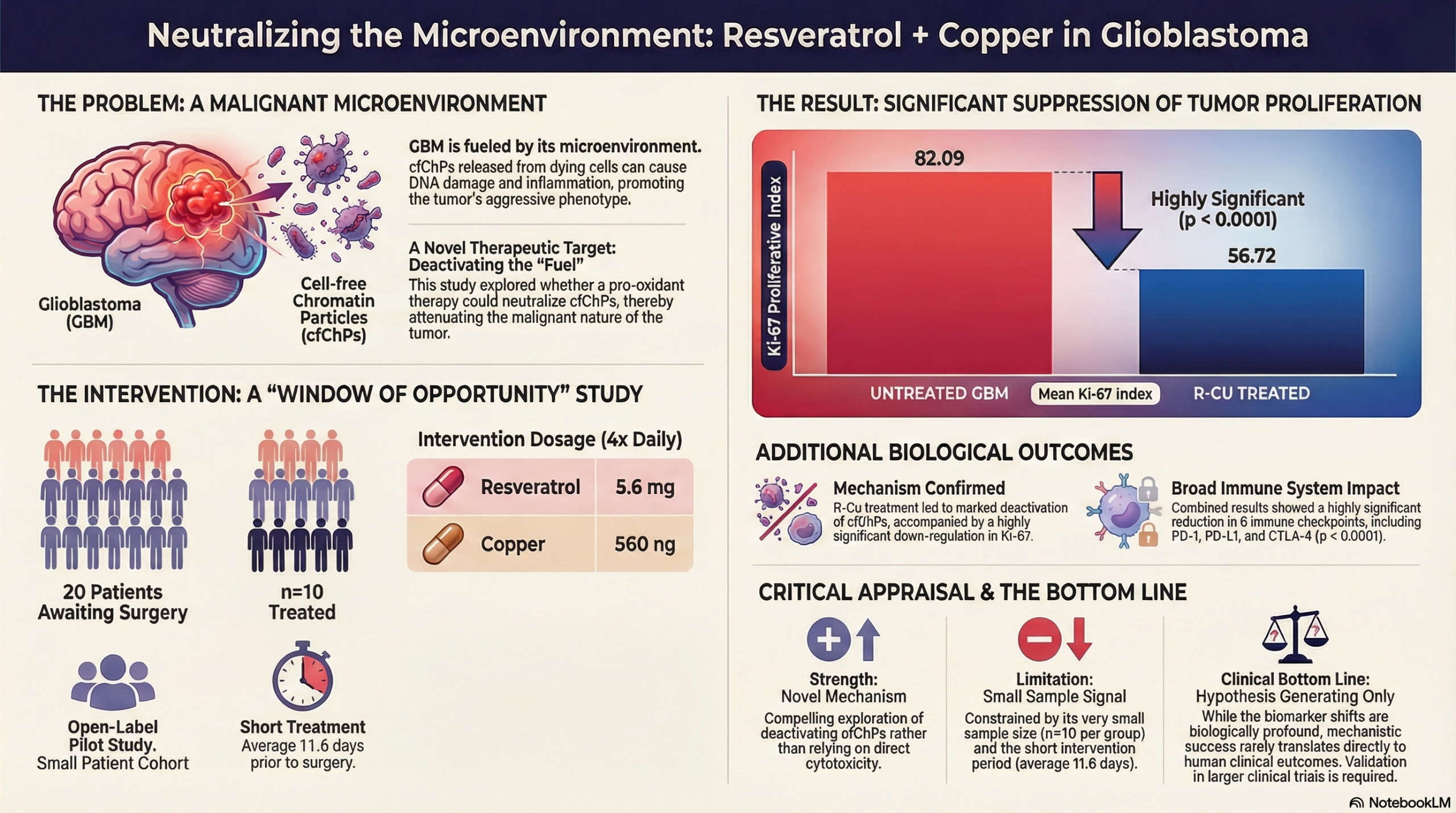
This pilot study offers a compelling glimpse into how targeting the tumor microenvironment (TME) through unconventional mechanisms can yield profound biological results. By utilizing a low-dose, pro-oxidant combination of Resveratrol and Copper, researchers were able to essentially “neutralize” the TME by deactivating cell-free chromatin particles. The downstream biochemical effects were remarkable: a highly significant down-regulation of the proliferation marker Ki-67 and a sweeping suppression of multiple hallmarks of cancer.
And we must maintain a healthy skepticism given the small sample size (n=10) and the short “window of opportunity” design, and quite frankly the extremely low doses used. While the biomarker shifts in this study are biologically profound, we need to remember that mechanistic success rarely translates directly to human clinical outcomes.
The Wonk Debate – Audio Critique & Clinical Commentary:
Summary:
Clinical Bottom Line
This small, open-label biomarker study suggests that a low-dose oral combination of Resveratrol (R) and Copper (Cu) may significantly attenuate the aggressive phenotype of glioblastoma (GBM). The treatment appeared to work by deactivating cell-free chromatin particles (cfChPs) in the tumor microenvironment, leading to a marked down-regulation of proliferation markers (Ki-67), cancer hallmarks, and immune checkpoints. While these results are biologically profound, they are based on a very short treatment duration (avg. 11.6 days) in only 10 treated patients; therefore, the findings must be considered hypothesis-generating and require validation in larger clinical trials to determine if this translates into improved patient survival.
Results in Context
- Main Results: Oral R-Cu treatment led to the virtual elimination of cfChPs from the tumor microenvironment (TME). This was accompanied by a highly significant reduction in the proliferative index Ki-67 (82.09 ± 2.03 in controls vs 56.72 ± 2.33 in treated; p < 0.0001).
- Definitions & Context: The study investigated a prognostic and pharmacodynamic response to a novel therapeutic approach . cfChPs are particles released from dying cells that can integrate into the genomes of healthy bystander cells, causing DNA damage and inflammation. Deactivating these particles is intended to “neutralize” the TME.
- Secondary Biomarker Outcomes:
- Hallmarks of Cancer: 13 out of 15 biomarkers representing 9 hallmarks of cancer were significantly down-regulated (p < 0.0001).
- Immune Checkpoints: Combined results showed a highly significant reduction in 6 immune checkpoints, including PD-1, PD-L1, and CTLA-4 (p < 0.0001).
- Stem Cell Markers: Significant reduction in CD133, CD44, and SOX2 (p < 0.0001).
- Transcriptome Sequencing: RNA-seq revealed a marked upregulation of pro-apoptotic genes and down-regulation of anti-apoptotic genes. It also detected the down-regulation of PVRIG-2P, a functional analogue of PD-L1.
Assertive Critical Appraisal
- Appraisal of Biomarker Claim: The authors claim that R-Cu acts as a pro-oxidant therapy to deactivate cfChPs. While the surrogate markers (Ki-67 and IF staining) showed dramatic shifts, the study was not designed to measure clinical outcomes like progression-free survival or overall survival.
- Reporting Quality Assessment (REMARK):
- Critical Flag: The study is limited by its very small sample size (n=10 per group) and the short duration of the intervention (average 11.6 days).
- Methodology: The use of immunofluorescence on FFPE sections was well-described, but the authors noted that uneven sections occasionally interfered with staining for certain transcription factors like SOX2.
- Blinding: IF analysis was performed in a blinded fashion, which strengthens the reliability of the biomarker quantification.
- Complex RNA-Protein Relationship: The authors observed an “inverse correlation” between gene expression and protein levels for 19 out of 24 markers. They attribute this to efficient proteasomal degradation following R-Cu treatment, but this discordant finding suggests complex regulatory mechanisms that are not yet fully understood.
- Applicability: The treatment uses inexpensive, non-toxic nutraceuticals. However, because this was a pre-surgical window study, it is unknown if these effects persist when combined with standard-of-care treatments like Temozolomide.
Research Objective
To investigate whether oral administration of a Resveratrol-Copper combination can deactivate cfChPs in the tumor microenvironment and attenuate the malignant phenotype of glioblastoma.
Study Design
- Type: Open-label, window-of-opportunity biomarker study.
- Intervention: Bi-layered tablets containing 5.6 mg Resveratrol and 560 ng Copper, administered four times daily on an empty stomach.
- Control: 10 patients awaiting surgery who did not receive R-Cu.
- Analysis: Post-surgical tissue was analyzed via confocal microscopy, immunofluorescence, and whole transcriptome sequencing.
Setting and Participants
- Location: Advanced Centre for Treatment, Research and Education in Cancer (ACTREC), Tata Memorial Centre, India.
- Participants: 20 patients with histologically verified GBM (WHO 2021 classification) awaiting surgery. Groups were evenly balanced for age and sex.
Bibliographic Data
- Title: Attenuation of malignant phenotype of glioblastoma following a short course of the pro-oxidant combination of Resveratrol and Copper
- Authors: Chaitra Bandiwadekar, et al.
- Journal: BJC Reports
- Year: 2025
- DOI: https://doi.org/10.1038/s44276-025-00177-8
Original Article:
Full text: PubMed Central
Fair Use & Copyright: This post provides a transformative, thesis‑driven critical appraisal intended for educational and scholarly purposes. It is not a reproduction of, nor a market substitute for, the original research article.
Support the Version of Record: To support the copyright holders and verify the underlying data—including primary survival curves, risk estimates, and other core outcomes—readers are strongly encouraged to access the original Version of Record via the link or DOI provided above.
Medical Disclaimer: This content is for informational and educational purposes only and is not a substitute for professional medical advice, diagnosis, or treatment.