
Audio Overview:
Statistical Concept Definition
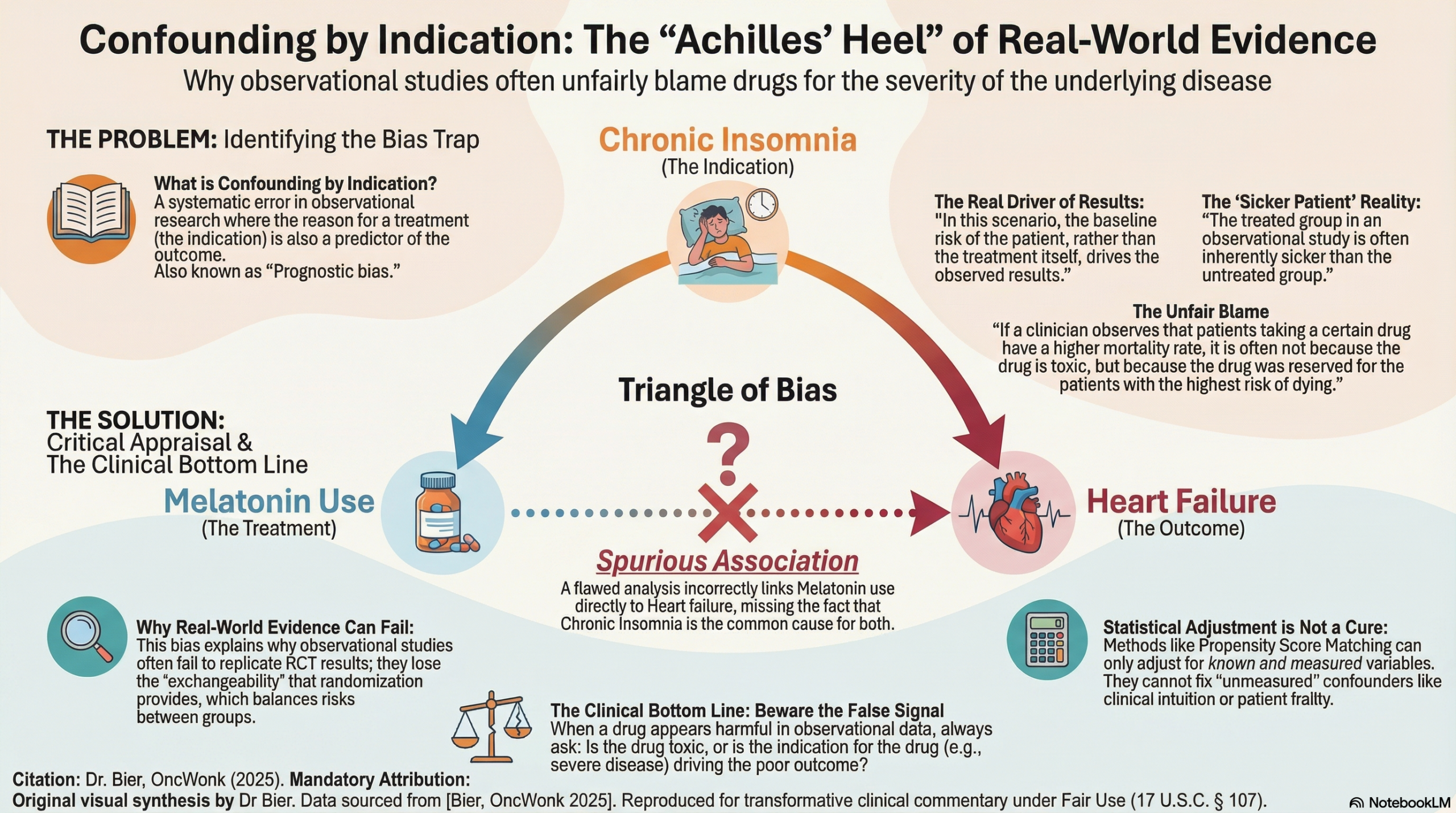
Confounding by indication (also known as “prognostic bias” or “susceptibility bias”) is a systematic error prevalent in observational research where the clinical reason for a treatment—the indication—is also a predictor of the outcome. In this scenario, the baseline risk of the patient, rather than the treatment itself, drives the observed results.
Clinical Significance
This concept is the “Achilles’ heel” of real-world evidence. In clinical practice, physicians do not prescribe medications at random; they prescribe based on disease severity, comorbidities, and prognosis. Therefore, the “treated” group in an observational study is often inherently sicker than the “untreated” group.
If a clinician observes that patients taking a certain drug have a higher mortality rate, it is often not because the drug is toxic, but because the drug was reserved for the patients with the highest risk of dying. Without randomization to balance these risks, the drug is unfairly “blamed” for the natural progression of the underlying disease.
Critical Appraisal Guide
When reviewing a non-randomized study, apply the following steps to evaluate this bias:
-
Examine Baseline Balance (Table 1): In an RCT, according to CONSORT guidelines, baseline characteristics should be balanced. In observational studies, look for significant differences in disease severity or markers of frailty between groups.
-
Assess Adjustment Techniques: Verify if authors used Multivariable Regression or Propensity Score Matching to “level the playing field.” However, remain skeptical: these methods only adjust for known and measured variables.
-
Evaluate for Residual Confounding: Always consider “unmeasured” confounders—factors like “clinical intuition” or “frailty” that are rarely captured in medical databases but influence both the prescription and the outcome.
Common Misinterpretations
-
The Efficacy vs. Effectiveness Trap: Readers often assume that observational studies provide better “real-world” data. While they provide larger scale, they lose the “exchangeability” of patients that randomization provides.
-
Assuming Adjustment is Cure: Statistical adjustment is a “correction,” not a “cure.” If the indication for a drug is strongly linked to the outcome (e.g., prescribing palliative morphine to patients near death), no amount of adjustment can truly separate the drug’s effect from the patient’s terminal status.
Clinical Case Study: Melatonin and Heart Failure
Consider the abstract investigating long-term melatonin supplementation and the incidence of heart failure (HF) in patients with insomnia.
-
The Observation: The study might show a correlation between melatonin use and increased HF risk.
-
The Indication: Melatonin is prescribed for insomnia.
-
The Confounder: Chronic insomnia is a physiological stressor linked to sympathetic nervous system overactivity and hypertension, both of which are independent risk factors for heart failure.
In this scenario, confounding by indication suggests that melatonin is merely a marker for severe, chronic sleep disturbance. The “indication” (insomnia) is the true driver of the heart failure, but the drug (melatonin) appears associated because it is the treatment for that indication. To determine if melatonin is truly harmful, we would require an RCT where patients with identical insomnia severity are randomized to melatonin or placebo, thereby “breaking” the link between the indication and the treatment choice.
Fair Use & Copyright: This post provides a transformative, thesis‑driven critical appraisal intended for educational and scholarly purposes. It is not a reproduction of, nor a market substitute for, the original research article.
Support the Version of Record: To support the copyright holders and verify the underlying data—including primary survival curves, risk estimates, and other core outcomes—readers are strongly encouraged to access the original Version of Record via the link or DOI provided above.
Medical Disclaimer: This content is for informational and educational purposes only and is not a substitute for professional medical advice, diagnosis, or treatment.