
Comment:
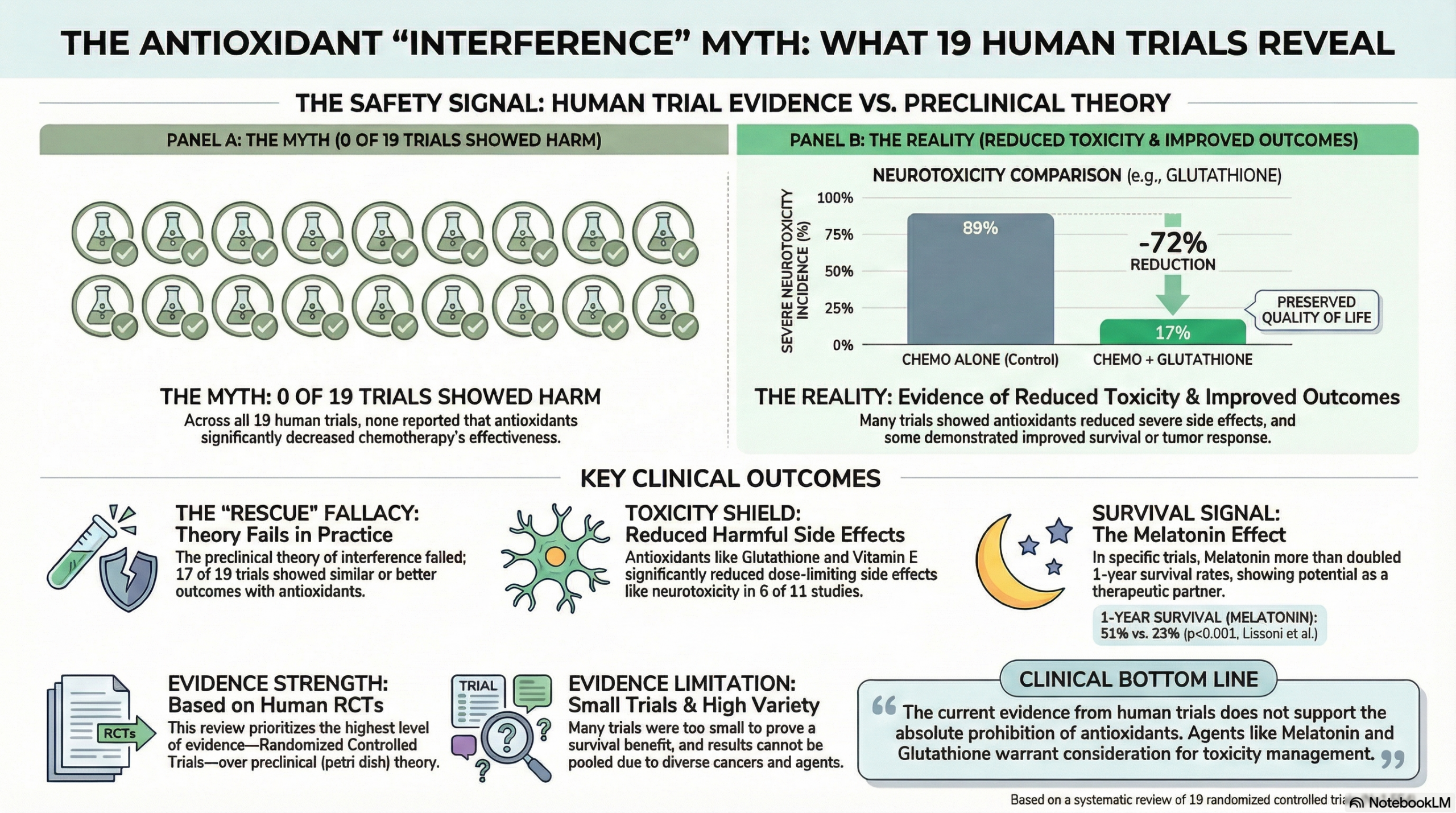
This systematic review serves as a definitive corrective to the long-standing dogma against concurrent antioxidant use with chemotherapy. Patients still come in being told that antioxidants might ‘rescue’ tumor cells from chemotherapy, almost completely from preclinical models. However, these findings remind us why Randomized Controlled Trials are the ultimate arbiter. When tested in actual patients, that theoretical interference fails to materialize. Instead, the high-level human data shows preserved efficacy and reduced toxicity.
The Wonk Debate – Audio Critique & Clinical Commentary:
Summary:
Clinical Bottom Line
This systematic review found no evidence that antioxidant supplementation reduces the efficacy of chemotherapy in patients with advanced or relapsed cancer. Conversely, the majority of included trials (17 of 19) suggested that antioxidants may improve survival, tumor response, or both, while significantly reducing dose-limiting toxicities such as neurotoxicity. While these findings are promising, the clinical impact is tempered by the fact that many included studies were small and lacked the statistical power to definitively confirm improvements in survival or response.
Results
-
Summary of Results: Of the 19 randomized controlled trials (RCTs) evaluated, none reported a significant decrease in chemotherapy efficacy due to antioxidant use.
-
Survival: 13 studies reported survival data; all showed similar or better outcomes in the antioxidant group, with four reaching statistical significance.
-
Tumor Response: 17 studies reported overall response rates; 16 showed similar or better results in the antioxidant group.
-
Toxicity Mitigation: 15 of 17 studies reporting general toxicities showed reduced or similar side effects. Notably, 6 of 11 studies investigating neurotoxicity reported statistically significant reductions.
-
Definitions: A systematic review is a high-level summary of primary research on a focused clinical question that identifies, selects, assesses, and summarizes all high-quality evidence.
Assertive Critical Appraisal
-
Certainty of Evidence (GRADE Framework): The overall certainty of evidence is Low to Moderate. While the findings are consistent across many trials, the evidence is downgraded due to:
-
Imprecision: Many studies had small sample sizes (e.g., n = 20 to n = 30), leading to a lack of statistical power to detect modest differences in survival.
-
Risk of Bias: Only four studies utilized double-blinding, and many had low Jadad scores, increasing the risk of performance and detection bias.
-
Heterogeneity: A meta-analysis was not performed because of high heterogeneity in tumor types (ranging from lung to ovarian cancer) and varying treatment protocols.
-
Publication Bias: The authors performed duplicate independent searches to minimize bias, but noted that the preferential publication of positive trials (publication bias) cannot be entirely excluded.
-
Special Consideration for Pooled Results: Although a formal meta-analysis was avoided, the review highlights that while individual small studies might not show significant survival benefits, the consistent trend across multiple trials suggests a real effect that larger, well-powered studies might confirm.
-
Reporting Quality Assessment (PRISMA): The review includes a clear flow chart (Figure 1) detailing the exclusion of 826 articles, which enhances transparency. However, the dependence on written reports alone for quality assessment is a noted limitation.
Research Objective
-
PICO:
-
Population: Cancer patients undergoing chemotherapy.
-
Intervention: Concurrent antioxidant supplementation (e.g., glutathione, melatonin, vitamins A, C, E).
-
Comparison: Chemotherapy alone or with placebo.
-
Outcome: Survival, tumor response, and toxicity mitigation.
-
Study Design
-
Search Strategy: MEDLINE, Cochrane, CinAhl, AMED, AltHealthWatch, and EMBASE were searched from inception to December 2006.
-
Selection Criteria: Only randomized controlled trials reporting survival and/or tumor response were included.
Setting and Participants
-
Total Included: 19 RCTs involving 1,554 patients.
-
Patient Profile: Most subjects had advanced or relapsed disease.
Bibliographic Data
-
Title: Impact of antioxidant supplementation on chemotherapeutic efficacy: A systematic review of the evidence from randomized controlled trials
-
Authors: Keith I. Block, Amanda C. Koch, Mark N. Mead, Peter K. Tothy, Robert A. Newman, Charlotte Gyllenhaal
-
Journal: Cancer Treatment Reviews
-
Year: 2007
Fair Use & Copyright: This post provides a transformative, thesis‑driven critical appraisal intended for educational and scholarly purposes. It is not a reproduction of, nor a market substitute for, the original research article.
Support the Version of Record: To support the copyright holders and verify the underlying data—including primary survival curves, risk estimates, and other core outcomes—readers are strongly encouraged to access the original Version of Record via the link or DOI provided above.
Medical Disclaimer: This content is for informational and educational purposes only and is not a substitute for professional medical advice, diagnosis, or treatment.