
Comment:
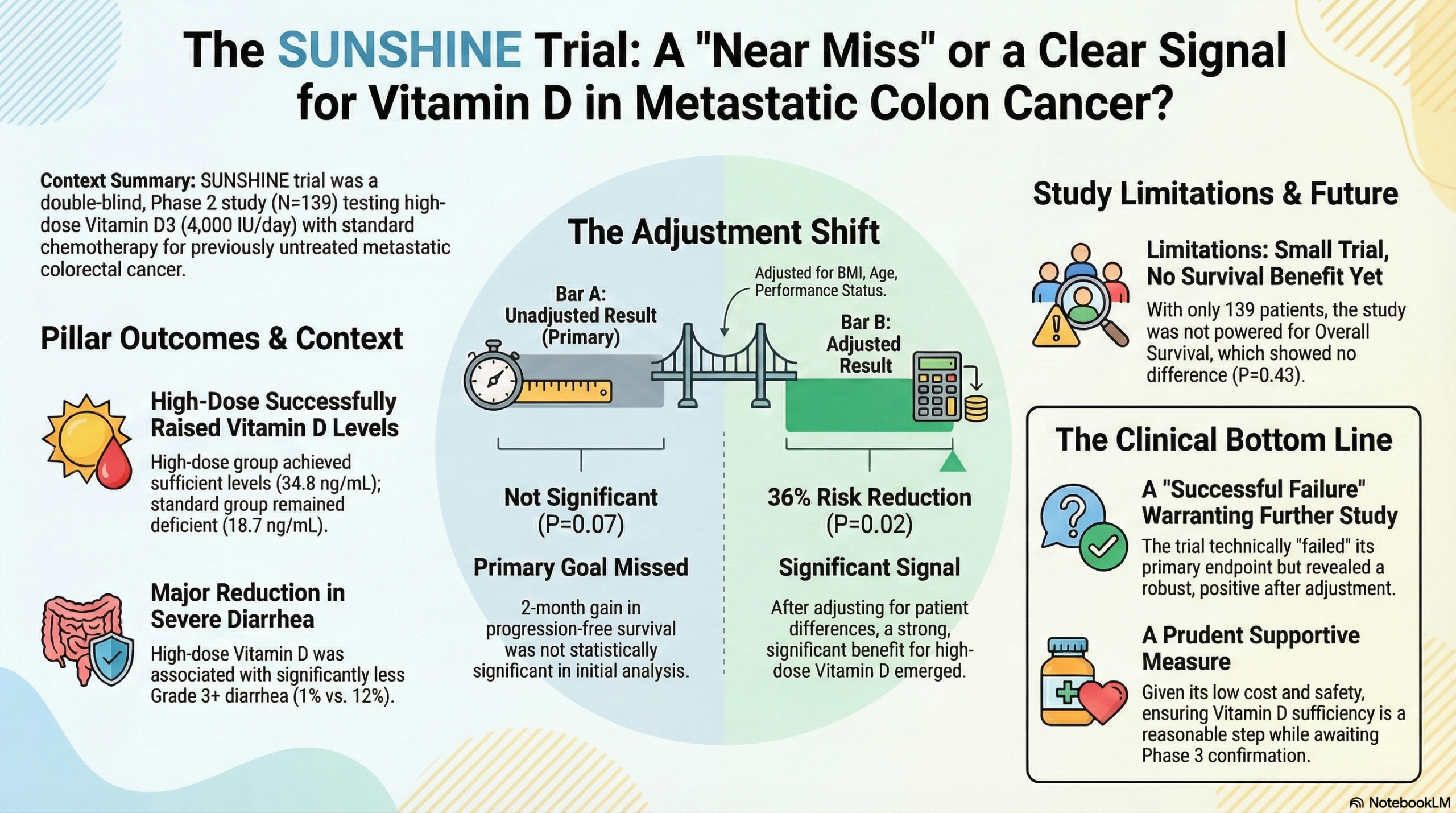
These findings are another, again highlight the massive, untapped potential of nutritional synergy with conventional treatment. Adding just 4,000 IU of Vitamin D3 didn’t just improve serum levels,; it translated to a tangible clinical victory—a 36% reduction in the risk of progression or death. This indicates that Vitamin D acts as a ‘force multiplier’ for chemotherapy, enhancing efficacy while simultaneously protecting the patient from side effects.
One of the amazing things about these findings is that the benefits in survival were seen at a fairly low level – 32ng/mL. This meta-analysis showed the benefits only came in around 50ng/mL, so I dose whatever is necessary to get into the higher end normal range. I don’t consider 4,000IU high-dose as it often takes more than double that to normalize levels.
The Wonk Debate – Audio Critique & Clinical Commentary:
Summary:
Clinical Bottom Line
This phase 2 trial (SUNSHINE) suggests that adding high-dose vitamin D3 to standard chemotherapy may improve outcomes for patients with metastatic colorectal cancer. While the study did not reach statistical significance for its primary endpoint of median progression-free survival (PFS) improvement (13.0 vs 11.0 months; P=.07), the multivariable hazard ratio showed a significant 36% reduction in the risk of disease progression or death (HR 0.64; P=.02). These findings are promising and warrant confirmation in a larger phase 3 trial.
Results in Context
- Primary Outcome: The median progression-free survival was 13.0 months for the high-dose group compared to 11.0 months for the standard-dose group. The unadjusted log-rank test resulted in a P value of .07, which exceeded the pre-specified 1-sided significance level of .05. However, a supportive multivariable Cox proportional hazards model—adjusting for age, sex, race, BMI, performance status, and metastatic sites—yielded a hazard ratio of 0.64 (95% CI, 0–0.90; P=.02), suggesting a significant benefit when accounting for baseline differences.
- Key Secondary & Specialized Outcomes:
- Oncology Endpoints: The tumor objective response rate (ORR) was similar between groups (58% high-dose vs 63% standard-dose; P=.27). Overall survival (OS) data were immature, with no significant difference observed at the time of analysis (median 24.3 months for both; P=.43).
- Vitamin D Levels: High-dose supplementation successfully raised median plasma 25(OH)D levels from a deficient baseline of 16.1~ng/mL to a sufficient level of 32.0~ng/mL at first restaging (P<.001). The standard-dose group remained deficient throughout the study (median 18.7~ng/mL at first restaging).
- Harms and Adverse Events: Grade 3 or higher adverse events were generally balanced. The most common were neutropenia (35% high-dose vs 31% standard-dose) and hypertension (13% vs 16%). Notably, high-dose vitamin D3 was associated with a lower incidence of grade 3+ diarrhea (1% vs 12%). No cases of hypercalcemia were observed.
Assertive Critical Appraisal
- Risk of Bias (RoB 2 Framework): Low. The study employed a double-blind, randomized design with identical-appearing capsules and central randomization. Adherence was high (median 98%), and loss to follow-up was minimal.
- Subgroup Analyses: Exploratory analysis suggested that the benefit of high-dose vitamin D3 was more pronounced in patients with a lower BMI (P=.04 for interaction) and those with KRAS wild-type tumors (P=.04 for interaction). As these are subgroup findings, they should be considered hypothesis-generating.
- Reporting Quality Assessment (CONSORT): High quality. The paper includes a participant flow diagram (Figure 1), clearly defined eligibility criteria, and detailed descriptions of randomization and blinding.
- Applicability: The trial was conducted at both academic and community cancer centers in the US, enhancing its relevance to general clinical practice. However, the sample size was relatively small (n=139), and there was a lack of racial diversity (75-79% white), which may limit generalizability to all populations.
Research Objective
To determine if adding high-dose vitamin D3 to standard chemotherapy improves progression-free survival in patients with previously untreated metastatic colorectal cancer.
Study Design
- Type: Double-blind, phase 2 randomized clinical trial.
- Intervention: Patients received mFOLFOX6 plus bevacizumab every 2 weeks combined with either high-dose vitamin D3 (8000~IU/d loading dose for cycle 1, then 4000~IU/d) or standard-dose vitamin D3 (400~IU/d).
- Participants: 139 patients with advanced or metastatic CRC.
Bibliographic Data
- Title: Effect of High-Dose vs Standard-Dose Vitamin D3 Supplementation on Progression-Free Survival Among Patients With Advanced or Metastatic Colorectal Cancer: The SUNSHINE Randomized Clinical Trial
- Authors: Kimmie Ng, Halla S. Nimeiri, Nadine J. McCleary, et al.
- Journal: JAMA
- Year: 2019
- DOI: 10.1001/jama.2019.2402
Fair Use & Copyright: This post provides a transformative, thesis‑driven critical appraisal intended for educational and scholarly purposes. It is not a reproduction of, nor a market substitute for, the original research article.
Support the Version of Record: To support the copyright holders and verify the underlying data—including primary survival curves, risk estimates, and other core outcomes—readers are strongly encouraged to access the original Version of Record via the link or DOI provided above.
Medical Disclaimer: This content is for informational and educational purposes only and is not a substitute for professional medical advice, diagnosis, or treatment.