
Comment:
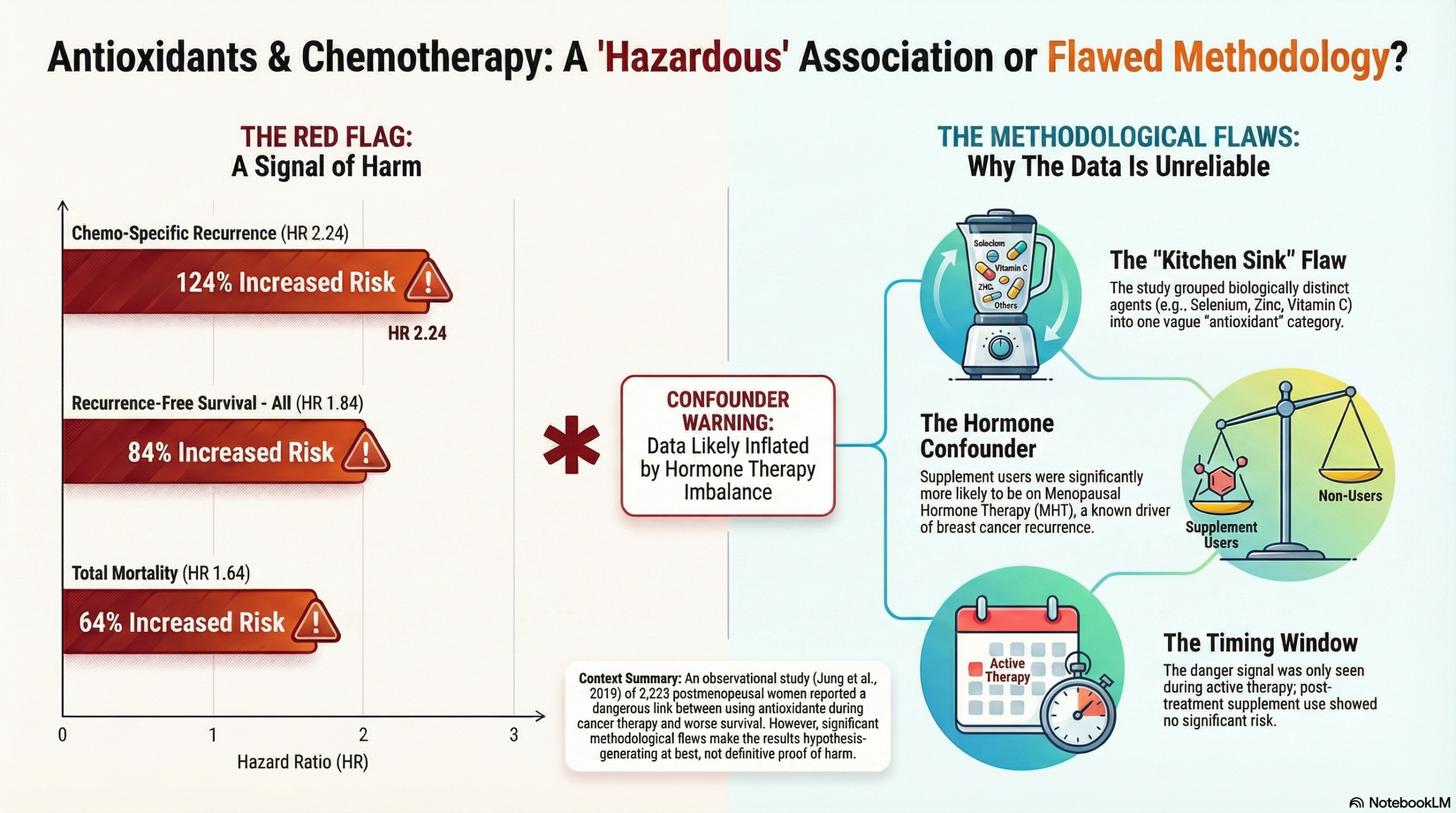
While the headline of this study suggests a clear danger, the methodology reveals significant issues which makes the results difficult to trust. They ‘lump’ biologically distinct agents—grouping trace minerals like selenium with high-dose Vitamin C—which renders the ‘antioxidant’ variable clinically meaningless. This is the same mistake done in this trial, which is really a sloppy way to try and get significance when you really want it to be, but the study is underpowered and doesn’t find any.
Second, and perhaps more damning, is the significant imbalance in Menopausal Hormone Therapy (MHT) use. Since the supplement group was far more likely to be on MHT, a significant driver of recurrence, these findings likely capture the risk of hormone therapy rather than any impact of a broad class of ‘antioxidants’.
The Wonk Debate – Audio Critique & Clinical Commentary:
Summary:
Clinical Bottom Line
While this study reports a significant association between concurrent antioxidant use during chemotherapy or radiation and worsened survival/recurrence, the findings should be viewed as hypothesis-generating rather than definitive. Serious methodological limitations—most notably the grouping of biologically distinct supplements (e.g., selenium vs. vitamin C) into a single category and a significant imbalance in menopausal hormone therapy (MHT) use—prevent a firm conclusion. While it is prudent for clinicians to discuss the potential for antioxidants to interfere with the oxidative mechanisms of cytotoxic therapy, this observational data alone does not prove harm.
Results in Context
- Primary Outcome Analysis: Concurrent antioxidant use (for ≥ 1 month) during chemotherapy or radiation was associated with an increased risk of total mortality (HR: 1.64; 95% CI: 1.01, 2.66) and worsened recurrence-free survival (HR: 1.84; 95% CI: 1.26, 2.68).
- Impact of Chemotherapy: Among women specifically undergoing chemotherapy, concurrent antioxidant use was linked to a significantly higher risk of recurrence (HR: 2.24; 95% CI: 1.39, 3.63).
- Statistical Definitions: A Hazard Ratio (HR) of 1.84 suggests an 84% increase in the “hazard” of an event over time compared to the reference group; however, the lower bound of the 95% CI (1.26) indicates the true effect could be much smaller.
- Non-Antioxidant Findings: Postdiagnosis use of magnesium or calcium, whether used individually or currently at follow-up, showed no significant association with mortality or recurrence.
Assertive Critical Appraisal
- Limitations & Bias (STROBE Framework):
- High Risk of Confounding by MHT: A critical flaw in the study’s patient distribution is that supplement users were significantly more likely to be taking menopausal hormone therapy (MHT) at diagnosis (51.1% vs 46.3% for non-users; p = 0.03). Because MHT is a established risk factor for breast cancer, this baseline imbalance may have skewed the survival data, making it difficult to isolate the effect of the antioxidants themselves.
- Biological Overgeneralization: The researchers combined selenium, multivitamins, zinc, and vitamins A, C, and E into one “antioxidant” variable to maintain statistical power. This ignores the vastly different pharmacokinetics and biological roles of these substances; for example, the impact of high-dose Vitamin C on chemotherapy may differ radically from that of trace minerals like Zinc or Selenium.
- Recall Bias: Exposure data was collected a median of 5.8 years after diagnosis. Relying on a patient’s memory of their supplement use during active treatment years prior introduces significant potential for misclassification, which can either attenuate or falsely inflate risk estimates.
- Reporting Quality Assessment (STROBE): The authors used a delayed-entry Cox proportional hazard model to account for the time elapsed between diagnosis and the follow-up interview, which is a robust approach for this study design. However, the lack of dose and frequency data for the supplements limits the ability to establish a dose-response relationship.
- Applicability: The findings are limited to postmenopausal women in Germany. Given the relatively low prevalence of supplement use in this population (45%) compared to the US (~80%), these results may not be directly generalizable to high-supplement-use populations where doses may also be higher.
Research Objective
To examine the prevalence of dietary supplement use in postmenopausal breast cancer survivors and investigate whether antioxidant use during chemotherapy or radiation therapy is associated with worsened prognosis (mortality and recurrence).
Study Design
- Type: Population-based prospective cohort study (MARIE study).
- Participants: 2,223 women diagnosed with non-metastatic (Stage 0–III) breast cancer.
- Timing: Recruitment occurred in 2002–2005, with follow-up re-interviews in 2009 and vital status monitoring through June 2015.
Bibliographic Data
- Title: Antioxidant supplementation and breast cancer prognosis in postmenopausal women undergoing chemotherapy and radiation therapy
- Authors: Audrey Y Jung, Xinting Cai, Kathrin Thoene, et al.
- Journal: American Journal of Clinical Nutrition
- Year: 2019
- DOI: 10.1093/ajcn/nqy223
Fair Use & Copyright: This post provides a transformative, thesis‑driven critical appraisal intended for educational and scholarly purposes. It is not a reproduction of, nor a market substitute for, the original research article.
Support the Version of Record: To support the copyright holders and verify the underlying data—including primary survival curves, risk estimates, and other core outcomes—readers are strongly encouraged to access the original Version of Record via the link or DOI provided above.
Medical Disclaimer: This content is for informational and educational purposes only and is not a substitute for professional medical advice, diagnosis, or treatment.