
Comment:
This review maps the landscape of metformin trials and ultimately highlights the lack of evidence for its routine use.
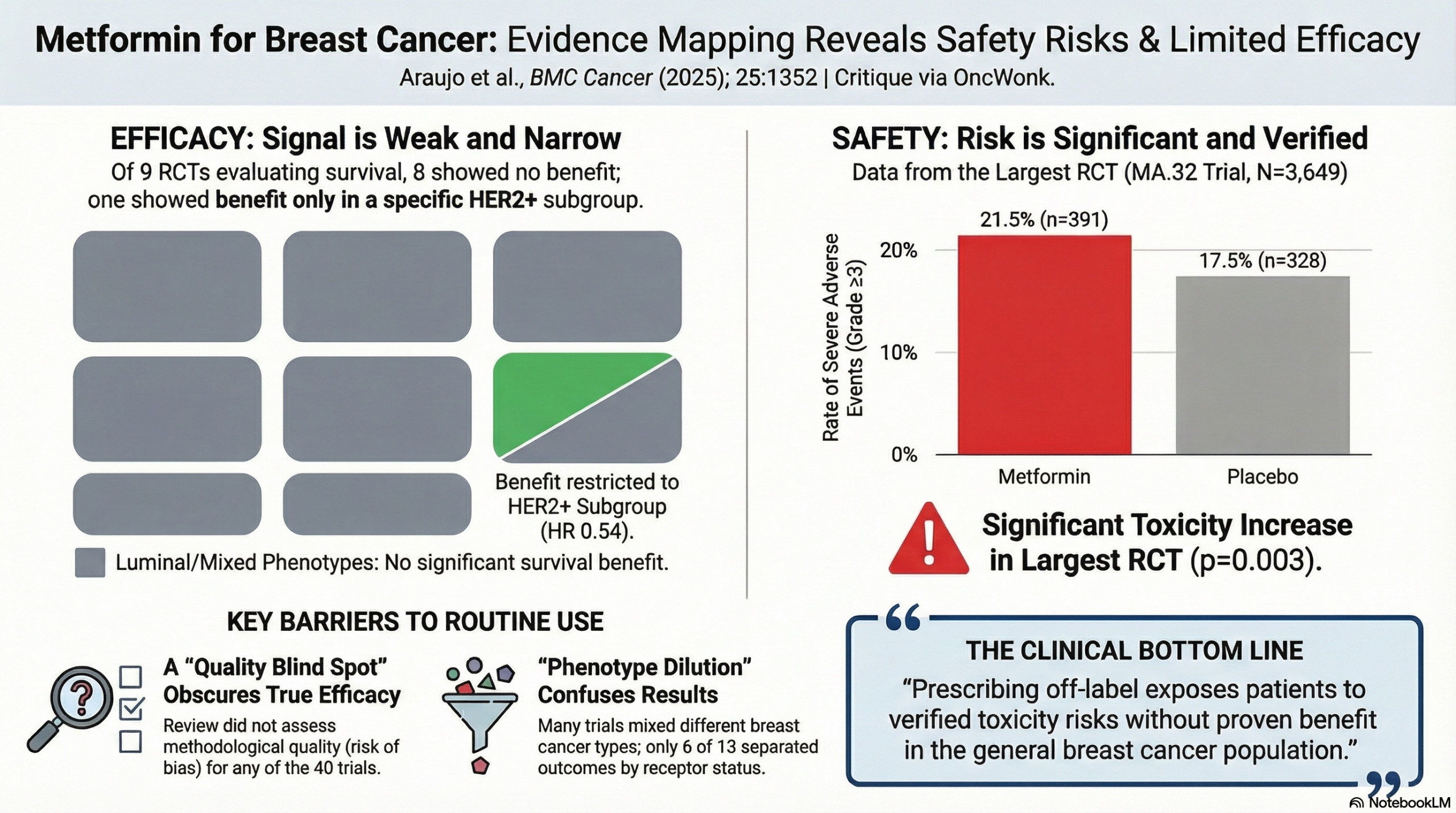
Only one trial (NCIC CTG MA.32) showed a survival benefit, and strictly within the HER2+ subgroup. Critically, the review lacks a risk-of-bias assessment, complicating the interpretation of smaller ‘positive’ studies. Furthermore, the largest trial reported significantly higher rates of Grade 3 adverse events (e.g., hypertension, diarrhea) with metformin. The repurposed drug movement often downplays the risks of ‘safe’ FDA-approved medications. However, as this study (and others) ata show, when combined with chemotherapy, these drugs can introduce significant, verified toxicity.
The Wonk Debate – Audio Critique & Clinical Commentary:
Summary:
Clinical Bottom Line:
This scoping review maps the landscape of 40 randomized clinical trials (RCTs) investigating metformin for breast cancer. It identifies a critical gap in the literature: the majority of trials do not stratify results by breast cancer phenotype (Luminal, HER2+, Triple-Negative), obscuring potential subgroup benefits. While no meta-analysis was performed due to significant clinical heterogeneity, the review highlights isolated evidence from a single large RCT (NCIC CTG MA.32) suggesting a potential survival benefit specifically in HER2+ patients, but not in others. Consequently, there is currently insufficient evidence to support the routine use of metformin for breast cancer treatment, and future research must adopt phenotype-specific reporting standards.
Results in Context
Summary of Results
- Scope: The review identified 40 RCTs (122 reports) comprising a total of 5,623 participants.
- Phenotype Reporting Gap: The primary finding is a lack of granular data. Most studies (13 mixed-population trials) did not present results according to breast cancer phenotype. Only six studies reported relevant clinical outcomes (e.g., pCR, OS) by hormone/HER2 receptor subgroups.
- Overall Survival (OS): Nine studies evaluated OS. Only one study (NCIC CTG MA.32) demonstrated a benefit, and this was restricted to the HER2+ subgroup (HR=0.54; 95% CI: 0.30-0.98; P=0.04). No benefit was observed in the overall mixed population or Luminal phenotypes in that study.
- Disease-Free Survival (DFS): Seven studies evaluated DFS. Two reported positive results:
- NCIC CTG MA.32: Improved DFS in HER2+ participants (HR=0.64; 95% CI: 0.43-0.95; P=0.03).
- El-Haggar et al.: In a mixed population, metformin was associated with an improved DFS (HR=0.31; 95% CI: 0.11-0.86; P=0.023) after adjustment for confounders.
- Pathological Complete Response (pCR): Eight studies reported pCR results. Only one small study (Liubota, N=72) reported a positive result in a mixed population (p<0.05).
Adverse Events
- Metformin was generally well tolerated. However, the largest trial (NCIC CTG MA.32) noted a significantly higher rate of Grade 3 or higher adverse events in the metformin arm compared to placebo (21.5% vs 17.5%, P=0.003), specifically hypertension, irregular menses, and diarrhea.
Assertive Critical Appraisal
Certainty of Evidence & Study limitations
- Lack of Quantitative Synthesis: The authors did not perform a meta-analysis. They correctly identified that the clinical heterogeneity (varying tumor stages, phenotypes, and concurrent treatments) would likely render a pooled estimate meaningless or biased. While methodologically sound for a scoping review, this limits the ability to provide a precise estimate of the treatment effect size for the general clinician.
- Risk of Bias Assessment (Omitted): A major limitation of this review is the complete absence of quality appraisal for the included RCTs. The authors explicitly state they did not appraise the methodological quality (Risk of Bias) of the included articles, citing alignment with scoping review expectations. This is a critical omission for clinical interpretation; we do not know if the few “positive” small studies (e.g., Liubota, El-Haggar) had fatal methodological flaws compared to the larger, negative trials.
Reporting Quality Assessment (PRISMA-ScR)
- The review adhered to the PRISMA Extension for Scoping Reviews (PRISMA-ScR) guidelines.
- Strengths: The search strategy was comprehensive, including gray literature and clinical trial registries, and covered multiple databases without language or date restrictions. The authors provided a clear flow diagram.
- Weaknesses: As noted, the lack of risk of bias assessment prevents a determination of the reliability of the mapped evidence.
Applicability
- The review identifies that current evidence is insufficient to recommend metformin as an adjuvant breast cancer treatment. The findings are most applicable to researchers designing future trials, emphasizing the necessity of stratifying by phenotype (Luminal A/B, HER2+, TNBC) to detect potential subgroup-specific efficacy.
Research Objective
To comprehensively map the literature of RCTs regarding the use of metformin in the treatment of breast cancer, specifically examining phenotypes, stages, treatment modalities, and outcomes.
Study Design
- Design: Systematic Scoping Review.
- Search Strategy: Searched MEDLINE, EMBASE, LILACS, Web of Science, CENTRAL, and gray literature up to September 2023.
- Selection: Two independent reviewers screened and extracted data.
Setting and Participants
- Total Included: 40 RCTs comprising 122 reports.
- Population: 5,623 adult participants with breast cancer (all phenotypes and stages included).
- Interventions: Metformin (alone or in combination with chemotherapy/hormone therapy/lifestyle interventions) vs. placebo, standard care, or other comparators.
Bibliographic Data
- Title: Metformin for the treatment of breast cancer: a scoping review of randomized clinical trials
- Authors: Araujo CFM, Nunes LC, Murta-Nascimento C, et al.
- Journal: BMC Cancer
- Year: 2025
- DOI: 10.1186/s12885-025-14468-3
Original Article:
Full text: PubMed Central
Fair Use & Copyright: This post provides a transformative, thesis‑driven critical appraisal intended for educational and scholarly purposes. It is not a reproduction of, nor a market substitute for, the original research article.
Support the Version of Record: To support the copyright holders and verify the underlying data—including primary survival curves, risk estimates, and other core outcomes—readers are strongly encouraged to access the original Version of Record via the link or DOI provided above.
Medical Disclaimer: This content is for informational and educational purposes only and is not a substitute for professional medical advice, diagnosis, or treatment.