
🍏Comment:
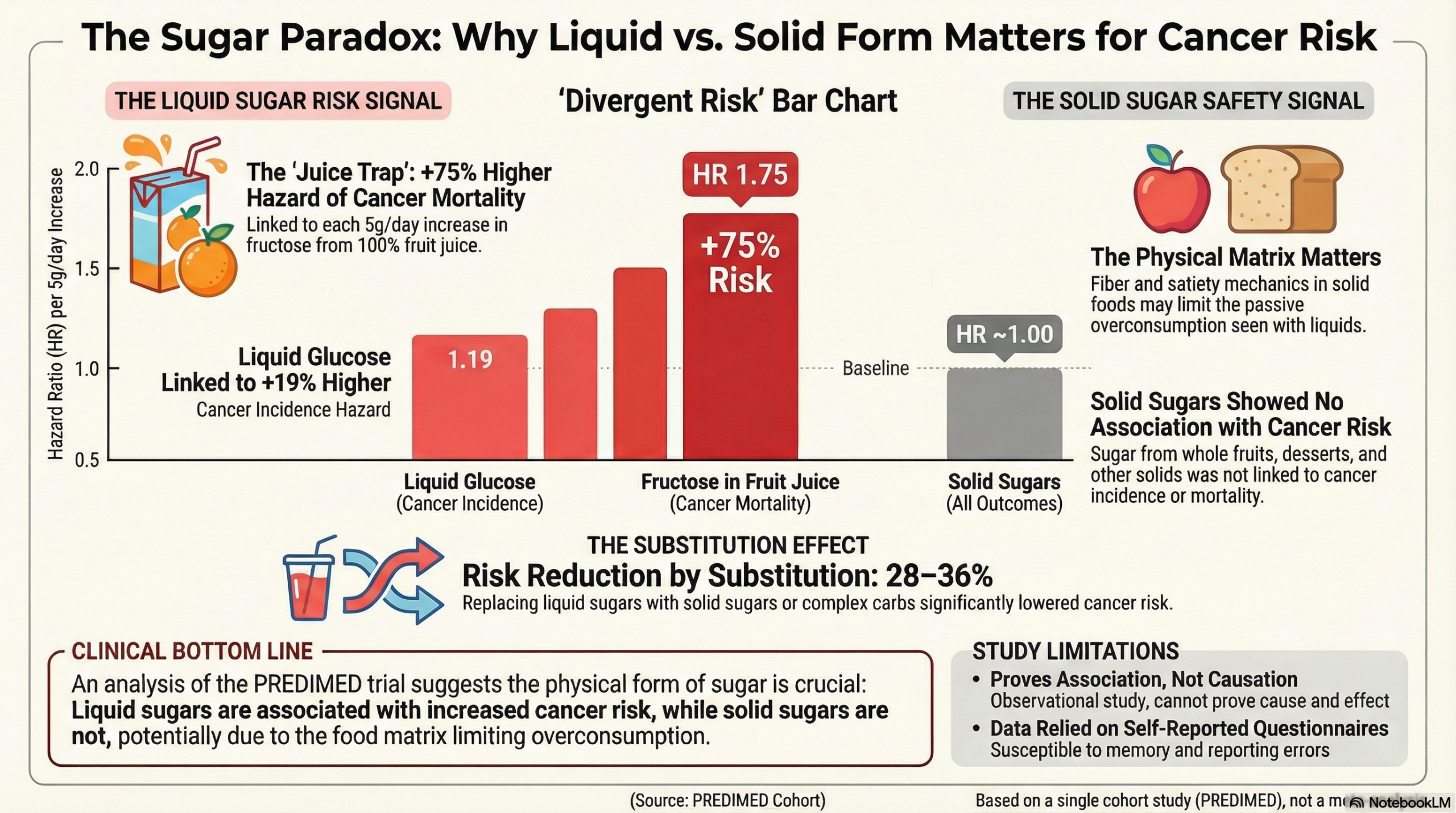
This study, stemming from the PREDIMED trial, suggest that it’s not the total amount of simple sugar that seems to drive cancer risk and mortality in this high-risk population, but the physical form it’s consumed in. It isolates liquid sugars (like those in fruit juice and presumably sugary drinks) as the significant culprits, with a higher intake being associated with an increased risk for cancer incidence and all-cause mortality.
I’ve been saying that sugar is sugar, whether from white or fruit, which this study supports. Fructose from fruit juice, which was linked to a 75% higher hazard of cancer mortality for every 5 g/day increase.
This 5 g/day increase is alarmingly easy to hit:
| Fruit Juice (100% unless noted) | Fructose (grams) | Total Sugars (grams) |
| Grape Juice | 19g | 36g |
| Apple Juice | 14g | 28g |
| Cranberry Juice Cocktail | 14g | 28g |
| Orange Juice | approx 10.5g^* | approx 21g |
| Pineapple Juice | approx 9.5g | 26g |
| Coconut Water (Unsweetened) | 5.2g | 8g |
While this is an observational study, the strength of the association and the robust confounding adjustments are commendable. It strongly reinforces the recommendation to prioritize whole fruits over all fruit juices, even 100% varieties, especially for high-risk older adults. The physical form of our diet clearly matters as much as the nutritional label.
The Wonk Debate – Audio Critique & Clinical Commentary:
Summary:
Clinical Bottom Line 🚨
This prospective cohort study suggests that a higher intake of simple sugars in liquid form (total liquid sugar, liquid glucose, liquid fructose, and fructose from fruit juice) is significantly associated with an increased risk of overall cancer incidence and cancer and all-cause mortality in older, high cardiovascular risk adults from a Mediterranean cohort. Importantly, this association was not observed for simple sugars consumed in solid form, including fructose from whole fruits. This finding suggests that the physical form of the sugar intake, rather than the total amount of simple sugar, may be the critical risk factor. The significant associations for liquid sugars remained independent of energy intake and BMI.
Therefore, while this observational study cannot prove causation, it provides strong evidence of an association, implying that reducing the consumption of sugary drinks, including 100% fruit juice, could be an effective public health measure for cancer and all-cause mortality prevention in this type of high-risk population.
Results in Context 📈
The study included 7,056 participants from the PREDIMED trial (mean age 67.0 ± 6.2 years) followed for a median of 6 years.
Main Results: Liquid Sugars and Increased Risk
A 5 g/day increase in intake of simple sugars in liquid form was associated with increased risks for cancer incidence, cancer mortality, and all-cause mortality. The highest risk was consistently associated with intake of fructose from fruit juice.
The association is expressed using Hazard Ratios (HRs), where an HR > 1.00 indicates an increased risk, and the 95% Confidence Interval (CI) shows the precision of that estimate.
|
Exposure (5 g/day increase) |
Cancer Incidence (HR [95% CI]) |
Cancer Mortality (HR [95% CI]) |
All-Cause Mortality (HR [95% CI]) |
|
Total Liquid Sugar |
1.08 (1.03–1.13) |
1.14 (1.05–1.24) |
1.08 (1.02–1.15) |
|
Liquid Glucose |
1.19 (1.07–1.31) |
1.35 (1.12–1.64) |
1.20 (1.05–1.37) |
|
Liquid Fructose |
1.14 (1.05–1.23) |
1.26 (1.09–1.45) |
1.15 (1.04–1.28) |
|
Fructose in Fruit Juice |
1.39 (1.10–1.74) |
1.75 (1.12–2.73) |
1.34 (0.98–1.84) |
- Interpretation of HRs: For every 5 g/day increase in liquid glucose intake, the hazard (or instantaneous risk) of cancer incidence was estimated to be 19% higher. Similarly, a 5 g/day increase in fructose from fruit juice was associated with a 75% higher hazard of cancer mortality.
Solid Sugars and Substitution Analysis
- Solid Sugars: Intake of simple sugars in solid form (total solid sugar, solid glucose, solid fructose, or fructose in fruits) was found to be unrelated to cancer incidence, cancer mortality, or all-cause mortality.
- Dose-Response: For all liquid sugars, the risk of cancer incidence increased linearly with increasing doses (tertiles of intake).
- Substitution: Isocaloric replacement of liquid sugars with other nutrients was associated with a reduction in cancer risk. Specifically, replacing liquid sugars with monounsaturated fatty acids (MUFAs), total solid sugars, or complex carbohydrates significantly reduced the risk of both cancer incidence and cancer mortality.
Assertive Critical Appraisal 🧐
Limitations & Bias (STROBE Framework)
- Causality: As an observational cohort study based on the PREDIMED trial, it can only establish an association, not a definitive cause-and-effect relationship. The strong association found (especially with liquid sugars) still warrants clinical attention, but the possibility of residual or unmeasured confounding cannot be entirely ruled out.
- Exposure Misclassification: Dietary intake data were collected using a validated Food Frequency Questionnaire (FFQ), which relies on self-reported consumption and is susceptible to exposure misclassification (inaccurate reporting). Although the study used yearly updated measures of intake, this limitation inherent to FFQs remains.
- Generalizability: The study population consisted of older individuals (mean age 67.0 years) at high cardiovascular risk from a specific Mediterranean cohort. The findings may therefore not be generalizable to younger, lower-risk, or non-Mediterranean populations.
- Low Exposure Range: The intake of liquid sugars and fruit juice was relatively low in this cohort (only 57.5% reported any liquid sugar intake), which may have compromised the statistical power to find associations for certain outcomes, such as CVD mortality, for which no association was observed.
- Multiple Testing: The researchers examined 9 dietary exposures in relation to 4 outcomes, which increases the probability of finding a statistically significant result purely by chance.
Reporting Quality Assessment (STROBE)
- Confounding Management: The study demonstrated commendable efforts to address confounding by adjusting the Cox models for a wide range of known CVD and cancer risk factors in the fully adjusted model (e.g., sex, age, BMI, history of diabetes, total energy intake, physical activity, smoking, adherence to Mediterranean diet score). The use of time-dependent variables for sugar intake and adjustment for yearly changes in energy intake and BMI further strengthens the control for confounding along the causal pathway. This is a critical strength in observational research.
- Flow Diagram: A clear flow diagram (Fig. 1) is included, which is essential for transparency. It shows the number of participants excluded and the reasons for exclusion (e.g., prevalent cancer, energy intake outside predefined limits, incomplete dietary information).
- Outcome Ascertainment: Cancer incidence and mortality were ascertained by a blinded endpoint adjudication committee, with incident cancer cases largely confirmed by pathology or cytology reports, minimizing the risk of outcome misclassification.
Research Objective 🎯
The objective was to examine the associations between intake of simple sugars (total sugar, glucose, and fructose from solid or liquid sources, and fructose from fruit and 100% fruit juice) and cancer incidence, cancer mortality, and total mortality in a prospective cohort study based on the PREDIMED trial. The primary outcome was cancer incidence, with cancer and all-cause mortality as secondary outcomes.
Study Design 🔬
- Study Design: Prospective cohort study.
- Source Population: Data were drawn from the PREDIMED trial, a multicenter, randomized clinical trial. The PREDIMED trial itself tested the efficacy of Mediterranean diets for the primary prevention of Cardiovascular Disease (CVD) in older individuals at high CVD risk.
- Statistical Analysis: Multivariable-adjusted, time-dependent Cox proportional hazard models were used to assess the association between simple sugar intake (updated yearly) and outcomes. Sugar intakes were modeled as continuous variables (per 5 g/day increase) and as categorical variables (tertiles for liquid sugars).
Setting and Participants 👥
- Setting: Multi-center study in Spain.
- Trial Dates: Recruitment occurred between October 2003 and June 2009; the follow-up for this analysis extended until June 2012.
- Participants: 7,056 participants (94.7% of the original PREDIMED cohort).
- Age: Mean age was 67.0 ± 6.2 years.
- Sex: 57.6% were women.
- Risk Profile: The cohort had a high prevalence of obesity (53.1%) and diabetes (49.0%).
- Exclusions: Participants with prevalent cancer (n=159), those with total energy intakes outside predefined limits (n=154), and those with incomplete dietary information (n=78) were excluded from the analysis.
Bibliographic Data 📚
- Title: Simple sugar intake and cancer incidence, cancer mortality and all-cause mortality: A cohort study from the PREDIMED trial
- Authors: Juan C. Laguna, Marta Alegret, Montserrat Cofán et al.
- Journal: Clinical Nutrition
- Year: 2021
- DOI: 10.1016/j.cinu.2021.07.031
Fair Use & Copyright: This post provides a transformative, thesis‑driven critical appraisal intended for educational and scholarly purposes. It is not a reproduction of, nor a market substitute for, the original research article.
Support the Version of Record: To support the copyright holders and verify the underlying data—including primary survival curves, risk estimates, and other core outcomes—readers are strongly encouraged to access the original Version of Record via the link or DOI provided above.
Medical Disclaimer: This content is for informational and educational purposes only and is not a substitute for professional medical advice, diagnosis, or treatment.