
Comment:
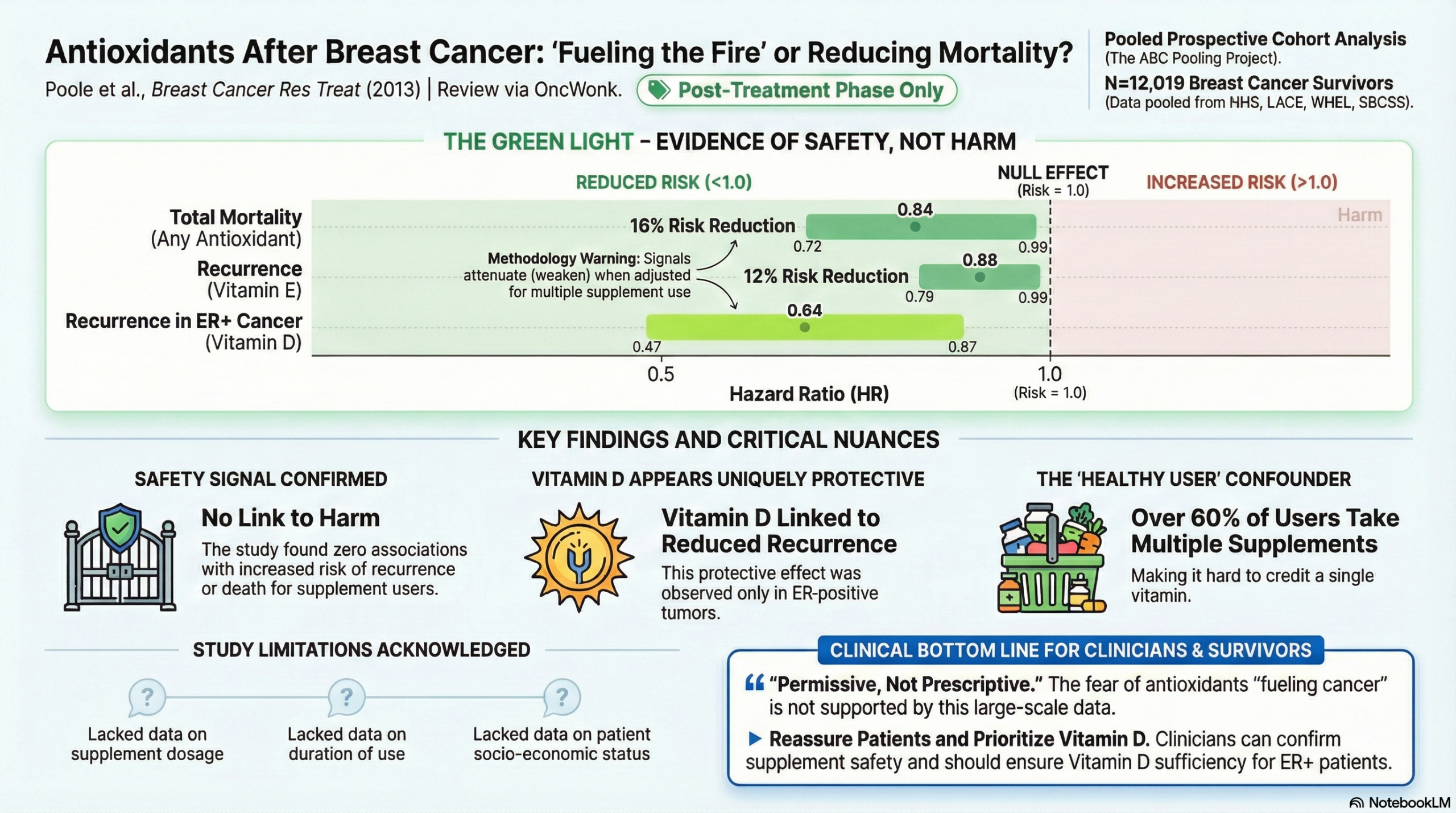
Cancer survivors are still frequently told that they should avoid antioxidants due to the wholly theoretical risk that they might ‘rescue’ residual cancer cells. This large-scale analysis effectively dismantles that dogma. Instead of harm, we see a clear survival advantage—a 16% reduction in total mortality for those using antioxidants post-treatment. Whether it is the broad support of a multivitamin or the targeted power of Vitamin D (showing a massive 36% recurrence drop in ER+ patients), the data confirms that supporting the host terrain is not risky, but protective.
The Wonk Debate – Audio Critique & Clinical Commentary:
Summary:
Clinical Bottom Line
This large-scale observational study suggests that the post-treatment use of antioxidant supplements (specifically vitamin C, vitamin E, or multivitamins) is associated with a 16% reduction in the risk of total mortality among breast cancer survivors. However, while individual vitamins (C and E) initially showed benefits for mortality and recurrence, these effects weakened when adjusted for the use of other supplements, highlighting the difficulty of isolating the impact of a single nutrient in patients who often take multiple vitamins. Notably, vitamin D use was associated with a significant decrease in recurrence risk specifically for women with ER-positive tumors, suggesting that supplement effects may vary by tumor subtype. Clinicians should view these findings as supportive of general antioxidant use post-treatment rather than as definitive evidence for specific high-dose mono-supplementation.
Results in Context
Main Results
The study analyzed several outcomes related to supplement use at least one year post-diagnosis:
- Total Mortality: Use of any antioxidant supplement (C, E, or multivitamins) was associated with a 16% decreased risk of death (HR: 0.84; 95% CI 0.72–0.99).
- Vitamin E and Recurrence: Use was associated with a 12% decreased risk of recurrence (HR: 0.88; 95% CI 0.79–0.99).
- Vitamin C and Mortality: Use was associated with a 19% decreased risk of total mortality (HR: 0.81; 95% CI 0.72–0.92).
- Vitamin D Interaction: Among women with ER+ tumors, vitamin D use was associated with a 36% decreased risk of recurrence (HR: 0.64; 95% CI 0.47–0.87). No such benefit was seen in ER- tumors.
- Attenuation: When models were mutually adjusted for the use of other supplements, the statistically significant associations for individual vitamins A, B, C, D, and E were generally attenuated.
Definitions
- Hazard Ratio (HR): A measure of how often a particular event (like recurrence or death) happens in one group compared to another over time. An HR of 0.84 means the supplement group had a 16% lower rate of the event than the non-user group.
- 95% Confidence Interval (CI): The range of values within which we can be 95% certain the true effect lies. If the range includes 1.0, the result is generally not considered statistically significant.
Participants
The analysis included 12,019 breast cancer survivors (Stage I–III) from four prospective cohorts in the United States and China. Approximately 60.6% of participants reported using at least one supplement post-diagnosis.
Assertive Critical Appraisal
Limitations & Bias (STROBE Framework)
- Mutual Supplementation Bias: The authors correctly identify that 59.6% of supplement users take multiple types. This makes it extremely difficult to determine if a benefit is caused by Vitamin C, Vitamin E, or the overall health-seeking behavior of the patient.
- Unmeasured Confounding: While the study adjusted for BMI, smoking, and physical activity, it lacked data on socio-economic status (SES). Since supplement use is often a marker for higher SES and better access to care, this may bias the results toward a protective effect.
- Dose and Duration: A major weakness is the lack of consistent data on the dose and duration of supplement use across the four cohorts. This prevents the determination of a “therapeutic range” or the identification of potential risks from high-dose supplementation.
Reporting Quality Assessment (STROBE)
The study demonstrates high reporting quality by clearly defining its exclusion criteria (e.g., excluding those diagnosed before 1990 to ensure cohort comparability) and detailing its statistical methods, including random-effects meta-analysis. However, the authors explicitly flag the lack of detailed dietary data, meaning they could not account for total nutrient intake (food + supplements), which is a significant omission in nutritional epidemiology.
Applicability
The findings are highly relevant to clinical practice because supplement use is ubiquitous among survivors (45–80%). The results provide reassurance that post-treatment supplement use is not associated with increased risk of recurrence or death, addressing a common clinical concern that antioxidants might “protect” residual tumor cells.
Research Objective
To investigate the associations between the use of common vitamin supplements (A, B, C, D, E, and multivitamins) after breast cancer diagnosis and the risk of recurrence, breast cancer-specific mortality, and all-cause mortality.
Study Design
This was a meta-analysis of four prospective cohort studies (the After Breast Cancer Pooling Project). Data were harmonized from:
- Shanghai Breast Cancer Survival Study (SBCSS).
- Life After Cancer Epidemiology (LACE) Study.
- Women’s Healthy Eating and Living (WHEL) Study.
- Nurses’ Health Study (NHS).
Setting and Participants
- Setting: Multicenter; United States and Shanghai, China.
- Eligibility: Stage I–III breast cancer survivors who provided supplement information 1–5 years post-diagnosis.
- Exclusions: Patients with in situ or Stage IV cancer at diagnosis, those missing supplement data, or those diagnosed before 1990 (for the NHS cohort).
Bibliographic Data
- Title: Postdiagnosis supplement use and breast cancer prognosis in the After Breast Cancer Pooling Project
- Authors: Elizabeth M. Poole, Xiao-Ou Shu, Bette J. Caan, et al.
- Journal: Breast Cancer Research and Treatment
- Year: 2013
- DOI: 10.1007/s10549-013-2548-4
Original Article:
Full text: PubMed Central
Fair Use & Copyright: This post provides a transformative, thesis‑driven critical appraisal intended for educational and scholarly purposes. It is not a reproduction of, nor a market substitute for, the original research article.
Support the Version of Record: To support the copyright holders and verify the underlying data—including primary survival curves, risk estimates, and other core outcomes—readers are strongly encouraged to access the original Version of Record via the link or DOI provided above.
Medical Disclaimer: This content is for informational and educational purposes only and is not a substitute for professional medical advice, diagnosis, or treatment.