
Comment:
While the biomarker shifts and preclinical toxicity reductions in this review are biologically profound, it is always important to remember that mechanistic success rarely translates directly to human clinical outcomes. That being clear, on a risk-benefit assessment, there is no reason to not include genistein, and some clear signals to.
The tangible significance of this synthesis is that it provides a biologically plausible foundation for using soy isoflavones to mitigate treatment-induced damage. Given the low risk of adverse effects and the potential for synergy with conventional agents, it is a clear example of a natural component that is safe for clinical use even as we wait for more robust survival data.
The Wonk Debate – Audio Critique & Clinical Commentary:
Summary:
Clinical Bottom Line:
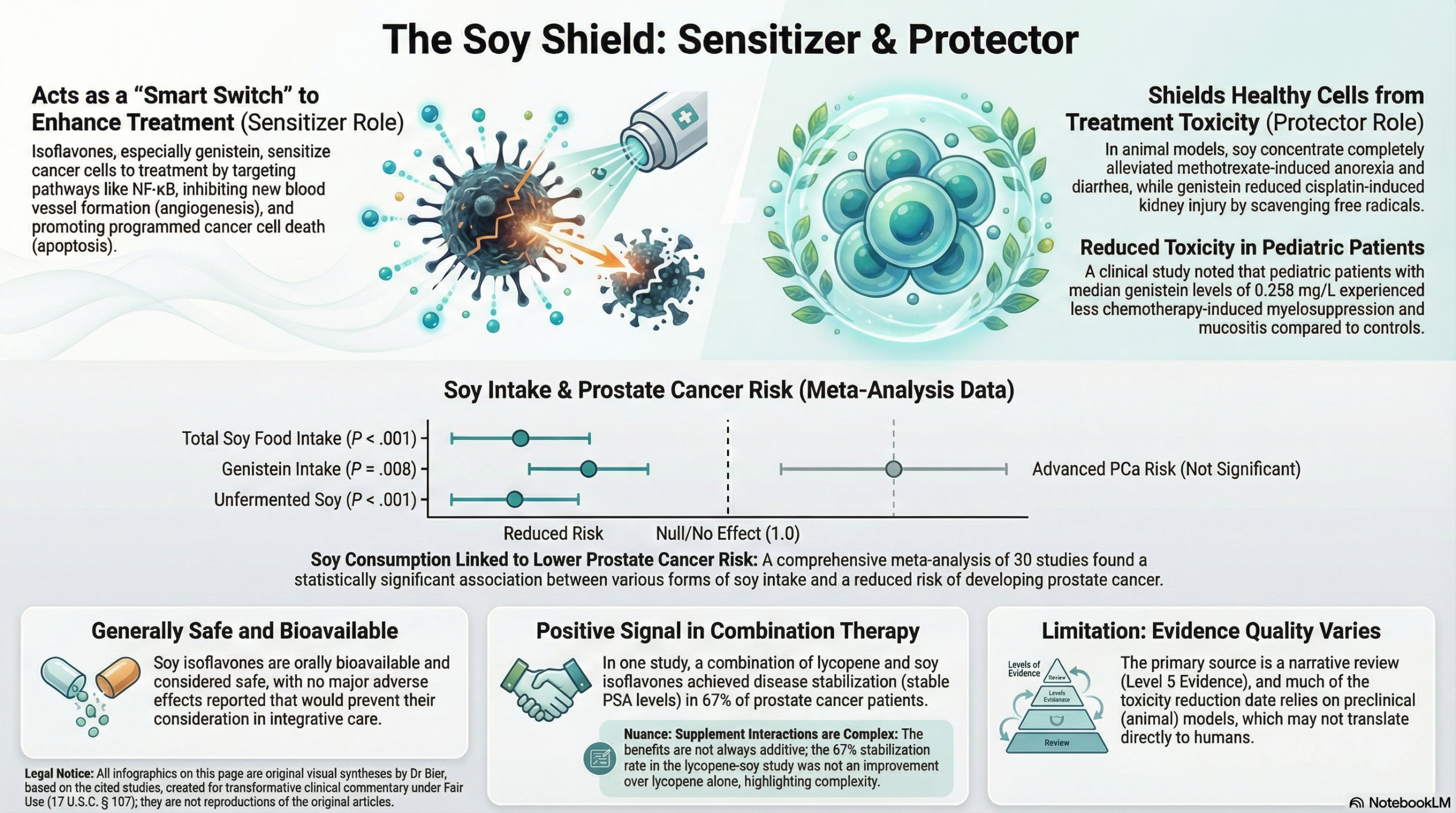
This narrative review argues that soy isoflavones, particularly genistein, offer a significant dual therapeutic benefit in oncology: they appear to sensitize cancer cells (specifically prostate cancer) to chemotherapy and radiation while simultaneously protecting normal tissues from treatment-induced toxicity. The authors posit that genistein targets specific pathways like NF-\kappa B to inhibit cancer growth while utilizing antioxidant properties to shield healthy cells. However, much of the supporting evidence is derived from preclinical models and epidemiological associations, and the authors acknowledge the necessity for larger placebo-controlled clinical trials to firmly establish clinical protocols.
Key Themes & Evidence Summary
- Mechanisms of Action:
- Isoflavones (genistein, daidzein, glycitein) are structurally similar to estrogen but act via multiple non-hormonal pathways.
- Genistein is identified as the most active compound, inhibiting NF-\kappa B activation, DNA methylation, and angiogenesis while enhancing histone acetylation.
- It induces cell cycle arrest (specifically G2/M phase) and apoptosis in cancer cells via the ATM/p53-p21 signaling network.
- Prostate Cancer (PCa) Prevention and Control:
- Epidemiological data indicates a lower incidence of PCa in Asian populations with high soy intake compared to Western populations.
- A cited meta-analysis of 30 articles found significant associations between soy consumption and decreased PCa risk (Total soy food P<.001; Genistein P=.008).
- Combination approaches show promise; for example, combining lycopene (tomato extract) with soy isoflavones stabilized PSA levels in 67% of evaluable patients in a referenced study.
- Reduction of Chemotherapy and Radiation Toxicity:
- Methotrexate (MTX): In rat models, soy concentrate completely alleviated MTX-induced anorexia and diarrhea and prevented intestinal necrosis, likely by inhibiting apoptosis in normal gastrointestinal cells.
- Cisplatin: Genistein combined with cisplatin reduced genotoxicity in human lymphocytes and reduced renal injury in mice by scavenging free radicals.
- Radiotherapy: The review cites limited clinical data where pediatric patients receiving genistein during abdominal radiotherapy experienced less pain and no diarrhea.
- Safety and Pharmacokinetics:
- Isoflavones are orally bioavailable, though bioavailability is higher when ingested as \beta-glycosides rather than aglycones.
- Adverse effects are generally mild (constipation, bloating), and while concerns exist regarding estrogenic effects, the review suggests these are minimal at dietary levels.
Assertive Critical Appraisal
- Evidence Level: Narrative Review (Level 5 Evidence/Expert Opinion). This paper summarizes existing literature to support a hypothesis but does not follow the rigorous, reproducible methodology of a systematic review.
- Quality Assessment (SANRA Scale Audit):
- Search Strategy: Weakness. The authors mention performing a specific search (PubMed/EMBASE 1975–2015) only for the section regarding “Adverse Effects” and PCa. There is no documented comprehensive search strategy for the sections on efficacy or toxicity reduction, increasing the risk of selection bias (cherry-picking studies that support the hypothesis).
- Scientific Reasoning: The arguments are logical, but the clinician should note the heavy reliance on preclinical data (cell lines and rat models) to support claims of toxicity reduction. The translation of these specific benefits to human clinical practice remains largely theoretical outside of the few small trials cited.
- Differentiation of Evidence: The review mixes epidemiological data (associations) with interventional animal data (causation). While the epidemiological signal for prostate cancer prevention is strong, the evidence for treatment synergy in humans is less robust.
- Conflict of Interest: The authors declared no potential conflicts of interest and received no financial support.
Research Objective:
To review in vitro, in vivo, clinical, and epidemiological evidence regarding the effects of soy isoflavones on sensitizing cancer cells to chemotherapy and radiation while protecting normal cells from treatment side effects.
Bibliographic Data:
- Authors: Sahin I, Bilir B, Ali S, Sahin K, Kucuk O
- Journal: Integrative Cancer Therapies
- Year: 2019
- DOI: 10.1177/1534735419835310
Original Article:
Full text: PubMed Central
Fair Use & Copyright: This post provides a transformative, thesis‑driven critical appraisal intended for educational and scholarly purposes. It is not a reproduction of, nor a market substitute for, the original research article.
Support the Version of Record: To support the copyright holders and verify the underlying data—including primary survival curves, risk estimates, and other core outcomes—readers are strongly encouraged to access the original Version of Record via the link or DOI provided above.
Medical Disclaimer: This content is for informational and educational purposes only and is not a substitute for professional medical advice, diagnosis, or treatment.