
Comment:
While the synergy described here is scientifically elegant, we must contextualize the ‘vitamin’ label. The efficacy observed in this study relies on massive pharmacological dosing—equivalent to approximately 22 grams administered daily in an average human. This magnitude of exposure is not really possible to attain from oral supplementation, which begs the question – does it require daily intravenous infusions?
The Wonk Debate – Audio Critique & Clinical Commentary:
Summary:
Clinical Bottom Line
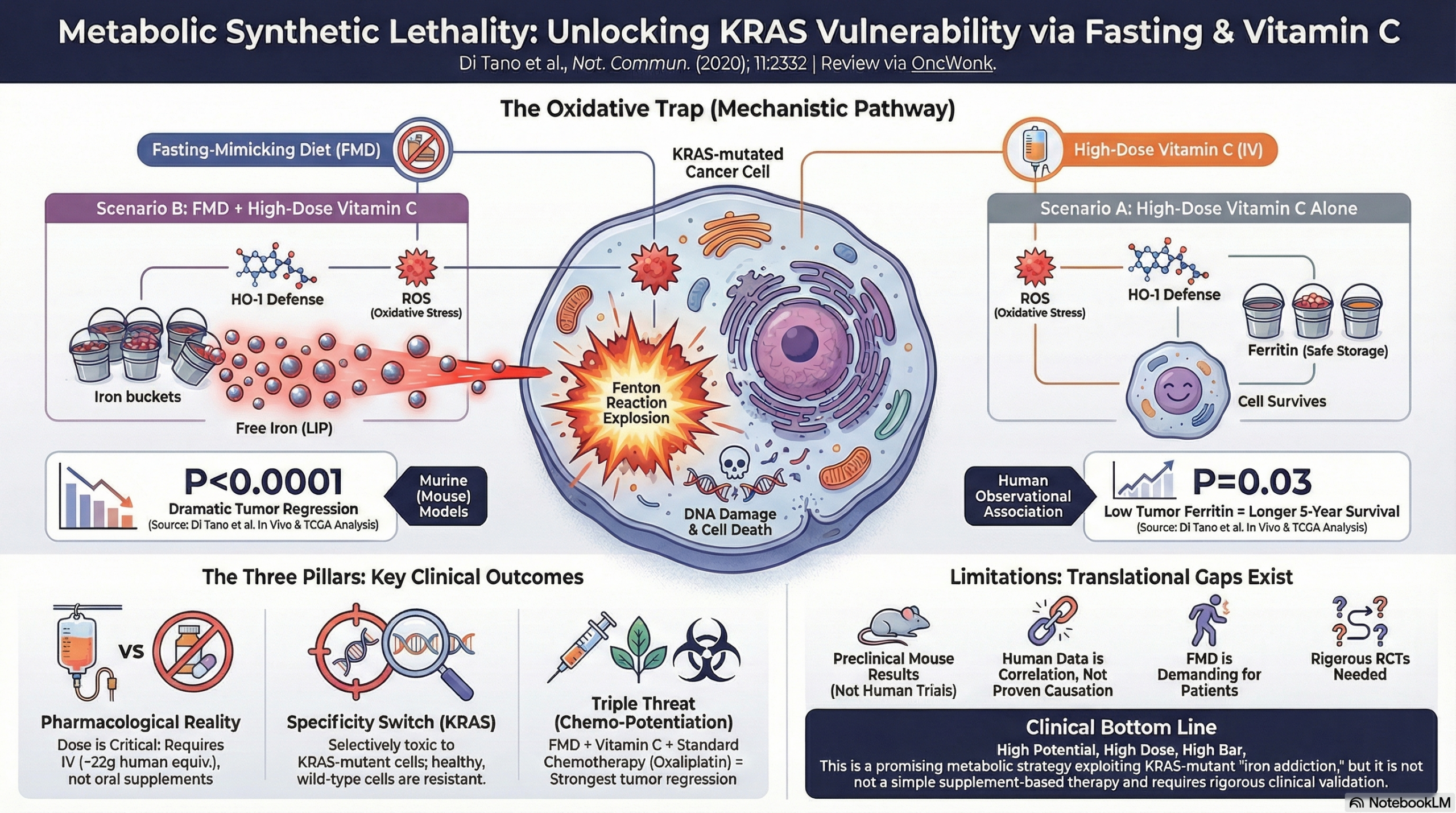
This translational study demonstrates that a Fasting-Mimicking Diet (FMD) selectively sensitizes KRAS-mutated colorectal cancer cells to high-dose Vitamin C, resulting in significant tumor regression in mouse models. The mechanism appears to be driven by oxidative stress: FMD prevents the tumor’s protective upregulation of Heme-Oxygenase-1 (HO-1) and Ferritin, leading to an accumulation of reactive iron and fatal Reactive Oxygen Species (ROS)3. Importantly, this combination was found to be safe in mice and further potentiated by standard chemotherapy (oxaliplatin). While these findings are mechanically robust and supported by retrospective human survival data linking low ferritin to better outcomes in KRAS-mutant cancers, they are currently pre-clinical. Rigorous clinical trials are required to confirm if this low-toxicity strategy is effective in humans.
Results in Context
Primary Outcome (In Vivo Tumor Efficacy)
- Tumor Growth Delay: In xenograft and syngeneic mouse models of KRAS-mutated colorectal cancer, the combination of weekly FMD cycles and daily high-dose Vitamin C (4 g/kg) significantly delayed tumor progression compared to ad libitum feeding or either treatment alone.
- Magnitude of Effect: The FMD plus Vitamin C combination reduced tumor growth to a similar extent as high-dose Vitamin C alone but with greater consistency, and the “triple” combination (FMD + Vitamin C + Oxaliplatin) was the most active intervention, effectively halting tumor progression.
Key Secondary & Mechanistic Outcomes - Selective Toxicity: In vitro experiments showed that KRAS-mutant cells were selectively vulnerable to the combination of Short-Term Starvation (STS, mimicking FMD) and Vitamin C, whereas KRAS-wild-type cells were resistant.
- Mechanism of Action (ROS and Iron):
- The Fenton Reaction: Vitamin C acts as a pro-oxidant in this context. Its toxicity relies on the presence of a labile iron pool (LIP) to generate hydrogen peroxide and hydroxyl radicals via Fenton chemistry. * HO-1 Regulation: Typically, Vitamin C treatment upregulates the stress-protein HO-1, which sequesters iron into ferritin (FTH), protecting the cell. The study found that FMD/STS selectively reverses this upregulation in KRAS-mutant cells, keeping free iron levels high and maximizing oxidative damage.
- Human Clinical Correlation (TCGA Analysis):
- In a retrospective analysis of colorectal cancer patients from The Cancer Genome Atlas (TCGA), those with KRAS-mutated tumors and low intratumoral ferritin (FTH1) mRNA levels displayed significantly longer 3- and 5-year overall survival compared to those with high ferritin.
- Context: This association was not observed in KRAS-wild-type tumors, reinforcing the study’s hypothesis that iron regulation is a specific vulnerability in KRAS-driven cancers.
Harms and Adverse Events
- Safety Profile: The combination of FMD and Vitamin C was reported to be safe and well-tolerated in mice.
- Weight Loss: Mouse body weight loss did not exceed 20% during FMD cycles and was rapidly recovered upon refeeding, indicating the regimen is feasible in animal models.
Assertive Critical Appraisal
Translational Validity & Applicability
- Animal to Human Translation: While the mouse models (xenograft and syngeneic) are standard for oncology research, metabolic differences between mice and humans are significant. The “Fasting-Mimicking Diet” is a specific formulation, and patient adherence to such a restrictive diet during chemotherapy can be challenging in a clinical setting.
- Dosing Feasibility: The study used Vitamin C doses of 4 g/kg in mice. In humans, achieving the millimolar plasma concentrations required for cytotoxicity (as seen in vitro) typically requires intravenous administration, not oral supplementation. The “pharmacological” label is crucial here; standard vitamin supplements will not achieve these effects.
Methodological Rigor - Risk of Bias (Animal Studies): The authors report randomizing mice into treatment groups. However, the text provided does not explicitly detail blinding procedures for the researchers measuring tumor volumes, which is a common source of detection bias in animal studies.
- Support for Mechanistic Claims: The study uses rescue experiments (e.g., adding iron chelators like DFO or antioxidants like NAC) to definitively prove that ROS and Iron are the drivers of toxicity. This adds high credibility to the proposed mechanism of action.
Reporting Quality
- Clarity: The distinction between KRAS-mutant and wild-type responses is clearly delineated and supported by multiple cell lines.
- Completeness: The inclusion of human TCGA data strengthens the rationale for the therapeutic approach, though it remains correlative and cannot prove causation in patients.
Research Objective
To investigate whether a Fasting-Mimicking Diet (FMD) can potentiate the anticancer activity of pharmacological Vitamin C in KRAS-mutated cancers and to elucidate the molecular mechanism driving this synergy.
Study Design
- In Vitro: Comparative viability assays using human and murine colorectal, lung, and pancreatic cancer cell lines (KRAS-mutant vs. Wild-type) under Short-Term Starvation (STS) and Vitamin C treatment.
- In Vivo: Randomized controlled experiments in Xenograft (immunocompromised) and Syngeneic (immunocompetent) mouse models.
- Observational: Retrospective survival analysis of human patient data from the TCGA database.
Setting and Participants
- Cell Lines: HCT116, DLD-1, CT26, H23, H727, PANC1 (KRAS-mutant); SW48, HT29, PC-3, COV362 (Wild-type).
- Animals: Female NOD scid gamma (NSG) and BALB/c mice26.
- Human Data: Colorectal cancer patients from The Cancer Genome Atlas (TCGA) database (n=~266 analyzed for ferritin expression).
Bibliographic Data
- Title: Synergistic effect of fasting-mimicking diet and vitamin C against KRAS mutated cancers
- Authors: Di Tano M, Raucci F, Vernieri C, et al.
- Journal: Nature Communications
- Year: 2020
- DOI: 10.1038/s41467-020-16243-3
Original Article:
Full text: PubMed Central
Fair Use & Copyright: This post provides a transformative, thesis‑driven critical appraisal intended for educational and scholarly purposes. It is not a reproduction of, nor a market substitute for, the original research article.
Support the Version of Record: To support the copyright holders and verify the underlying data—including primary survival curves, risk estimates, and other core outcomes—readers are strongly encouraged to access the original Version of Record via the link or DOI provided above.
Medical Disclaimer: This content is for informational and educational purposes only and is not a substitute for professional medical advice, diagnosis, or treatment.