
Comment:
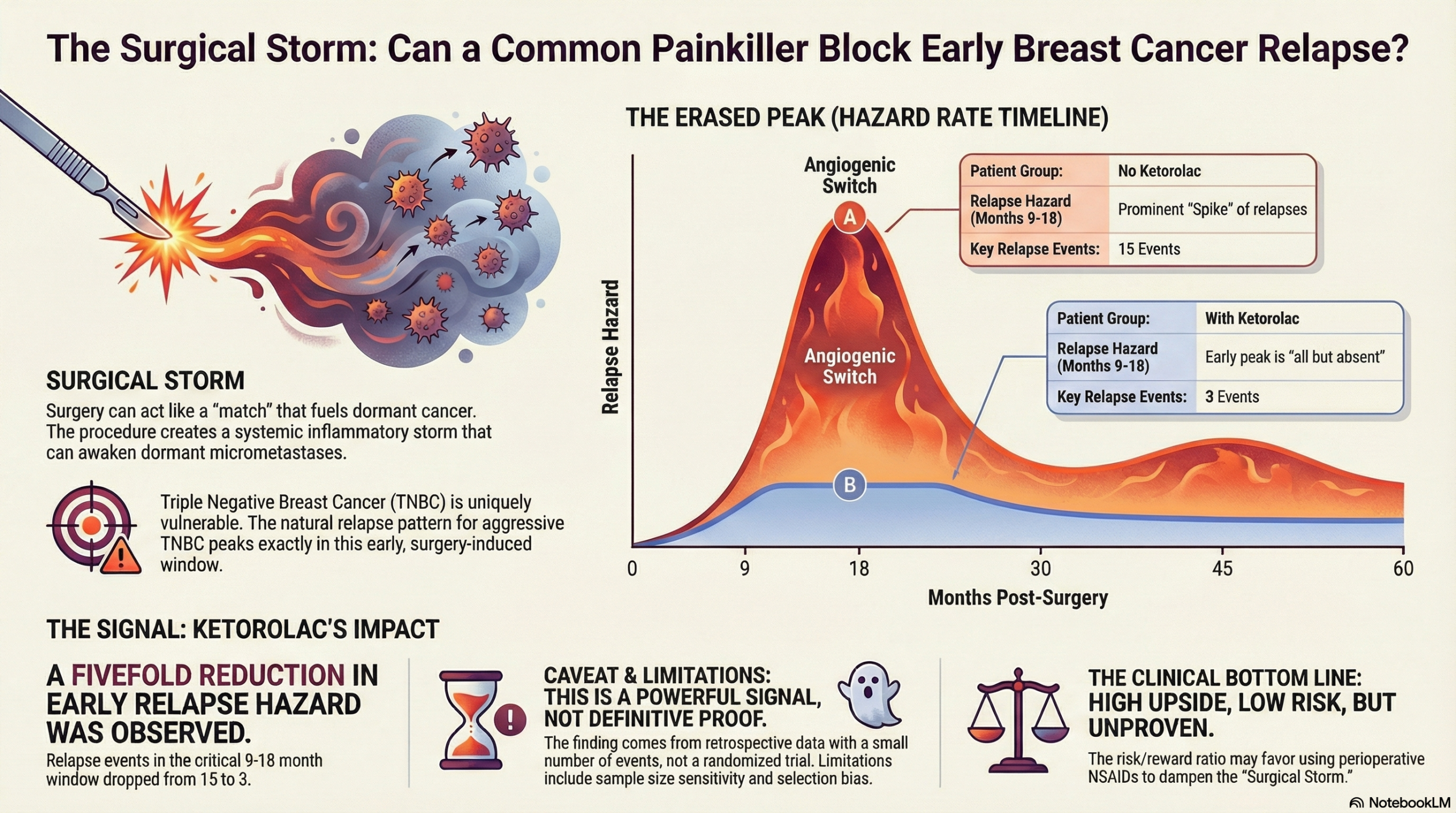
This study is not the only one showing NSAIDs (vs tylenol) for pain management around surgery has a potential upside. However what this ones suggests is that ketorolac specifically may be a better option than other NSAIDS. that a standard perioperative analgesic acts as a potent anti-cancer agent by ‘abrogating’ the specific inflammatory signal that wakes up dormant disease. For the TNBC subgroup, where the early relapse peak is so lethal, this intervention offers a massive potential upside with virtually no downside. I have extensive protocols that I use around all surgeries, but especially oncology ones, and this reinforces that we should treat the surgical event as a systemic inflammatory storm that requires aggressive management.
The Wonk Debate – Audio Critique & Clinical Commentary:
Summary:
Clinical Bottom Line
This retrospective analysis suggests that perioperative ketorolac is associated with a superior disease-free survival (DFS) in the first few years after surgery, specifically by reducing early relapse events in months 9–18. However, regarding Overall Survival (OS), the paper does not report direct mortality statistics (e.g., Hazard Ratio for death). Instead, it relies on the strong inference that preventing early, aggressive relapses—particularly in Triple Negative Breast Cancer (TNBC), which accounts for a disproportionate amount of breast cancer mortality—will translate into a survival benefit.
Results in Context
- Primary Outcome (Relapse/Disease-Free Survival):
- The study focuses on relapse hazard, reporting a “fivefold reduction” in relapses during the 9–18 month post-surgery window for patients receiving ketorolac.
- In the analysis of 327 patients, the expected “early relapse risk peak” was “all but absent” in the ketorolac group.
- Specific data for the 9-18 month period showed 3 relapses in the ketorolac group compared to 15 in the non-ketorolac group.
- Changes in Overall Survival (OS):
- Direct Measurement: The study explicitly defines its scope as a “retrospective disease-free survival study”. It does not present a Kaplan-Meier curve for Overall Survival or calculate an OS Hazard Ratio.
- Surrogate Correlation: The authors argue that TNBC accounts for ~20% of breast cancer mortality despite being only ~10% of incidence. They posit that the “bimodal” relapse pattern includes an early peak (months 9-18) driven by surgery-induced inflammation.
- Inferred Benefit: By “abrogating” this early hazard of recurrence, the authors imply a survival benefit, as early relapses in TNBC are typically fatal. They support this mechanism by citing other studies (e.g., Rothwell et al.) showing daily aspirin reduces cancer mortality.
- Participants:
- 327 consecutive patients treated with mastectomy.
- Follow-up average was 27.3 months (range 13-44 months).
Assertive Critical Appraisal
- Limitations & Bias (STROBE Framework):
- Surrogate Endpoint limitation: The primary limitation regarding the user’s query is the use of DFS/Relapse as a surrogate for OS. While preventing recurrence is necessary for survival, the short follow-up (avg 27.3 months) is likely insufficient to capture mature Overall Survival data, especially for late relapses.
- Retrospective Design: The study is a retrospective analysis of a prospectively maintained database. Treatment allocation (ketorolac vs. no ketorolac) was not randomized for cancer outcomes, introducing potential selection bias.
- Sample Size: The number of events in the critical window (3 vs 15) is small, which could lead to imprecise estimates of the true survival benefit.
- Applicability:
- The authors identify Triple Negative Breast Cancer (TNBC) as the ideal group for a future prospective trial because its natural relapse history mirrors the “no-ketorolac” hazard spikes. If validated, this cheap intervention could significantly impact mortality in this high-risk group.
Research Objective
To determine if perioperative NSAID (ketorolac) administration reduces the hazard of early breast cancer relapse, testing the hypothesis that surgery-induced inflammation triggers metastatic outgrowth.
Study Design
Retrospective cohort analysis of 327 consecutive mastectomy patients comparing those who received perioperative ketorolac to those who did not.
Bibliographic Data
- Title: NSAID analgesic ketorolac used perioperatively may suppress early breast cancer relapse: particular relevance to triple negative subgroup
- Authors: Retsky M, Rogers R, Demicheli R, et al.
- Journal: Breast Cancer Research and Treatment
- Year: 2012
- DOI: 10.1007/s10549-012-2094-5
Fair Use & Copyright: This post provides a transformative, thesis‑driven critical appraisal intended for educational and scholarly purposes. It is not a reproduction of, nor a market substitute for, the original research article.
Support the Version of Record: To support the copyright holders and verify the underlying data—including primary survival curves, risk estimates, and other core outcomes—readers are strongly encouraged to access the original Version of Record via the link or DOI provided above.
Medical Disclaimer: This content is for informational and educational purposes only and is not a substitute for professional medical advice, diagnosis, or treatment.